Class 1 Measurement- When we talk about “Class 1 Measurement,” we’re generally referring to the foundational concepts of measurement that young children are introduced to in their early education. This typically involves:
- Comparing Length:
- Understanding concepts like “longer” and “shorter.”
- Comparing the lengths of different objects.
- Using non-standard units of measurement (e.g., using blocks, hands, or string to measure).
- Comparing Weight:
- Understanding concepts like “heavier” and “lighter.”
- Comparing the weights of different objects.
- Using simple balance scales.
- Comparing Capacity:
- Understanding concepts like “more” and “less.”
- Comparing the amounts that different containers can hold.
- Introduction to Time:
- Understanding basic time concepts like “morning,” “afternoon,” and “night.”
- Recognizing days of the week.
- Introduction to Money:
- Recognizing basic coins.
- Basic comparative words:
- Taller/shorter
- Thick/thin.
Here’s a breakdown of what that often entails:
- Focus on Comparisons:
- At this age, the emphasis is on comparing objects rather than using precise, standard units.
- Using Non-Standard Units:
- Children often use everyday objects to measure, which helps them grasp the concept of measurement.
- Real-World Applications:
- The lessons are typically linked to real-world scenarios to make them relatable and engaging.
In essence, Class 1 measurement is about building a basic understanding of size, weight, and capacity through hands-on activities and comparisons.
What is Required Class 1 Measurement
Courtesy- Scratch Garden
In Class 1, the focus of measurement is on building foundational understanding through practical experiences. Here’s a breakdown of what’s typically required:
Key Measurement Concepts for Class 1:
- Length:
- Comparing lengths: Identifying which objects are longer or shorter.
- Ordering objects by length.
- Measuring length using non-standard units (e.g., blocks, hands, feet).
- Weight (Mass):
- Comparing weights: Identifying which objects are heavier or lighter.
- Using simple balance scales to compare weights.
- Capacity:
- Comparing capacities: Identifying which containers hold more or less.
- Using terms like “full,” “empty,” “more than,” and “less than.”
- Time:
- Understanding basic time concepts: Recognizing morning, afternoon, and night.
- Identifying the days of the week.
- Understanding the concept of time passing (earlier, later).
- Currency:
- Recognizing basic coins.
Essential Skills:
- Comparison: The ability to compare two or more objects based on their attributes (length, weight, capacity).
- Vocabulary: Using appropriate vocabulary to describe measurements (e.g., longer, shorter, heavier, lighter, more, less).
- Practical Application: Applying measurement concepts to real-world situations.
- Non-Standard Measurement: Using everyday objects to measure.
Key Points:
- The emphasis is on developing an intuitive understanding of measurement rather than mastering precise measurements.
- Hands-on activities and visual aids are crucial for effective learning.
- Relating measurement to everyday experiences helps children grasp the concepts.
Who is Required Class 1 Measurement
When we talk about “who is required Class 1 measurement,” we’re essentially asking:
- Who is the target audience for this learning?
The answer is:
- Primarily, it’s aimed at children in their first year of formal schooling, typically around the ages of 5 to 6 years old. These are the children who are beginning to develop their understanding of the world around them, and measurement is a key part of that.
- Therefore, the children themselves are the ones who “require” this learning.
However, it’s also important to acknowledge that:
- Teachers: Are required to teach these concepts.
- Parents/Guardians: Are encouraged to reinforce these concepts at home.
So, while the children are the primary recipients, the following are also involved:
- Educators: To design and deliver appropriate lessons.
- Curriculum developers: To define the required learning outcomes.
In summary, Class 1 measurement is a fundamental part of early childhood education, designed to provide young children with the basic skills and understanding they need to navigate the world around them.
When is Required Class 1 Measurement

The “when” of required Class 1 measurement aligns with the typical early years of formal education. Here’s a breakdown:
- During the First Year of Formal Schooling:
- This is the primary time frame. In most educational systems, children begin to learn these foundational measurement concepts in their first year of elementary school, which is often called Class 1 or first grade.
- This typically corresponds to children aged 5 to 6 years old.
- Throughout the Early Elementary Years:
- While the core introduction happens in Class 1, these measurement concepts are reinforced and expanded upon in subsequent early elementary grades.
- The understanding of measurement is a progressive process, so children continue to build upon their initial knowledge.
- Integration with Daily Activities:
- Measurement learning isn’t confined to specific classroom times. It’s woven into daily activities, both at school and at home.
- For example:
- Comparing the heights of children.
- Measuring ingredients during cooking.
- Understanding time during daily routines.
Therefore, “when” Class 1 measurement is required is:
- Primarily during the first year of formal education.
- Continuously throughout the early elementary years.
- Integrated into everyday life.
Where is Required Class 1 Measurement
Class 1 measurement is required in a variety of settings, both formal and informal. Here’s a breakdown of where this learning typically takes place:
- Formal Educational Settings:
- Classrooms: This is the primary location. Schools and classrooms are where structured lessons on measurement are delivered by teachers.
- Early childhood education centers: Preschools and kindergartens also introduce foundational measurement concepts.
- Informal Educational Settings:
- Homes: Parents and guardians play a crucial role in reinforcing measurement concepts through everyday activities.
- Everyday environments: Measurement is encountered in numerous real-world situations, such as:
- Cooking: Measuring ingredients.
- Shopping: Understanding quantities and sizes.
- Playtime: Comparing the sizes of toys.
- Outdoors: comparing the size of objects found in nature.
- Key points:
- The learning of measurement is not limited to a single location.
- It is a continuous process that occurs in various settings.
- Practical, hands-on experiences are essential for effective learning.
In essence, Class 1 measurement is required anywhere children are learning about the world around them, whether it’s in a structured classroom setting or during everyday activities at home and beyond.
How is Required Class 1 Measurement
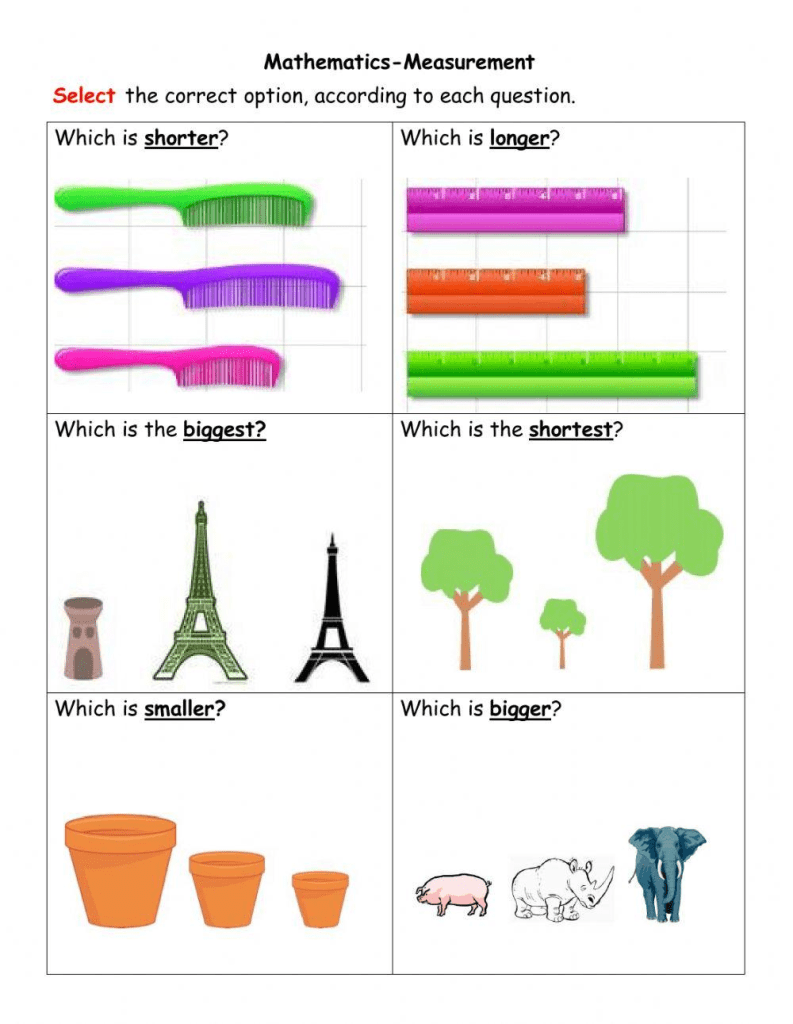
Teaching Class 1 measurement effectively involves a hands-on, interactive approach that focuses on building a strong foundational understanding. Here’s a breakdown of how it’s typically done:
Key Teaching Strategies:
- Hands-on Activities:
- Children learn best by doing. Provide opportunities for them to manipulate objects, compare sizes, and explore measurement concepts through play.
- Examples:
- Using blocks or other objects to measure the length of a table.
- Filling containers with water or sand to compare capacities.
- Using balance scales to compare the weights of different objects.
- Use of Non-Standard Units:
- Begin with non-standard units (e.g., hands, feet, blocks, paper clips) to help children understand the concept of measurement before introducing standard units.
- This helps them grasp the idea that measurement involves comparing an object to a unit.
- Comparative Language:
- Encourage the use of comparative language (e.g., longer, shorter, heavier, lighter, more, less).
- This helps children develop their vocabulary and understanding of measurement concepts.
- Real-World Connections:
- Connect measurement concepts to real-world situations to make them relevant and engaging.
- Examples:
- Measuring ingredients while cooking.
- Comparing the sizes of toys.
- Telling time during daily routines.
- Visual Aids:
- Use visual aids, such as pictures, diagrams, and charts, to reinforce measurement concepts.
- Games and Activities:
- Incorporate games and activities that make learning measurement fun and engaging.
- Examples:
- Comparing the heights of classmates.
- Ordering objects by size.
- Focus on Comparison:
- At this age the primary focus is on the act of comparing. Is this longer, shorter, heavier, lighter. The introduction of standard units comes later.
Important Considerations:
- Patience and Repetition:
- Measurement concepts can be challenging for young children. Be patient and provide plenty of opportunities for practice and reinforcement.
- Individualized Learning:
- Children learn at different paces. Provide individualized support and adjust activities to meet their needs.
By using these strategies, educators can help children develop a solid foundation in measurement that will serve them well in future learning.
Case Study on Class 1 Measurement
Courtesy- Catrack Kids TV
It’s helpful to frame a case study for Class 1 measurement around a practical classroom scenario. Here’s a hypothetical case study designed to illustrate common challenges and effective teaching strategies:
Case Study: “The Mystery of the Missing Length”
Background:
- Ms. Anya’s Class 1 students are beginning their unit on length measurement.
- She observes that while some students easily grasp the concept of “longer” and “shorter,” many struggle to understand how to quantify length using non-standard units.
The Scenario:
- Ms. Anya sets up a learning station with various objects (pencils, ribbons, blocks) and non-standard measuring tools (paper clips, straws).
- She presents the students with a “mystery”: a piece of ribbon whose length needs to be determined.
- Students are asked to work in groups to measure the ribbon using the provided tools.
Observations:
- Varied Approaches:
- Some students lay paper clips end-to-end along the ribbon, demonstrating a basic understanding of linear measurement.
- Others scatter the paper clips randomly, showing a lack of understanding of consistent unit use.
- A few students struggle to understand that the measurement is about length, not other attributes of the ribbon.
- Vocabulary Challenges:
- Students have difficulty using precise language to describe their measurements.
- They may say “a lot” or “some” instead of providing a numerical estimate.
- Unit Consistency:
- Many students mix different measuring tools, leading to inaccurate results.
Ms. Anya’s Interventions:
- Guided Practice:
- Ms. Anya demonstrates how to lay the measuring tools in a straight line, ensuring no gaps or overlaps.
- She emphasizes the importance of using the same unit throughout the measurement.
- Vocabulary Reinforcement:
- She introduces and reinforces vocabulary such as “length,” “measure,” “units,” and “about.”
- She has the students repeat sentences such as “The ribbon is about 10 paper clips long.”
- Visual Aids:
- She uses a large visual chart to illustrate the process of linear measurement.
- Group Discussion:
- She facilitates a class discussion where students share their measurement results and explain their methods.
- This allows the children to learn from each other.
Outcomes:
- Through guided practice and discussion, most students improve their understanding of length measurement.
- They begin to use more precise language and demonstrate greater accuracy in their measurements.
- Ms. Anya observes increased engagement and confidence among her students.
Key Learning Points:
- Hands-on activities are essential for teaching measurement concepts to young children.
- Explicit instruction and reinforcement of measurement vocabulary are crucial.
- Addressing misconceptions and providing guided practice can help students overcome common challenges.
- That peer to peer learning is highly valuable.
This case study highlights the importance of:
- Careful observation of student understanding.
- Targeted interventions to address specific learning needs.
- Creating a supportive and engaging learning environment.
White paper on Class 1 Measurement
Creating a comprehensive white paper on Class 1 measurement would involve a detailed exploration of the subject. Here’s a structured outline of what such a white paper could contain, highlighting key areas:
White Paper: Foundations of Measurement in Class 1
1. Introduction:
- Purpose of the white paper: To provide educators and parents with a comprehensive understanding of Class 1 measurement.
- Importance of early measurement skills: Establishing a foundation for future mathematical learning.
- Overview of key measurement concepts for Class 1.
2. Core Measurement Concepts:
- Length:
- Comparing lengths (longer, shorter).
- Ordering objects by length.
- Using non-standard units of measurement.
- Weight (Mass):
- Comparing weights (heavier, lighter).
- Introduction to balance scales.
- Capacity:
- Comparing capacities (more, less).
- Understanding terms like “full” and “empty.”
- Time:
- Basic time concepts (morning, afternoon, night).
- Days of the week.
- Currency:
- Basic coin recognition.
3. Pedagogical Approaches:
- Hands-on Learning:
- The importance of practical activities.
- Examples of engaging measurement activities.
- Use of Non-Standard Units:
- Rationale for starting with non-standard units.
- Transitioning to standard units (future grades).
- Vocabulary Development:
- Key measurement vocabulary.
- Strategies for reinforcing vocabulary.
- Real-World Applications:
- Connecting measurement to everyday experiences.
- Examples of real-world measurement scenarios.
- Differentiation:
- Accommodating diverse learning needs.
4. Assessment and Evaluation:
- Methods for assessing measurement understanding.
- Observational assessment.
- Practical tasks and activities.
- Identifying and addressing common misconceptions.
5. The Role of Parents and Caregivers:
- Reinforcing measurement concepts at home.
- Everyday measurement activities for families.
- Creating a supportive learning environment.
6. Challenges and Solutions:
- Common challenges in teaching and learning Class 1 measurement.
- Strategies for overcoming these challenges.
7. Conclusion:
- Summarizing the key principles of Class 1 measurement.
- Emphasizing the importance of building a strong foundation.
- Recommendations for future learning.
Key Considerations:
- Visual Aids: Incorporating visual aids, such as diagrams and charts, to enhance understanding.
- Practical Examples: Providing numerous practical examples to illustrate measurement concepts.
- Age-Appropriate Language: Using clear and concise language that is appropriate for young children.
By following this structure, a comprehensive white paper can be created that provides valuable insights into the teaching and learning of Class 1 measurement.
Industrial Application of Class 1 Measurement
Courtesy- Peekaboo Kidz
While “Class 1 measurement” refers to the foundational concepts taught to young children, the principles of measurement are absolutely vital in numerous industrial applications. Here’s how those basic concepts translate into critical industrial processes:
Core Measurement Concepts and Their Industrial Relevance:
- Length:
- In manufacturing, precise length measurements are essential for quality control. From the dimensions of machine parts to the length of textiles, accuracy is paramount.
- Construction relies heavily on length measurements for building structures, laying pipes, and installing electrical wiring.
- Aerospace engineering demands extremely precise length measurements for components of aircraft and spacecraft.
- Weight (Mass):
- In the food industry, accurate weight measurements are crucial for packaging, labeling, and ensuring consistent product quality.
- Pharmaceutical manufacturing requires precise weight measurements for ingredients in medications.
- Shipping and logistics depend on weight measurements for determining shipping costs and ensuring safe transport.
- Capacity (Volume):
- The chemical industry relies on accurate volume measurements for mixing and processing liquids and gases.
- The oil and gas industry uses volume measurements to determine the quantity of fuel extracted and transported.
- In beverage production, precise volume measurements are essential for filling bottles and cans.
- Time:
- Manufacturing processes are often timed to optimize efficiency and ensure consistent product quality.
- In logistics, time measurements are critical for tracking shipments and ensuring timely delivery.
- Industrial control systems rely on precise time measurements to regulate machinery and processes.
Specific Industrial Applications:
- Manufacturing:
- Quality control: Measuring dimensions, tolerances, and surface finishes of manufactured parts.
- Process control: Monitoring and adjusting production processes based on real-time measurements.
- Automation: Using sensors and measurement devices to automate manufacturing tasks.
- Construction:
- Site surveying: Measuring distances, elevations, and angles for building layouts.
- Material estimation: Calculating quantities of materials needed for construction projects.
- Structural integrity: Measuring the dimensions and properties of structural components.
- Aerospace:
- Precision machining: Manufacturing components with extremely tight tolerances.
- Flight testing: Measuring aircraft performance and stability.
- Satellite tracking: Measuring the position and velocity of satellites.
- Chemical Industry:
- Process monitoring: Measuring temperature, pressure, and flow rates in chemical reactions.
- Quality assurance: Analyzing the composition and purity of chemical products.
- Dosage control: measuring accurate amounts of chemicals for mixing.
- Food Industry:
- Portion control.
- Quality control of products.
- Packaging.
In essence, the fundamental measurement concepts learned in early education are the basis for a vast array of sophisticated measurement technologies and applications that drive modern industry.
References
- ^ Jump up to:a b Pedhazur, Elazar J.; Schmelkin, Leora and Albert (1991). Measurement, Design, and Analysis: An Integrated Approach (1st ed.). Hillsdale, NJ: Lawrence Erlbaum Associates. pp. 15–29. ISBN 978-0-8058-1063-9.
- ^ Jump up to:a b International Vocabulary of Metrology – Basic and General Concepts and Associated Terms (VIM) (PDF) (3rd ed.). International Bureau of Weights and Measures. 2008. p. 16.
- ^ Young, Hugh D; Freedman, Roger A. (2012). University Physics (13 ed.). Pearson Education Inc. ISBN 978-0-321-69686-1.
- ^ Kirch, Wilhelm, ed. (2008). “Level of measurement”. Encyclopedia of Public Health. Vol. 2. Springer. p. 81. ISBN 978-0-321-02106-9.
- ^ “A Brief History of Metrology – bowersUK”. bowers rest of world. Retrieved 2024-10-10.
- ^ Crease 2011, pp. 182–4
- ^ C.S. Peirce (July 1879) “Note on the Progress of Experiments for Comparing a Wave-length with a Metre” American Journal of Science, as referenced by Crease 2011, p. 203
- ^ Crease, Robert P. (2011). World in the Balance: The Historical Quest for an Absolute System of Measurement. New York & London: W. W. Norton. p. 203. ISBN 978-0-393-34354-0.
- ^ “About Us”. National Measurement Institute of Australia. 3 December 2020.
- ^ The International System of Units (PDF) (9th ed.), International Bureau of Weights and Measures, Dec 2022, ISBN 978-92-822-2272-0
- ^ Groves, Robert (2004). Survey Methodology. New Jersey: Wiley. ISBN 9780471483489. “By measurement error we mean a departure from the value of the measurement as applied to a sample unit and the value provided. ” pp. 51–52 .
- ^ Page 41 in: VanPool, Todd (2011). Quantitative analysis in archaeology. Chichester Malden: Wiley-Blackwell. ISBN 978-1-4443-9017-9. OCLC 811317577.
- ^ Gill, Simeon; Parker, Christopher J. (2017). “Scan posture definition and hip girth measurement: the impact on clothing design and body scanning”. Ergonomics. 60 (8): 1123–1136. doi:10.1080/00140139.2016.1251621. PMID 27764997. S2CID 23758581.
- ^ Jump up to:a b Michell, J. (1999). Measurement in psychology: a critical history of a methodological concept. New York: Cambridge University Press.
- ^ Ernest Nagel: “Measurement”, Erkenntnis, Volume 2, Number 1 / December 1931, pp. 313–335, published by Springer, the Netherlands
- ^ Stevens, S.S. On the theory of scales and measurement 1946. Science. 103, 677–80.
- ^ Douglas Hubbard: “How to Measure Anything”, Wiley (2007), p. 21
- ^ Jump up to:a b Messiah, Albert (1966). Quantum Mechanics. North Holland, John Wiley & Sons. ISBN 0486409244.
- ^ Penrose, Roger (2007). The road to reality : a complete guide to the laws of the universe. New York: Vintage Books. ISBN 978-0-679-77631-4. “The jumping of the quantum state to one of the eigenstates of Q is the process referred to as state-vector reduction or collapse of the wavefunction. It is one of quantum theory’s most puzzling features …” “[T]he way in which quantum mechanics is used in practice is to take the state indeed to jump in this curious way whenever a measurement is deemed to take place.” p 528 Later Chapter 29 is entitled the Measurement paradox.
- ^ Houle, David; Pélabon, Christophe; Wagner, Günter P.; Hansen, Thomas F. (2011). “Measurement and Meaning in Biology” (PDF). The Quarterly Review of Biology. 86 (1): 3–34. doi:10.1086/658408. ISSN 0033-5770. PMID 21495498. S2CID 570080. Archived from the original (PDF) on 2019-05-29.
- ^ Montévil, Maël (2019). “Measurement in biology is methodized by theory”. Biology & Philosophy. 34 (3). doi:10.1007/s10539-019-9687-x. ISSN 0169-3867. S2CID 96447209.
- ^ Magurran, A.E. & McGill, B.J. (Hg.) 2011: Biological Diversity: Frontiers in Measurement and Assessment Oxford University Press.
- Archimedes Measuring the Circle
- ^ Heath, T. L. (1897). “Measurement of a Circle”. The Works Of Archimedes. Osmania University, Digital Library Of India. Cambridge University Press. pp. 91–98.
- ^ Bengio, Yoshua; Lahlou, Salem; Deleu, Tristan; Hu, Edward J.; Tiwari, Mo; Bengio, Emmanuel (2021). “GFlowNet Foundations”. arXiv:2111.09266 [cs.LG].
- ^ Fremlin, D. H. (2010), Measure Theory, vol. 2 (Second ed.), p. 221
- ^ Jump up to:a b c Mukherjea & Pothoven 1985, p. 90.
- ^ Folland 1999, p. 25.
- ^ Edgar 1998, Theorem 1.5.2, p. 42.
- ^ Edgar 1998, Theorem 1.5.3, p. 42.
- ^ Jump up to:a b Nielsen 1997, Exercise 11.30, p. 159.
- ^ Fremlin 2016, Section 213X, part (c).
- ^ Royden & Fitzpatrick 2010, Exercise 17.8, p. 342.
- ^ Hewitt & Stromberg 1965, part (b) of Example 10.4, p. 127.
- ^ Fremlin 2016, Section 211O, p. 15.
- ^ Jump up to:a b Luther 1967, Theorem 1.
- ^ Mukherjea & Pothoven 1985, part (b) of Proposition 2.3, p. 90.
- ^ Fremlin 2016, part (a) of Theorem 243G, p. 159.
- ^ Jump up to:a b Fremlin 2016, Section 243K, p. 162.
- ^ Fremlin 2016, part (a) of the Theorem in Section 245E, p. 182.
- ^ Fremlin 2016, Section 245M, p. 188.
- ^ Berberian 1965, Theorem 39.1, p. 129.
- ^ Fremlin 2016, part (b) of Theorem 243G, p. 159.
- ^ Rao, M. M. (2012), Random and Vector Measures, Series on Multivariate Analysis, vol. 9, World Scientific, ISBN 978-981-4350-81-5, MR 2840012.
- ^ Bhaskara Rao, K. P. S. (1983). Theory of charges: a study of finitely additive measures. M. Bhaskara Rao. London: Academic Press. p. 35. ISBN 0-12-095780-9. OCLC 21196971.
- ^ Folland 1999, p. 27, Exercise 1.15.a.


