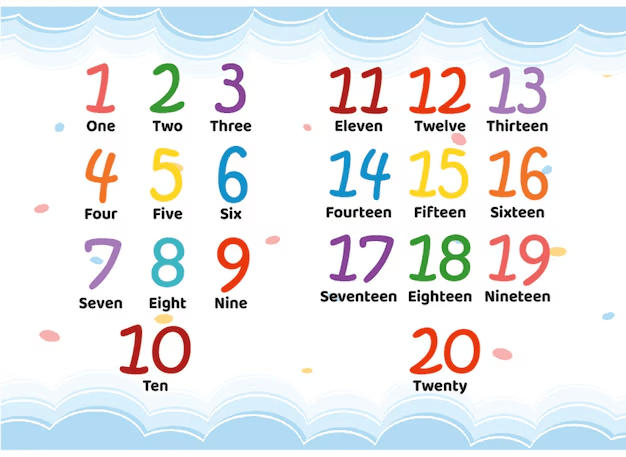
Class 1 Numbers up to 20- When teaching Class 1 students about numbers up to 20, the focus is on building a strong foundation in number recognition, counting, and basic number concepts. Here’s a breakdown of key areas:
Core Concepts:
- Number Recognition:
- Identifying and naming numbers from 1 to 20.
- Matching numerals with corresponding quantities.
- Counting:
- Counting objects in a set.
- Counting forward and backward within 20.
- Understanding the concept of “one more” and “one less.”
- Number Names:
- Learning to write the number names (one, two, three, etc.).
- Number Sequence:
- Understanding the order of numbers.
- Identifying missing numbers in a sequence.
- Basic Addition and Subtraction:
- Introducing simple addition and subtraction within 20 using concrete objects.
Teaching Strategies:
- Visual Aids:
- Use number charts, flashcards, and manipulatives (like blocks or counters).
- Hands-on Activities:
- Engage children in counting games, sorting activities, and using number lines.
- Real-Life Examples:
- Connect numbers to everyday situations (e.g., counting toys, fruits, or fingers).
- Repetition and Practice:
- Provide ample opportunities for children to practice counting and recognizing numbers.
- Games and Songs:
- Use fun and engaging games and songs to reinforce number concepts.
Key Points to Remember:
- Start with smaller numbers and gradually introduce larger numbers.
- Use concrete objects and visual aids to make learning concrete.
- Make learning fun and engaging to keep children motivated.
- It is very important that children learn the number names, as well as the numerical values.
What is Required Class 1 Numbers up to 20
Courtesy- The Singing Walrus – English Songs For Kids
In Class 1, when focusing on numbers up to 20, the requirements go beyond just memorizing the sequence. It’s about building a solid understanding of fundamental number concepts. Here’s a breakdown of the key requirements:
Essential Skills and Understandings:
- Number Recognition and Counting:
- Accurately identify and name numbers from 1 to 20.
- Count objects in a set with one-to-one correspondence.
- Count forward and backward within the range of 1 to 20.
- Number Names and Writing:
- Learn to read and write the number names (one, two, three, etc.).
- Be able to associate the numeral with its corresponding word.
- Number Order and Relationships:
- Understand the sequential order of numbers.
- Identify numbers that come before, after, or between given numbers.
- Grasp the concept of “more than” and “less than.”
- Basic Arithmetic:
- Begin to understand simple addition and subtraction within 20, often using concrete objects or visual aids.
- Start to develop an understanding of how numbers can be combined or taken away.
- Place Value (Introduction):
- While not a deep dive, Class 1 may introduce the concept of “tens” and “ones” in a very basic way, particularly when dealing with numbers from 11 to 20.
- Problem Solving:
- Begin to solve very simple word problems involving numbers up to 20.
Why These Skills Are Important:
- These skills form the foundation for future mathematical learning.
- They help children develop logical thinking and problem-solving abilities.
- They are essential for everyday life, from counting objects to telling time.
In essence, Class 1 math with numbers up to 20 is about making numbers tangible and meaningful for young learners.
Who is Required Class 1 Numbers up to 20
When discussing “who” is required to understand Class 1 numbers up to 20, we’re essentially talking about:
- The Students:
- Primarily, it’s the Class 1 students themselves who are required to learn and grasp these fundamental number concepts. This is a crucial stage in their early mathematical development.
- The Educators:
- Teachers are required to have a strong understanding of how to effectively teach these concepts. They need to be able to:
- Present the material in an engaging and age-appropriate way.
- Use a variety of teaching methods to cater to different learning styles.
- Assess students’ understanding and provide appropriate support.
- Teachers are required to have a strong understanding of how to effectively teach these concepts. They need to be able to:
- The Parents/Guardians:
- Parents and guardians play a vital role in reinforcing these concepts at home. They can:
- Provide opportunities for children to practice counting and number recognition in everyday situations.
- Offer encouragement and support.
- Help the students with homework assignments.
- Parents and guardians play a vital role in reinforcing these concepts at home. They can:
- The Educational System:
- Curriculum developers, and educational institutions, are required to provide the correct curriculum, and resources so that children, teachers, and parents have the correct tools to allow the children to learn the required information.
In summary, it’s a collaborative effort involving students, teachers, parents, and the educational system to ensure that children develop a strong foundation in numbers up to 20.
When is Required Class 1 Numbers up to 20

The requirement for Class 1 students to learn numbers up to 20 is tied to their early childhood education and developmental milestones. Here’s a breakdown of “when” this is typically required:
- During the Class 1 school year:
- This is the primary time frame. Educational curriculums are designed to introduce and reinforce these number concepts during this specific grade level.
- The timing within the school year may vary, with teachers often starting with smaller numbers and gradually progressing to 20.
- Early Childhood Development:
- The foundation for number sense begins even before formal schooling. Preschool and kindergarten experiences contribute to a child’s readiness for Class 1 math.
- Therefore, some children may have already been introduced to basic counting and number recognition before entering Class 1.
- As a Foundation for Future Learning:
- Understanding numbers up to 20 is not just a Class 1 requirement; it’s a crucial stepping stone for future mathematical learning.
- These skills are essential for:
- Learning higher numbers.
- Performing more complex arithmetic operations.
- Developing problem-solving abilities.
- Within the context of curriculum guidelines:
- Educational boards and organizations set specific curriculum guidelines that dictate when and what mathematical concepts should be taught. So, the “when” is also tied to the curriculum that the school is following.
In essence, the learning of numbers up to 20 is a process that begins in early childhood and is formally solidified during the Class 1 school year, serving as a vital foundation for future mathematical success.
Where is Required Class 1 Numbers up to 20
The requirement to learn Class 1 numbers up to 20 isn’t tied to a single physical location, but rather to several key educational environments:
- In the Classroom:
- This is the primary location. Schools and classrooms are where formal instruction takes place. Teachers guide students through lessons, activities, and exercises designed to build number sense.
- At Home:
- Learning extends beyond the classroom. Parents and guardians reinforce these concepts at home through:
- Everyday counting activities (e.g., counting toys, food, stairs).
- Homework assignments.
- Interactive games and activities.
- Learning extends beyond the classroom. Parents and guardians reinforce these concepts at home through:
- In Everyday Environments:
- Children encounter numbers in various real-world settings, such as:
- Stores (counting items, recognizing prices).
- Playgrounds (counting swings, slides).
- Any situation where counting and number recognition are involved.
- Children encounter numbers in various real-world settings, such as:
- Through Educational Resources:
- Learning also occurs through:
- Textbooks and workbooks.
- Educational apps and websites.
- Online learning platforms.
- Learning also occurs through:
Therefore, “where” learning occurs is a combination of formal educational settings and everyday environments, all working together to solidify a child’s understanding of numbers up to 20.
How is Required Class 1 Numbers up to 20
Teaching Class 1 numbers up to 20 effectively involves a variety of engaging and interactive methods. Here’s a breakdown of how this is typically achieved:
Key Teaching Approaches:
- Concrete Materials:
- Using manipulatives like blocks, counters, beads, and number rods allows children to physically interact with numbers. This helps them visualize and understand the concept of quantity.
- Visual Representations:
- Number lines, number charts, and picture cards provide visual aids that reinforce number recognition and sequencing.
- Hands-on Activities:
- Games, puzzles, and sorting activities make learning fun and engaging. Examples include:
- Counting games: “How many apples are in the basket?”
- Matching games: Matching numerals with corresponding sets of objects.
- Using playdough to create number shapes.
- Games, puzzles, and sorting activities make learning fun and engaging. Examples include:
- Real-World Connections:
- Relating numbers to everyday situations helps children see the practical application of math. For example:
- Counting the number of steps while walking.
- Counting toys during playtime.
- Counting the number of fingers on their hands.
- Relating numbers to everyday situations helps children see the practical application of math. For example:
- Repetition and Practice:
- Consistent practice is essential for mastering number concepts. This can involve:
- Repeating number sequences.
- Practicing writing numerals.
- Regularly reviewing number names.
- Consistent practice is essential for mastering number concepts. This can involve:
- Songs and Rhymes:
- Using songs and rhymes can make learning numbers more memorable and enjoyable.
- Introducing “Tens” and “Ones”:
- When children begin to learn the numbers between 11 and 20 it is important to begin to introduce the concepts of tens and ones. This helps the children to begin to understand place value.
Important Considerations:
- Individualized Learning: Teachers should adapt their teaching methods to meet the individual needs of each child.
- Positive Reinforcement: Encouraging and praising children’s efforts helps build their confidence and motivation.
- Making it Fun: Keeping the learning environment positive and enjoyable is crucial for fostering a love of math.
By combining these approaches, educators can effectively help Class 1 students develop a strong foundation in numbers up to 20.
Case Study on Class 1 Numbers up to 20
Courtesy- Baby Shark – Pinkfong Kids’ Songs & Stories
It’s important to understand that “case studies” in the context of Class 1 mathematics often look different than those in higher education. They focus on observing and analyzing how individual children or small groups of children learn and interact with number concepts. Here’s a conceptual case study framework, and elements that would be within a real world example.
Conceptual Case Study Framework:
- Objective:
- To observe and analyze how a Class 1 student develops their understanding of numbers up to 20.
- To identify any learning challenges or strengths.
- To evaluate the effectiveness of different teaching strategies.
- Participants:
- A selected Class 1 student (or a small group).
- The teacher.
- Methods:
- Observation of classroom activities.
- One-on-one assessments (e.g., counting tasks, number recognition exercises).
- Analysis of student work samples.
- Teacher interviews.
- Data Collection:
- Notes on student behavior and participation.
- Records of assessment results.
- Examples of student worksheets and drawings.
Elements of a Real-World Example:
- Scenario:
- A Class 1 student, “Alex,” is observed during math lessons focusing on numbers 11-20.
- The teacher notices Alex struggles to consistently count these numbers in sequence.
- Observations:
- Alex often skips numbers or reverses their order (e.g., saying “14, 12, 13”).
- When using manipulatives, Alex sometimes counts the same object twice.
- Alex has difficulty associating the numeral with the corresponding quantity.
- Assessments:
- One-on-one counting tasks reveal that Alex has a stronger grasp of numbers 1-10.
- Number recognition flashcards show that Alex confuses “13” and “15.”
- Analysis:
- Alex’s challenges suggest a difficulty with number sequencing and one-to-one correspondence.
- There may be a need for more hands-on practice with concrete materials.
- The teacher might introduce visual aids, such as a number line, to reinforce sequencing.
- Intervention:
- The teacher provides Alex with extra practice using number blocks and number lines.
- The teacher incorporates counting songs and games into lessons.
- The teacher works with Alex in small group sessions.
- Outcome:
- Over time, Alex shows improvement in counting and number recognition.
- The teacher continues to monitor Alex’s progress and provide individualized support.
Key Takeaways:
- Case studies in Class 1 math are about understanding individual learning patterns.
- They emphasize the importance of observation, assessment, and targeted intervention.
- They highlight the need for flexible teaching strategies that cater to diverse learning needs.
White paper on Class 1 Numbers up to 20
Creating a comprehensive white paper on Class 1 numbers up to 20 involves delving into the pedagogical approaches, developmental considerations, and practical strategies for effective early numeracy education. Here’s a structured outline and key elements that would be included:
White Paper: Foundational Numeracy – Class 1 Numbers Up to 20
1. Introduction:
- Importance of Early Numeracy:
- Highlight the critical role of early math skills in future academic success.
- Emphasize the development of number sense as a foundation for higher-level mathematics.
- Scope and Purpose:
- Define the focus on numbers 1-20 in Class 1.
- State the paper’s objective: to provide educators and parents with evidence-based strategies for effective teaching and learning.
2. Developmental Considerations:
- Cognitive Development:
- Discuss Piaget’s stages and how they relate to early numeracy.
- Address the development of one-to-one correspondence, cardinality, and number conservation.
- Learning Styles:
- Recognize the diversity of learning styles in young children.
- Advocate for multi-sensory approaches to teaching numbers.
3. Core Concepts and Skills:
- Number Recognition and Counting:
- Strategies for teaching numeral identification and rote counting.
- Emphasis on accurate counting with one-to-one correspondence.
- Number Names and Writing:
- Methods for teaching number words and numeral formation.
- Number Order and Relationships:
- Activities to develop understanding of “more than,” “less than,” and “equal to.”
- Use of number lines and sequencing activities.
- Introduction to Basic Operations:
- Concrete examples of addition and subtraction within 20.
- Use of manipulatives to visualize operations.
- Place Value Foundations:
- Introducing the concepts of “tens” and “ones” with visual aids.
4. Effective Teaching Strategies:
- Hands-on Learning:
- Importance of manipulatives (blocks, counters, etc.).
- Engaging activities and games.
- Visual Aids:
- Use of number charts, flashcards, and interactive whiteboards.
- Real-World Connections:
- Integrating math into everyday activities.
- Differentiated Instruction:
- Strategies for addressing diverse learning needs.
- Assessment and Evaluation:
- Methods for monitoring student progress.
- Formative and summative assessment techniques.
5. Role of Parents and Caregivers:
- Creating a Math-Rich Environment:
- Suggestions for incorporating math into daily routines.
- Supporting Homework and Practice:
- Tips for making learning fun and engaging.
- Communication with Teachers:
- Importance of collaboration between home and school.
6. Technology Integration:
- Educational Apps and Software:
- Recommendations for age-appropriate digital resources.
- Interactive Learning Tools:
- Use of technology to enhance engagement and understanding.
7. Conclusion:
- Summary of Key Recommendations:
- Emphasis on the long term benefits of strong early numeracy skills.
Key Considerations:
- Evidence-Based Practices: The white paper would be grounded in research and best practices in early childhood mathematics education.
- Practical Applications: Provide concrete examples and activities that educators and parents can easily implement.
- Accessibility: Ensure the language and content are accessible to a wide audience.
By addressing these key areas, a white paper can serve as a valuable resource for improving the teaching and learning of Class 1 numbers up to 20.
Industrial Application of Class 1 Numbers up to 20
Courtesy- Math Songs by NUMBEROCK
While “Class 1 numbers up to 20” seems very basic, the foundational concepts they represent are absolutely crucial for numerous industrial applications. It’s less about directly using “1, 2, 3…20” in a complex calculation, and more about the underlying skills they build. Here’s how those foundational skills are relevant:
Core Skills and Their Industrial Relevance:
- Counting and Quantity:
- Inventory Management:
- Counting raw materials, finished products, and components is essential in any manufacturing or warehousing environment.
- Even basic counting ensures accurate stock levels, preventing shortages or overstocking.
- Quality Control:
- Inspecting products for defects often involves counting and categorizing faulty items.
- This helps identify production errors and maintain quality standards.
- Packaging:
- Ensuring the correct number of items are placed in packages is vital for consumer satisfaction and accurate distribution.
- Inventory Management:
- Number Order and Sequencing:
- Production Processes:
- Many industrial processes follow a specific sequence of steps. Understanding number order ensures tasks are performed in the correct order, preventing errors and delays.
- Data Entry:
- Accurate data entry, which is vital in modern industry, relies on understanding the correct sequence of numbers.
- Equipment Operation:
- Operating machinery often involves following numbered steps or settings.
- Production Processes:
- Basic Arithmetic (Addition/Subtraction):
- Resource Management:
- Calculating material usage, labor costs, and production output involves basic addition and subtraction.
- Measurement:
- Measuring lengths, weights, and volumes often requires adding or subtracting values.
- Time Management:
- Keeping track of time, which is very important in production, involves addition and subtraction.
- Resource Management:
Examples:
- Manufacturing:
- A factory worker counting the number of parts coming off an assembly line.
- A warehouse worker verifying the quantity of boxes being shipped.
- Construction:
- A construction worker counting the number of bricks or tiles needed for a project.
- A supervisor tracking the number of workers on a job site.
- Logistics:
- A shipping clerk counting the number of packages being loaded onto a truck.
- A delivery driver tracking the number of stops on a route.
In essence, the skills learned when mastering numbers up to 20 are the building blocks for more complex mathematical reasoning, which is essential in almost every industrial setting.
References
- ^ John H. Conway and Richard K. Guy, The Book of Numbers. New York: Copernicus (1996): 11. “”Score” is related to “share” and comes from the Old Norse “skor” meaning a “notch” or “tally” on a stick used for counting. … Often people counted in 20s; every 20th notch was larger, so “score” also came to mean 20.”
- ^ “score | Origin and meaning of score by Online Etymology Dictionary”. www.etymonline.com. Retrieved 2020-08-16.
- ^ “Sloane’s A071395 : Primitive abundant numbers”. The On-Line Encyclopedia of Integer Sequences. OEIS Foundation. Retrieved 2016-05-31.
- ^ Weber, Matthias (2005). “Kepler’s small stellated dodecahedron as a Riemann surface” (PDF). Pacific Journal of Mathematics. 220 (1): 172. doi:10.2140/pjm.2005.220.167. MR 2195068. S2CID 54518859. Zbl 1100.30036.
- ^ Weisstein, Eric W. “Icosahedron”. mathworld.wolfram.com. Retrieved 2020-08-16.
- ^ Weisstein, Eric W. “Dodecahedron”. mathworld.wolfram.com. Retrieved 2020-08-16.
- ^ “Definition of 20/20”. www.merriam-webster.com. Retrieved 2020-08-16.
- ^ “Adulthood | Introduction to Psychology”. lumenlearning.com.
- ^ “Japan’s Age of Majority Changed to 18 – Living the Japon.com”. www.japan-experience.com. Retrieved 19 March 2018.
- ^ Weisstein, Eric W. “Vigesimal”. mathworld.wolfram.com. Retrieved 2020-08-16.
- ^ “Definition of SCORE”. www.merriam-webster.com. Retrieved 2020-08-16.
- ^ “Biblical Criticism”, The Classical Journal 36:71:83ff (March 1827) full text
- ^ “CBS News”, Scores of Typhoon Survivors Flown to Manila (November 2013)
- Weisstein, Eric W. “Hardy–Ramanujan Number”. Archived from the original on 2004-04-08.
- ^ Ayonrinde, Oyedeji A.; Stefatos, Anthi; Miller, Shadé; Richer, Amanda; Nadkarni, Pallavi; She, Jennifer; Alghofaily, Ahmad; Mngoma, Nomusa (2020-06-12). “The salience and symbolism of numbers across cultural beliefs and practice”. International Review of Psychiatry. 33 (1–2): 179–188. doi:10.1080/09540261.2020.1769289. ISSN 0954-0261. PMID 32527165. S2CID 219605482.
- ^ “Demystified | Why a baker’s dozen is thirteen”. www.britannica.com. Retrieved 2024-06-05.
- ^ “Eighty-six – Definition of eighty-six”. Merriam-Webster. Archived from the original on 2013-04-08.
- ^ Rosen, Kenneth (2007). Discrete Mathematics and its Applications (6th ed.). New York, NY: McGraw-Hill. pp. 105, 158–160. ISBN 978-0-07-288008-3.
- ^ Rouse, Margaret. “Mathematical Symbols”. Retrieved 1 April 2015.
- ^ Lipscombe, Trevor Davis (2021-05-06), “Super Powers: Calculate Squares, Square Roots, Cube Roots, and More”, Quick(er) Calculations, Oxford University Press, pp. 103–124, doi:10.1093/oso/9780198852650.003.0010, ISBN 978-0-19-885265-0, retrieved 2021-10-28
- ^ “Nick’s Mathematical Puzzles: Solution 29”. Archived from the original on 2011-10-18.
- ^ “The Penguin Dictionary of Curious and Interesting Numbers” by David Wells, page 69
- ^ Sequence OEIS: A019692.
- ^ See Apéry 1979.
- ^ “The Penguin Dictionary of Curious and Interesting Numbers” by David Wells, page 33
- ^ Erdős, P. (1948), “On arithmetical properties of Lambert series” (PDF), J. Indian Math. Soc., New Series, 12: 63–66, MR 0029405
- ^ Borwein, Peter B. (1992), “On the irrationality of certain series”, Mathematical Proceedings of the Cambridge Philosophical Society, 112 (1): 141–146, Bibcode:1992MPCPS.112..141B, CiteSeerX 10.1.1.867.5919, doi:10.1017/S030500410007081X, MR 1162938, S2CID 123705311
- ^ André-Jeannin, Richard; ‘Irrationalité de la somme des inverses de certaines suites récurrentes.’; Comptes Rendus de l’Académie des Sciences – Series I – Mathematics, vol. 308, issue 19 (1989), pp. 539-541.
- ^ S. Kato, ‘Irrationality of reciprocal sums of Fibonacci numbers’, Master’s thesis, Keio Univ. 1996
- ^ Duverney, Daniel, Keiji Nishioka, Kumiko Nishioka and Iekata Shiokawa; ‘Transcendence of Rogers-Ramanujan continued fraction and reciprocal sums of Fibonacci numbers‘;
- ^ “A001620 – OEIS”. oeis.org. Retrieved 2020-10-14.
- ^ Jump up to:a b Rivoal, Tanguy (2012). “On the arithmetic nature of the values of the gamma function, Euler’s constant, and Gompertz’s constant”. Michigan Mathematical Journal. 61 (2): 239–254. doi:10.1307/mmj/1339011525. ISSN 0026-2285.
- ^ Jump up to:a b Lagarias, Jeffrey C. (2013-07-19). “Euler’s constant: Euler’s work and modern developments”. Bulletin of the American Mathematical Society. 50 (4): 527–628. arXiv:1303.1856. doi:10.1090/S0273-0979-2013-01423-X. ISSN 0273-0979.
- ^ Murty, M. Ram; Saradha, N. (2010-12-01). “Euler–Lehmer constants and a conjecture of Erdös”. Journal of Number Theory. 130 (12): 2671–2682. CiteSeerX 10.1.1.261.753. doi:10.1016/j.jnt.2010.07.004. ISSN 0022-314X.
- ^ Murty, M. Ram; Zaytseva, Anastasia (2013-01-01). “Transcendence of Generalized Euler Constants”. The American Mathematical Monthly. 120 (1): 48–54. doi:10.4169/amer.math.monthly.120.01.048. ISSN 0002-9890. S2CID 20495981.
- ^ “A073003 – OEIS”. oeis.org. Retrieved 2020-10-14.
- ^ Nesterenko, Yu. V. (January 2016), “On Catalan’s constant”, Proceedings of the Steklov Institute of Mathematics, 292 (1): 153–170, doi:10.1134/s0081543816010107, S2CID 124903059
- ^ “Khinchin’s Constant”.
- ^ Weisstein, Eric W. “Khinchin’s constant”. MathWorld.
- ^ Jump up to:a b Briggs, Keith (1997). Feigenbaum scaling in discrete dynamical systems (PDF) (PhD thesis). University of Melbourne.
- ^ OEIS: A065483
- ^ OEIS: A082695
- ^ “Lévy Constant”.
- ^ “The Penguin Dictionary of Curious and Interesting Numbers” by David Wells, page 29.
- ^ Weisstein, Eric W. “Gauss–Kuzmin–Wirsing Constant”. MathWorld.
- ^ OEIS: A065478
- ^ OEIS: A065493
- ^ “Laplace Limit”.
- ^ “2022 CODATA Value: Avogadro constant”. The NIST Reference on Constants, Units, and Uncertainty. NIST. May 2024. Retrieved 2024-05-18.
- ^ “2022 CODATA Value: electron mass”. The NIST Reference on Constants, Units, and Uncertainty. NIST. May 2024. Retrieved 2024-05-18.
- ^ “2022 CODATA Value: fine-structure constant”. The NIST Reference on Constants, Units, and Uncertainty. NIST. May 2024. Retrieved 2024-05-18.
- ^ “2022 CODATA Value: Newtonian constant of gravitation”. The NIST Reference on Constants, Units, and Uncertainty. NIST. May 2024. Retrieved 2024-05-18.
- ^ “2022 CODATA Value: molar mass constant”. The NIST Reference on Constants, Units, and Uncertainty. NIST. May 2024. Retrieved 2024-05-18.
- ^ “2022 CODATA Value: Planck constant”. The NIST Reference on Constants, Units, and Uncertainty. NIST. May 2024. Retrieved 2024-05-18.
- ^ “2022 CODATA Value: Rydberg constant”. The NIST Reference on Constants, Units, and Uncertainty. NIST. May 2024. Retrieved 2024-05-18.
- ^ “2022 CODATA Value: speed of light in vacuum”. The NIST Reference on Constants, Units, and Uncertainty. NIST. May 2024. Retrieved 2024-05-18.
- ^ “2022 CODATA Value: vacuum electric permittivity”. The NIST Reference on Constants, Units, and Uncertainty. NIST. May 2024. Retrieved 2024-05-18.
- ^ “Bags of Talent, a Touch of Panic, and a Bit of Luck: The Case of Non-Numerical Vague Quantifiers” from Linguista Pragensia, Nov. 2, 2010 Archived 2012-07-31 at archive.today
- ^ Boston Globe, July 13, 2016: “The surprising history of indefinite hyperbolic numerals”


