Class 1 Place Value- When teaching place value to Class 1 students, the focus is on building a foundational understanding of how numbers are structured, particularly with tens and ones. Here’s a breakdown of key concepts:
Core Concepts:
- Understanding Tens and Ones:
- Class 1 students begin by learning that numbers are made up of tens and ones.
- For example, the number 23 is made up of 2 tens and 3 ones.
- Visual Representation:
- Using concrete materials like blocks, counters, or drawings is crucial.
- These manipulatives help children visualize the concept of place value.
- For instance, using base-ten blocks, a “ten” is represented by a long rod, and a “one” by a single cube.
- Place Value Chart:
- Introducing a simple place value chart with “tens” and “ones” columns helps organize numbers.
- This visual tool reinforces the idea that the position of a digit determines its value.
- Counting and Grouping:
- Activities involving counting and grouping objects into tens and ones strengthen understanding.
- Examples include counting groups of ten straws or arranging counters into tens and leftover ones.
- Real-World Connections:
- Relating place value to real-life situations makes it more meaningful.
- For example, counting groups of ten fingers or toes.
Key Teaching Strategies:
- Hands-on Activities:
- Prioritize hands-on activities that allow children to manipulate objects and explore numbers.
- Visual Aids:
- Use visual aids like charts, diagrams, and pictures to reinforce concepts.
- Games and Songs:
- Incorporate games and songs to make learning fun and engaging.
- Gradual Progression:
- Start with smaller numbers and gradually introduce larger numbers as students gain confidence.
In essence, Class 1 place value instruction is about laying the groundwork for future mathematical understanding by making the concept of tens and ones tangible and relatable.
What is Required Class 1 Place Value
Courtesy- Learn Bright
In Class 1, the “required” understanding of place value focuses on establishing a fundamental grasp of how numbers are structured, particularly concerning tens and ones. Here’s a breakdown of the essential elements:
Key Requirements:
- Understanding Tens and Ones:
- Students must begin to recognize that two-digit numbers are composed of tens and ones.
- They should be able to identify the “tens” digit and the “ones” digit in a number.
- For example, understanding that 34 is made up of 3 tens and 4 ones.
- Counting in Tens:
- Class 1 students should be able to count in multiples of 10 (10, 20, 30, etc.).
- This skill is crucial for understanding how tens contribute to the value of a number.
- Representing Numbers:
- Students should be able to represent numbers using concrete materials (e.g., blocks, counters) and pictorial representations.
- This helps them visualize the concept of place value.
- Number Recognition and Value:
- They should be able to recognize and understand the value of digits within a two-digit number.
- This includes understanding that the position of a digit determines its value.
- Counting to 100:
- It is important for them to be able to count forward and backwards to 100.
Why These Skills Are Essential:
- These foundational skills are crucial for building a solid understanding of more advanced mathematical concepts.
- A strong grasp of place value is essential for addition, subtraction, and other mathematical operations.
In essence, the goal is to provide Class 1 students with a concrete and intuitive understanding of how numbers are structured, setting the stage for future mathematical success.
Who is Required Class 1 Place Value
When we talk about “who” is required to understand Class 1 place value, we’re essentially talking about:
- The Students:
- Primarily, it’s the Class 1 students themselves who are required to grasp these foundational concepts. It’s a crucial part of their early mathematical development.
- The Educators:
- Teachers and teaching assistants are required to understand how to effectively teach place value to young children. This includes:
- Knowing the core concepts.
- Using appropriate teaching methods (hands-on activities, visual aids).
- Being able to assess student understanding.
- Teachers and teaching assistants are required to understand how to effectively teach place value to young children. This includes:
- The Parents/Guardians:
- Parents and guardians play a vital role in reinforcing place value concepts at home. They should:
- Understand the basic principles.
- Be able to support their child’s learning through activities and practice.
- Parents and guardians play a vital role in reinforcing place value concepts at home. They should:
In essence, it’s a collaborative effort:
- Students are the learners.
- Educators are the facilitators.
- Parents are the supporters.
The goal is to ensure that all Class 1 students build a solid foundation in place value, which is essential for their future mathematical success.
When is Required Class 1 Place Value

Understanding “when” Class 1 place value is required involves considering the developmental stages of children and the structure of early math education. Here’s a breakdown:
- Early Elementary Years:
- Place value concepts are typically introduced in the early elementary years, with a strong focus in Class 1 (or Year 1 in some countries).
- This is the stage where children are beginning to grasp the concept of numbers beyond simple counting.
- Building Foundational Skills:
- It’s required at this stage because it lays the foundation for future mathematical learning.
- Understanding place value is essential for:
- Addition and subtraction of multi-digit numbers.
- Understanding larger numbers.
- Developing a strong number sense.
- Progressive Learning:
- The teaching of place value is a progressive process.
- In Class 1, the focus is on basic concepts like tens and ones.
- As children progress through later grades, they will build on this foundation and learn about hundreds, thousands, and so on.
- After basic counting skills are learned:
- It is very important that place value is taught after the child has a firm grasp of counting. Once the child can count forward and backward, and has a basic understanding of numbers, then the concept of place value can be introduced.
In essence, Class 1 is a crucial time for introducing place value because it’s when children are developmentally ready to begin understanding the structure of our number system.
Where is Required Class 1 Place Value
The concept of place value is fundamental and therefore “required” in various contexts, primarily within educational settings. Here’s a breakdown of where this knowledge is essential:
- In the Classroom:
- This is the most obvious place. Place value is a core component of early mathematics curricula, particularly in:
- Class 1 classrooms (or equivalent early elementary grades)
- Mathematics lessons throughout primary school.
- It’s where students are formally introduced to and begin to develop their understanding of the number system.
- This is the most obvious place. Place value is a core component of early mathematics curricula, particularly in:
- In Everyday Life:
- While not always explicitly stated, place value is used constantly in daily activities:
- Handling money: Understanding that a 10-dollar bill is worth more than a 1-dollar bill.
- Telling time: Recognizing that the position of digits in a time display indicates hours and minutes.
- Measuring: Interpreting measurements that involve multiple digits.
- When reading any multi digit number.
- While not always explicitly stated, place value is used constantly in daily activities:
- In Further Mathematics:
- Place value serves as the foundation for more advanced mathematical concepts:
- Multi-digit arithmetic (addition, subtraction, multiplication, division).
- Decimals and fractions.
- Algebra and beyond.
- Place value serves as the foundation for more advanced mathematical concepts:
Therefore, “where” place value is required is essentially:
- Anywhere numbers are used.
- Primarily, within the early years of education.
It’s a foundational concept that permeates mathematical understanding and practical application.
How is Required Class 1 Place Value
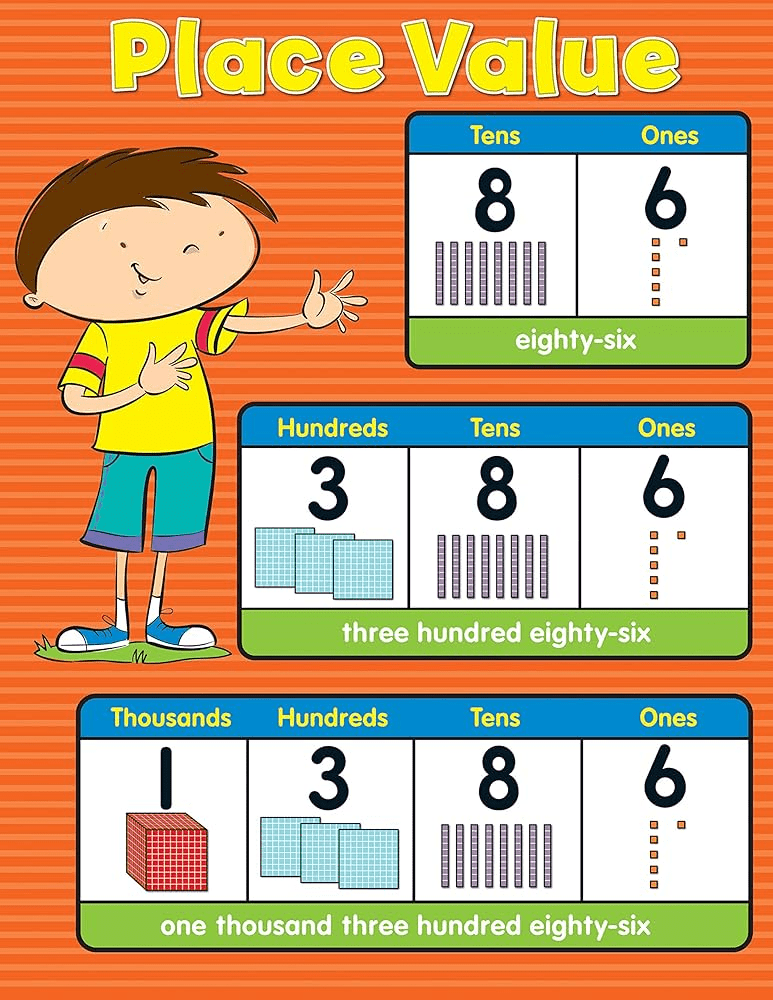
Teaching place value to Class 1 students effectively requires a hands-on, visual, and engaging approach. Here’s a breakdown of how it’s typically done:
1. Concrete Materials and Manipulatives:
- Base-Ten Blocks:
- These are essential. “Ones” are represented by single cubes, and “tens” by rods made up of ten cubes.
- Students physically manipulate these blocks to build numbers, making the concept tangible.
- Counters, Straws, and Other Objects:
- Grouping these items into tens and leftover ones helps students visualize the concept.
2. Visual Aids:
- Place Value Charts:
- Simple charts with “tens” and “ones” columns help students organize numbers and understand the position of each digit.
- Drawings and Diagrams:
- Visual representations of tens and ones reinforce the concept.
3. Hands-on Activities:
- Grouping Activities:
- Students count out a number of objects and then group them into tens, counting the leftover ones.
- Building Numbers:
- Using base-ten blocks, students build numbers that are called out by the teacher.
- Games:
- Games that involve matching numbers to their place value representations make learning fun.
4. Gradual Progression:
- Start with Small Numbers:
- Begin with numbers within 20, then gradually increase the range as students gain confidence.
- Focus on Tens and Ones:
- Ensure students have a solid understanding of tens and ones before moving on to more complex concepts.
5. Real-World Connections:
- Relating to Everyday Situations:
- Use examples from everyday life, such as counting groups of fingers or using money, to make the concept more relatable.
Key Teaching Principles:
- Active Learning:
- Encourage students to actively participate in activities and explore numbers.
- Repetition and Practice:
- Provide ample opportunities for students to practice identifying and representing numbers.
- Positive Reinforcement:
- Create a supportive and encouraging learning environment.
By using these methods, educators can help Class 1 students develop a strong foundation in place value, which is essential for their future mathematical success.
Case Study on Class 1 Place Value
Courtesy- Learning Notebook
Creating a comprehensive “case study” on Class 1 place value involves looking at typical student learning patterns, potential challenges, and effective teaching strategies. Here’s a structured approach to a hypothetical case study:
Hypothetical Case Study: “The Journey to Tens and Ones”
1. Student Profile:
- Setting: A typical Class 1 classroom with diverse learners.
- Focus Student: We’ll consider two hypothetical students:
- “Anya,” who grasps visual concepts easily but struggles with abstract number representation.
- “Ben,” who has strong counting skills but difficulty grouping objects.
2. Learning Objectives:
- Students should be able to:
- Identify tens and ones in two-digit numbers.
- Represent numbers using manipulatives (base-ten blocks, counters).
- Relate place value to real-world scenarios.
3. Teaching Strategies Implemented:
- Hands-on Activities:
- Using base-ten blocks to build numbers.
- Grouping counters into sets of ten.
- “Tens and Ones” games.
- Visual Aids:
- Place value charts with clear “tens” and “ones” columns.
- Drawing pictures of tens and ones.
- Real-World Connections:
- Counting groups of ten fingers or toes.
- Using examples of money (10-cent coins, 1-cent coins).
4. Observations and Challenges:
- Anya:
- Initially, Anya excelled at visually representing numbers with blocks.
- However, she struggled to connect the concrete representation to the abstract number symbol (e.g., writing “23”).
- Challenge: Bridging the gap between concrete and abstract understanding.
- Ben:
- Ben could count to 100 with ease.
- However, he struggled to group objects into tens.
- Challenge: Understanding the concept of grouping and how it relates to place value.
- General Observations:
- Some students found it difficult to differentiate between the “tens” column and the “ones” column.
- Maintaining engagement during repetitive practice was a challenge.
5. Interventions and Solutions:
- For Anya:
- Increased focus on writing numbers alongside manipulating blocks.
- Using flashcards with number representations and corresponding numerals.
- Using worksheets that connect the pictures of base ten blocks to the written numbers.
- For Ben:
- More practice with physical grouping activities.
- Using visual cues (e.g., colored bands) to separate groups of ten.
- Having Ben verbally explain his grouping process.
- General Solutions:
- Incorporating more varied and engaging games.
- Providing individualized support to students who were struggling.
- Frequent review of place value charts.
6. Outcomes:
- With targeted interventions, both Anya and Ben showed significant improvement.
- Anya was able to confidently connect concrete representations to abstract numerals.
- Ben developed a stronger understanding of grouping and its relation to place value.
- The class as a whole showed increased competency in place value concepts.
7. Conclusions:
- Hands-on activities and visual aids are essential for teaching place value in Class 1.
- Individualized support is crucial for addressing diverse learning needs.
- Connecting place value to real-world scenarios enhances student engagement and understanding.
- Consistent practice and reviews are needed.
This hypothetical case study highlights the importance of varied teaching methods and individualized support in helping Class 1 students grasp the fundamental concept of place value.
White paper on Class 1 Place Value
White Paper: Foundational Understanding of Place Value in Class 1
Abstract:
This white paper examines the critical role of place value instruction in Class 1 (or equivalent early elementary grades). It explores the core concepts, pedagogical approaches, and potential challenges associated with teaching tens and ones to young learners. Emphasizing the importance of concrete representations and hands-on activities, this paper advocates for a developmentally appropriate and engaging curriculum that lays the groundwork for future mathematical success.
1. Introduction:
Place value, the understanding that the position of a digit determines its value, is a cornerstone of mathematical literacy. In Class 1, students begin their journey towards grasping this fundamental concept, focusing specifically on the relationship between tens and ones. This early exposure is crucial for developing a strong number sense and building a solid foundation for more advanced mathematical operations.
2. Core Concepts for Class 1 Place Value:
- Tens and Ones as Building Blocks:
- Students must comprehend that two-digit numbers are composed of groups of ten and individual units (ones).
- This concept should be introduced through concrete examples and visual representations.
- Counting in Tens:
- The ability to count in multiples of ten (10, 20, 30, etc.) is essential for understanding the magnitude of numbers and the role of the tens digit.
- Representing Numbers:
- Students should be able to represent numbers using various manipulatives, such as base-ten blocks, counters, and drawings.
- This helps them visualize the abstract concept of place value.
- Digit Recognition and Value:
- Students need to recognize that the position of a digit determines its value.
- Understanding that the “2” in 23 represents two groups of ten, not just two individual units, is critical.
3. Pedagogical Approaches:
- Concrete-Representational-Abstract (CRA) Framework:
- This framework is highly effective in teaching place value to young learners.
- Start with concrete manipulatives (base-ten blocks), progress to representational drawings, and finally introduce abstract number symbols.
- Hands-on Activities:
- Engage students in activities that involve physically manipulating objects to represent numbers.
- Examples include grouping counters into tens, building numbers with base-ten blocks, and playing place value games.
- Visual Aids:
- Utilize place value charts with clearly labeled “tens” and “ones” columns.
- Use diagrams and illustrations to visually represent tens and ones.
- Real-World Connections:
- Relate place value concepts to everyday situations, such as counting money or measuring objects.
- This helps students see the relevance of mathematics in their lives.
- Differentiated Instruction:
- Recognize that students learn at different paces.
- Provide individualized support and adjust activities to meet the needs of all learners.
4. Potential Challenges and Solutions:
- Challenge: Difficulty transitioning from concrete representations to abstract symbols.
- Solution: Provide ample opportunities for students to connect manipulatives with written numerals. Use visual cues and verbal explanations to reinforce the connection.
- Challenge: Misunderstanding the concept of grouping tens.
- Solution: Focus on activities that involve physically grouping objects into tens. Use visual aids to highlight the groups.
- Challenge: Maintaining student engagement during repetitive practice.
- Solution: Incorporate games and varied activities to make learning fun and engaging. Provide positive reinforcement and celebrate student progress.
- Challenge: Students confusing the tens and ones column.
- Solution: Use color coding, and other visual cues to help students differentiate the columns.
5. Assessment:
- Observation: Observe students during hands-on activities to assess their understanding.
- Worksheets: Use worksheets to evaluate students’ ability to represent numbers and identify tens and ones.
- Verbal Explanations: Encourage students to explain their reasoning and demonstrate their understanding.
- Games: use games as a fun form of formative assessment.
6. Conclusion:
A strong foundation in place value is essential for future mathematical success. By employing developmentally appropriate teaching strategies and providing individualized support, educators can help Class 1 students develop a deep understanding of tens and ones. This early investment in place value instruction will empower students to confidently tackle more complex mathematical concepts in the years to come.
7. Recommendations:
- Prioritize hands-on activities and concrete representations in place value instruction.
- Utilize visual aids, such as place value charts and diagrams, to reinforce concepts.
- Connect place value to real-world situations to enhance student engagement.
- Provide individualized support and differentiated instruction to meet the needs of all learners.
- Continuously assess student understanding and adjust teaching strategies accordingly.
Industrial Application of Class 1 Place Value
Courtesy- Kids Academy
While “Class 1 place value” focuses on the foundational understanding of tens and ones, its principles are absolutely essential for numerous industrial applications. Here’s how those basic concepts translate to real-world scenarios:
Core Principles and Industrial Relevance:
- Accurate Measurement and Quantification:
- In manufacturing, engineering, and quality control, precise measurement is paramount. Place value ensures that measurements (e.g., millimeters, grams, liters) are accurately interpreted.
- For example, in pharmaceutical manufacturing, precise measurements of ingredients are crucial. Understanding place value ensures that a measurement of “12.5 mg” is correctly interpreted, with each digit holding its proper value.
- Data Analysis and Interpretation:
- Industries rely heavily on data analysis for decision-making. Place value is fundamental to understanding and interpreting numerical data, whether it’s sales figures, production statistics, or financial reports.
- In finance, for instance, understanding the difference between $1,000 and $10,000 is a direct application of place value.
- Computer Science and Technology:
- At the core of computer systems, data is represented using binary numbers, which rely on place value.
- From software development to hardware engineering, place value is essential for understanding how computers process and manipulate numerical information.
- Industrial automation relies heavily on computer control, so place value is very important in the programing of those systems.
- Inventory Management and Logistics:
- Accurate inventory tracking and logistics management depend on precise counting and record-keeping. Place value ensures that quantities of materials, products, and shipments are correctly recorded and managed.
- For example, tracking the number of items in a warehouse, where quantities of hundreds or thousands are common, relies heavily on place value.
- Financial Transactions and Accounting:
- Every financial transaction, from payroll to budgeting, relies on accurate calculations based on place value.
- Accounting practices depend on the precise recording and manipulation of numerical data.
In essence:
- Even though Class 1 focuses on basic concepts, those concepts are the bedrock of all numerical understanding.
- Industries of all kinds rely on accurate numerical information, and that information is only accurate if place value is understood.
Therefore, while a child learning “tens and ones” may seem far removed from an industrial setting, that fundamental knowledge is what allows those industrial settings to function.
References
- Kaplan, Robert (2000). The Nothing That Is: A Natural History of Zero. Oxford: Oxford University Press. pp. 11–12 – via archive.org.
- ^ “Greek numerals”. Archived from the original on 26 November 2016. Retrieved 31 May 2016.
- ^ Menninger, Karl: Zahlwort und Ziffer. Eine Kulturgeschichte der Zahl, Vandenhoeck und Ruprecht, 3rd. ed., 1979, ISBN 3-525-40725-4, pp. 150–153
- ^ Ifrah, page 187
- ^ L. F. Menabrea. Translated by Ada Augusta, Countess of Lovelace. “Sketch of The Analytical Engine Invented by Charles Babbage” Archived 15 September 2008 at the Wayback Machine. 1842.
- ^ Lam Lay Yong, “The Development of Hindu-Arabic and Traditional Chinese Arithmetic”, Chinese Science, 1996 p38, Kurt Vogel notation
- ^ Joseph Needham (1959). “Decimal System”. Science and Civilisation in China, Volume III, Mathematics and the Sciences of the Heavens and the Earth. Cambridge University Press.
- ^ Jump up to:a b Berggren, J. Lennart (2007). “Mathematics in Medieval Islam”. The Mathematics of Egypt, Mesopotamia, China, India, and Islam: A Sourcebook. Princeton University Press. p. 518. ISBN 978-0-691-11485-9.
- ^ Gandz, S.: The invention of the decimal fractions and the application of the exponential calculus by Immanuel Bonfils of Tarascon (c. 1350), Isis 25 (1936), 16–45.
- ^ Jump up to:a b Lam Lay Yong, “The Development of Hindu-Arabic and Traditional Chinese Arithmetic”, Chinese Science, 1996, p. 38, Kurt Vogel notation
- ^ Lay Yong, Lam. “A Chinese Genesis, Rewriting the history of our numeral system”. Archive for History of Exact Sciences. 38: 101–108.
- ^ B. L. van der Waerden (1985). A History of Algebra. From Khwarizmi to Emmy Noether. Berlin: Springer-Verlag.
- ^ Jump up to:a b c E. J. Dijksterhuis (1970) Simon Stevin: Science in the Netherlands around 1600, Martinus Nijhoff Publishers, Dutch original 1943
- ^ The digit will retain its meaning in other number bases, in general, because a higher number base would normally be a notational extension of the lower number base in any systematic organization. In the mathematical sciences there is virtually only one positional-notation numeral system for each base below 10, and this extends with few, if insignificant, variations on the choice of alphabetic digits for those bases above 10.
- ^ We do not usually remove the lowercase digits “l” and lowercase “o”, for in most fonts they are discernible from the digits “1” and “0”.
- ^ Collins, G. E.; Mignotte, M.; Winkler, F. (1983). “Arithmetic in basic algebraic domains” (PDF). In Buchberger, Bruno; Collins, George Edwin; Loos, Rüdiger; Albrecht, Rudolf (eds.). Computer Algebra: Symbolic and Algebraic Computation. Computing Supplementa. Vol. 4. Vienna: Springer. pp. 189–220. doi:10.1007/978-3-7091-7551-4_13. ISBN 3-211-81776-X. MR 0728973.
- ^ The exact size of the ν1,…,νn
does not matter. They only have to be ≥ 1.
- ^ Weisstein, Eric W. “Vinculum”. mathworld.wolfram.com. Retrieved 22 August 2024.
- ^ “Irrational Numbers: Definition, Examples and Properties”. flamath.com. 10 April 2024. Retrieved 22 August 2024.
- ^ Neugebauer, Otto; Sachs, Abraham Joseph; Götze, Albrecht (1945), Mathematical Cuneiform Texts, American Oriental Series, vol. 29, New Haven: American Oriental Society and the American Schools of Oriental Research, p. 2, ISBN 9780940490291, archived from the original on 1 October 2016, retrieved 18 September 2019
- ^ Bartley, Wm. Clark (January–February 1997). “Making the Old Way Count” (PDF). Sharing Our Pathways. 2 (1): 12–13. Archived (PDF) from the original on 25 June 2013. Retrieved 27 February 2017.
- ^ Barrow, John D. (1992), Pi in the sky: counting, thinking, and being, Clarendon Press, p. 38, ISBN 9780198539568.
- ^ (Mallory & Adams 1997) Encyclopedia of Indo-European Culture
- ^ Knuth, pages 195–213
- ^ Ifrah, pages 326, 379
- ^ Ifrah, pages 261–264


