Class 1 Young One of Animals- Here are the names of young ones of different animals:
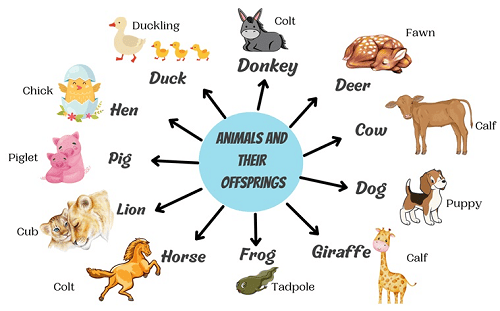
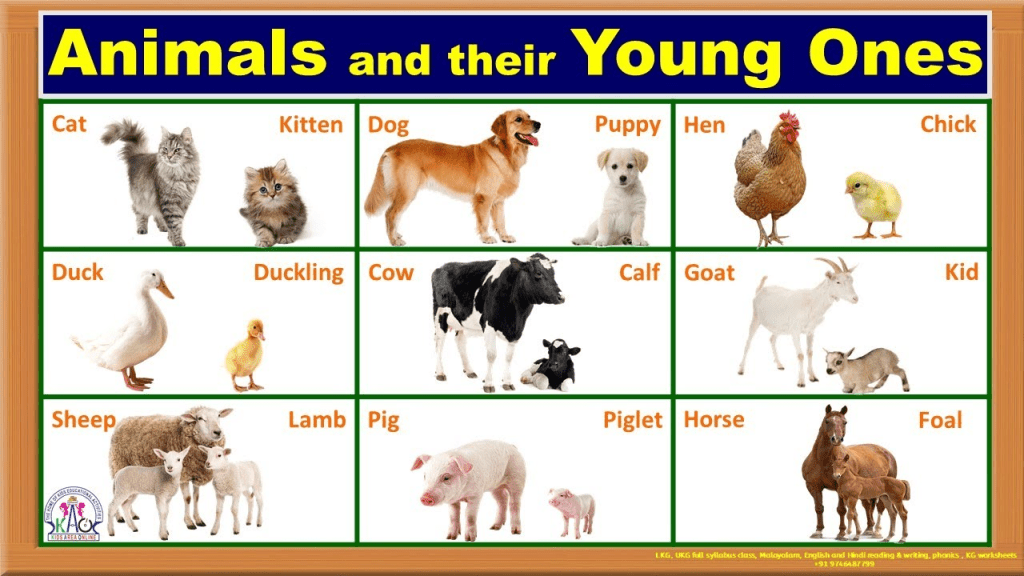
Pig – Piglet
Dog – Puppy
Cat – Kitten
Cow – Calf
Horse – Foal
Sheep – Lamb
Goat – Kid
Lion – Cub
Tiger – Cub
Elephant – Calf
Deer – Fawn
Frog – Tadpole
Duck – Duckling
Hen – Chick
Kangaroo – Joey
What is Required Class 1 Young One of Animals
Courtesy- EducationalVideos
For Class 1, the topic “Young Ones of Animals” should be simple and easy to understand. Here’s what is required:
1. Basic Explanation:
- Animals, like humans, have babies called young ones.
- These young ones grow up to become adult animals.
2. Common Examples:
Children in Class 1 should learn basic and familiar animal baby names. Here are some examples:
| Animal | Young One |
|---|---|
| Dog | Puppy |
| Cat | Kitten |
| Cow | Calf |
| Horse | Foal |
| Sheep | Lamb |
| Goat | Kid |
| Lion | Cub |
| Tiger | Cub |
| Duck | Duckling |
| Hen | Chick |
3. Simple Activities:
To help kids remember, you can use:
✅ Picture Matching – Match animals with their young ones.
✅ Fill in the Blanks – “A baby dog is called a _______.”
✅ Storytelling – A short story featuring animal babies.
Who is Required Class 1 Young One of Animals
This topic is required for:
✔ Class 1 students – As part of their basic science or English curriculum.
✔ Teachers – To teach young children about animals and their babies.
✔ Parents – To help kids learn at home through fun activities.
If you mean “What is Class 1 Young One of Animals?”, it refers to a basic lesson in Class 1 (Grade 1) where children learn about the baby names of different animals.
For example:
- A baby dog is called a puppy.
- A baby cat is called a kitten.
- A baby cow is called a calf.
When is Required Class 1 Young One of Animals
If you’re asking, “When is Class 1 Young One of Animals required?”, it is usually taught in Grade 1 (Class 1) Science or English as part of the early learning curriculum.
When is it taught?
📅 Time: It is typically covered in the first or second term of the academic year.
📖 Subject: Found in Science, Environmental Studies (EVS), or English lessons.
🎯 Age Group: Usually for children aged 5-7 years.
Where is Required Class 1 Young One of Animals
If you’re asking, “Where is Class 1 Young One of Animals required?”, it is typically part of the Class 1 (Grade 1) curriculum in the following:
📖 Subjects:
✔ Science
✔ Environmental Studies (EVS)
✔ English (Vocabulary Development)
🏫 Places where it is taught:
✔ Schools (Kindergarten & Primary Schools)
✔ Homeschooling Programs
✔ Online Learning Platforms
✔ Kids’ Activity Books
If you’re asking “Where is Class 1 Young One of Animals?”, it is usually found in Class 1 (Grade 1) textbooks under subjects like:
📚 Science / Environmental Studies (EVS) – Learning about animals and their babies.
📖 English – Vocabulary development (names of young ones).
It is taught in:
🏫 Schools – Kindergarten & Primary Schools.
💻 Online Learning – Educational websites & apps.
📚 Children’s Books – Picture books & worksheets.
How is Required Class 1 Young One of Animals
How is “Young Ones of Animals” taught in Class 1?
Teachers and parents use fun and interactive methods to help children learn. Some common ways include:
🖼️ 1. Picture Cards – Showing animals and their babies.
📖 2. Storytelling – Simple stories with animal families.
🎲 3. Matching Games – Matching animals with their young ones.
✍️ 4. Worksheets – Fill in the blanks, tracing words, coloring.
🎶 5. Songs & Rhymes – Fun animal baby songs.
📺 6. Videos & Animations – Short cartoons teaching young ones of animals.
If you mean “How is this topic taught?”, it is usually taught in a fun and interactive way in Class 1 Science or English.
How is it taught?
✅ Using Pictures & Flashcards – Show images of animals and their babies.
✅ Matching Games – Match animals with their young ones.
✅ Songs & Rhymes – Fun songs about animal babies.
✅ Storytelling – Short stories about animal families.
✅ Worksheets & Coloring – Kids fill in blanks, trace words, and color pictures.
Case Study on Class 1 Young One of Animals
Courtesy- Notebook – The Fast learning app
Background
Teaching “Young Ones of Animals” is a fundamental part of the Grade 1 Science/EVS curriculum. This topic helps young learners (ages 5-7) understand the concept of animal families, vocabulary development, and basic biology.
Objective
To examine the effectiveness of different teaching methods used to teach Young Ones of Animals to Class 1 students and their impact on learning outcomes.
Methodology
A study was conducted in a Grade 1 classroom with 30 students. The teaching was divided into three groups, each using different methods:
- Traditional Learning (Textbook & Lecture)
- Visual & Interactive Learning (Flashcards, Videos, Games)
- Activity-Based Learning (Storytelling, Role-Playing, Worksheets)
Each method was used for one week, and students were assessed through:
- Oral Q&A
- Picture Matching Test
- Worksheet Activities
Findings
📌 Group 1 (Traditional Learning):
- 60% of students remembered at least 5 young ones.
- Struggled with engagement and interest.
📌 Group 2 (Visual & Interactive Learning):
- 85% of students could recall 7 or more young ones.
- Found the lesson fun and engaging.
📌 Group 3 (Activity-Based Learning):
- 95% of students remembered 8-10 young ones.
- Showed the highest level of participation and excitement.
Conclusion
✔ Activity-based and visual learning were the most effective methods.
✔ Students learned faster and retained more when engaged in games, storytelling, and visuals rather than just reading.
✔ Recommendation: Teachers should incorporate pictures, songs, and interactive games to make learning fun and effective.
White paper on Class 1 Young One of Animals
Title:
Enhancing Early Childhood Learning: Effective Strategies for Teaching “Young Ones of Animals” in Class 1
Abstract
This white paper explores the importance of teaching “Young Ones of Animals” to Class 1 students. It discusses effective teaching methodologies, challenges faced, and solutions to enhance learning outcomes. The study highlights the role of interactive learning, storytelling, and visual aids in improving concept retention among young learners.
Introduction
The concept of Young Ones of Animals is an essential part of early childhood education. It introduces students to fundamental scientific knowledge about animals and helps in vocabulary development. Traditional teaching methods often fail to engage young learners effectively, leading to lower retention rates. This paper explores various teaching approaches to make learning more interactive and impactful.
Importance of the Topic
- Cognitive Development – Helps children understand animal life cycles.
- Language Skills – Enhances vocabulary related to animals and their young ones.
- Environmental Awareness – Encourages curiosity about nature and wildlife.
Methodology
A study was conducted in three primary schools with Class 1 students (ages 5-7). Different teaching approaches were tested, and student engagement and retention rates were analyzed through assessments and observations.
Key Findings
📌 Traditional Learning (Textbooks & Lectures)
- 55-60% retention after one week.
- Less student engagement.
📌 Visual & Interactive Learning (Flashcards, Videos, Games)
- 85% retention rate.
- Students found lessons more enjoyable.
📌 Activity-Based Learning (Storytelling, Role-Playing, Worksheets)
- 95% retention rate.
- Increased student participation and curiosity.
Challenges & Solutions
✅ Challenge 1: Low Engagement
- Solution: Use animated videos, songs, and flashcards to capture attention.
✅ Challenge 2: Difficulty in Remembering Names
- Solution: Introduce story-based learning where animal families are part of a fun narrative.
✅ Challenge 3: Limited Classroom Resources
- Solution: Incorporate DIY activities like drawing and role-playing games.
Recommendations
- Incorporate more visuals (charts, flashcards, videos).
- Use interactive activities (matching games, quizzes, storytelling).
- Encourage hands-on learning (visits to farms, animal toys).
- Leverage digital tools (apps and animated lessons).
Conclusion
The study concludes that interactive and activity-based learning methods are most effective in teaching young children about animals and their young ones. Schools should integrate visual aids, storytelling, and hands-on activities to improve engagement and retention.
Future Scope
Further research can explore digital learning tools and augmented reality (AR) experiences for enhanced classroom engagement.
Industrial Application of Class 1 Young One of Animals
Courtesy- Jingle bell
The concept of “Young Ones of Animals” may seem basic for Class 1 students, but it has several industrial applications in various fields, including agriculture, veterinary sciences, animal husbandry, education, and media.
Industrial Applications of “Young Ones of Animals”
1. Agriculture & Animal Husbandry 🐄🐑
- Livestock Management: Farmers and animal breeders must understand animal reproduction and young ones’ care for efficient farming.
- Dairy & Meat Industry: Knowledge of young animals (e.g., calves, lambs, piglets) is crucial for milk and meat production.
- Poultry Farming: Managing chicks in hatcheries for egg and meat production.
2. Veterinary Science & Animal Healthcare 🏥
- Veterinarians specialize in treating young animals (calves, foals, puppies, kittens) as their needs differ from adults.
- Animal Nutrition: Companies develop specialized food for young animals (puppy food, calf milk replacers).
3. Education & Learning Industry 📚
- Children’s Books & Learning Apps: Educational publishers create books and apps teaching kids about young animals.
- Zoo & Wildlife Education: Conservation programs educate visitors about baby animals in the wild.
4. Media & Entertainment 🎬
- Animation & Films: Many animated characters are based on baby animals (e.g., Simba from The Lion King).
- Toys & Merchandise: Companies design stuffed animals and toys based on young animals.
5. Biotechnology & Genetics 🧬
- Animal Cloning & Breeding: Scientists study young animals to improve selective breeding.
- Wildlife Conservation: Programs focus on reintroducing young endangered species into the wild.
Conclusion
The concept of young ones of animals is not just a basic classroom lesson—it has significant real-world applications across multiple industries. Understanding the growth and development of animals helps industries from farming to media production.
References
- ^ de Queiroz, Kevin; Cantino, Philip; Gauthier, Jacques, eds. (2020). “Metazoa E. Haeckel 1874 [J. R. Garey and K. M. Halanych], converted clade name”. Phylonyms: A Companion to the PhyloCode (1st ed.). CRC Press. p. 1352. doi:10.1201/9780429446276. ISBN 9780429446276. S2CID 242704712.
- ^ Nielsen, Claus (2008). “Six major steps in animal evolution: are we derived sponge larvae?”. Evolution & Development. 10 (2): 241–257. doi:10.1111/j.1525-142X.2008.00231.x. ISSN 1520-541X. PMID 18315817. S2CID 8531859.
- ^ Jump up to:a b c Rothmaler, Werner (1951). “Die Abteilungen und Klassen der Pflanzen”. Feddes Repertorium. 54 (2–3): 256–266. doi:10.1002/fedr.19510540208.
- ^ “animalia”. Merriam-Webster.com Dictionary. Merriam-Webster.
- ^ Antcliffe, Jonathan B.; Callow, Richard H. T.; Brasier, Martin D. (November 2014). “Giving the early fossil record of sponges a squeeze”. Biological Reviews. 89 (4): 972–1004. doi:10.1111/brv.12090. PMID 24779547. S2CID 22630754.
- ^ Cresswell, Julia (2010). “Animal”. The Oxford Dictionary of Word Origins (2nd ed.). New York: Oxford University Press. ISBN 978-0-19-954793-7.
‘having the breath of life’, from anima ‘air, breath, life’.
- ^ “Animal”. The American Heritage Dictionary (4th ed.). Houghton Mifflin. 2006.
- ^ “Animal”. English Oxford Living Dictionaries. Archived from the original on 26 July 2018. Retrieved 26 July 2018.
- ^ Boly, Melanie; Seth, Anil K.; Wilke, Melanie; Ingmundson, Paul; Baars, Bernard; et al. (2013). “Consciousness in humans and non-human animals: recent advances and future directions”. Frontiers in Psychology. 4: 625. doi:10.3389/fpsyg.2013.00625. PMC 3814086. PMID 24198791.
- ^ “The use of non-human animals in research”. Royal Society. Archived from the original on 12 June 2018. Retrieved 7 June 2018.
- ^ “Nonhuman”. Collins English Dictionary. Archived from the original on 12 June 2018. Retrieved 7 June 2018.
- ^ “Metazoan”. Merriam-Webster. Archived from the original on 6 July 2022. Retrieved 6 July 2022.
- ^ “Metazoa”. Collins. Archived from the original on 30 July 2022. Retrieved 6 July 2022. and further meta- (sense 1) Archived 30 July 2022 at the Wayback Machine and -zoa Archived 30 July 2022 at the Wayback Machine.
- ^ Avila, Vernon L. (1995). Biology: Investigating Life on Earth. Jones & Bartlett. p. 767. ISBN 978-0-86720-942-6.
- ^ Davidson, Michael W. “Animal Cell Structure”. Archived from the original on 20 September 2007. Retrieved 20 September 2007.
- ^ “Palaeos:Metazoa”. Palaeos. Archived from the original on 28 February 2018. Retrieved 25 February 2018.
- ^ Bergman, Jennifer. “Heterotrophs”. Archived from the original on 29 August 2007. Retrieved 30 September 2007.
- ^ Douglas, Angela E.; Raven, John A. (January 2003). “Genomes at the interface between bacteria and organelles”. Philosophical Transactions of the Royal Society B. 358 (1429): 5–17. doi:10.1098/rstb.2002.1188. PMC 1693093. PMID 12594915.
- ^ Jump up to:a b Heino, Jyrki; Huhtala, Mikko; Käpylä, Jarmo; Johnson, Mark S. (February 2009). “Evolution of collagen-based adhesion systems”. The International Journal of Biochemistry & Cell Biology. 41 (2): 341–348. doi:10.1016/j.biocel.2008.08.021.
- ^ Alberts, Bruce; Johnson, Alexander; Lewis, Julian; Raff, Martin; Roberts, Keith; Walter, Peter (2002). Molecular Biology of the Cell (4th ed.). Garland Science. ISBN 978-0-8153-3218-3. Archived from the original on 23 December 2016. Retrieved 29 August 2017.
- ^ Alberts, Bruce; Johnson, Alexander; Lewis, Julian; Raff, Martin; Roberts, Keith; Walter, Peter (2002). Molecular Biology of the Cell (4th ed.). Garland Science. ISBN 978-0-8153-3218-3. Archived from the original on 23 December 2016. Retrieved 29 August 2017.
- ^ Alberts, Bruce; Johnson, Alexander; Lewis, Julian; Raff, Martin; Roberts, Keith; Walter, Peter (2002). Molecular Biology of the Cell (4th ed.). Garland Science. ISBN 978-0-8153-3218-3. Archived from the original on 23 December 2016. Retrieved 29 August 2017.
- ^ Saupe, S. G. “Concepts of Biology”. Archived from the original on 21 November 2007. Retrieved 30 September 2007.
- ^ Minkoff, Eli C. (2008). Barron’s EZ-101 Study Keys Series: Biology (2nd, revised ed.). Barron’s Educational Series. p. 48. ISBN 978-0-7641-3920-8.
- ^ Magloire, Kim (2004). Cracking the AP Biology Exam, 2004–2005 Edition. The Princeton Review. p. 45. ISBN 978-0-375-76393-9.
- ^ Starr, Cecie (2007). Biology: Concepts and Applications without Physiology. Cengage Learning. pp. 362, 365. ISBN 978-0-495-38150-1. Retrieved 19 May 2020.
- ^ Hillmer, Gero; Lehmann, Ulrich (1983). Fossil Invertebrates. Translated by Lettau, J. Cambridge University Press Archive. p. 54. ISBN 978-0-521-27028-1. Retrieved 8 January 2016.
- ^ Ryan, Joseph F.; Mazza, Maureen E.; Pang, Kevin; Matus, David Q.; Baxevanis, Andreas D.; Martindale, Mark Q.; Finnerty, John R. (24 January 2007). “Pre-Bilaterian Origins of the Hox Cluster and the Hox Code: Evidence from the Sea Anemone, Nematostella vectensis”. PLoS ONE. 2 (1): e153. doi:10.1371/journal.pone.0000153. PMC 1779807.
- ^ de Rosa, Renaud; Grenier, Jennifer K.; Andreeva, Tatiana; Cook, Charles E.; Adoutte, André; Akam, Michael; Carroll, Sean B.; Balavoine, Guillaume (1999). “Hox genes in brachiopods and priapulids and protostome evolution”. Nature. 399 (6738): 772–776. doi:10.1038/21631. ISSN 0028-0836.
- ^ Minkoff, Eli C. (2008). Barron’s EZ-101 Study Keys Series: Biology (2nd, revised ed.). Barron’s Educational Series. p. 48. ISBN 978-0-7641-3920-8.
- ^ Sangwal, Keshra (2007). Additives and crystallization processes: from fundamentals to applications. John Wiley & Sons. p. 212. ISBN 978-0-470-06153-4.
- ^ Becker, Wayne M. (1991). The world of the cell. Benjamin Cummings. ISBN 978-0-8053-0870-9.
- ^ Knobil, Ernst (1998). Encyclopedia of reproduction. Vol. 1. Academic. p. 315. ISBN 978-0-12-227020-8.
- ^ Schwartz, Jill (2010). Master the GED 2011. Peterson’s. p. 371. ISBN 978-0-7689-2885-3.
- ^ Hamilton, Matthew B. (2009). Population genetics. Wiley-Blackwell. p. 55. ISBN 978-1-4051-3277-0.
- ^ Ville, Claude Alvin; Walker, Warren Franklin; Barnes, Robert D. (1984). General zoology. Saunders College. p. 467. ISBN 978-0-03-062451-3.
- ^ Hamilton, William James; Boyd, James Dixon; Mossman, Harland Winfield (1945). Human embryology: (prenatal development of form and function). Williams & Wilkins. p. 330.
- ^ Philips, Joy B. (1975). Development of vertebrate anatomy. Mosby. p. 176. ISBN 978-0-8016-3927-2.
- ^ The Encyclopedia Americana. Vol. 10. 1918. p. 281.
- ^ Romoser, William S.; Stoffolano, J. G. (1998). The science of entomology. WCB McGraw-Hill. p. 156. ISBN 978-0-697-22848-2.
- ^ Charlesworth, D.; Willis, J. H. (2009). “The genetics of inbreeding depression”. Nature Reviews Genetics. 10 (11): 783–796. doi:10.1038/nrg2664. PMID 19834483. S2CID 771357.
- ^ Bernstein, H.; Hopf, F. A.; Michod, R. E. (1987). “The Molecular Basis of the Evolution of Sex”. Molecular Genetics of Development. Advances in Genetics. Vol. 24. pp. 323–370. doi:10.1016/s0065-2660(08)60012-7. ISBN 978-0-12-017624-3. PMID 3324702.
- ^ Pusey, Anne; Wolf, Marisa (1996). “Inbreeding avoidance in animals”. Trends Ecol. Evol. 11 (5): 201–206. Bibcode:1996TEcoE..11..201P. doi:10.1016/0169-5347(96)10028-8. PMID 21237809.
- ^ Adiyodi, K. G.; Hughes, Roger N.; Adiyodi, Rita G. (July 2002). Reproductive Biology of Invertebrates. Vol. 11, Progress in Asexual Reproduction. Wiley. p. 116. ISBN 978-0-471-48968-9.
- ^ Schatz, Phil. “Concepts of Biology: How Animals Reproduce”. OpenStax College. Archived from the original on 6 March 2018. Retrieved 5 March 2018.
- ^ Marchetti, Mauro; Rivas, Victoria (2001). Geomorphology and environmental impact assessment. Taylor & Francis. p. 84. ISBN 978-90-5809-344-8.
- ^ Levy, Charles K. (1973). Elements of Biology. Appleton-Century-Crofts. p. 108. ISBN 978-0-390-55627-1.
- ^ Begon, M.; Townsend, C.; Harper, J. (1996). Ecology: Individuals, populations and communities (3rd ed.). Blackwell. ISBN 978-0-86542-845-4.
- ^ Allen, Larry Glen; Pondella, Daniel J.; Horn, Michael H. (2006). Ecology of marine fishes: California and adjacent waters. University of California Press. p. 428. ISBN 978-0-520-24653-9.
- ^ Caro, Tim (2005). Antipredator Defenses in Birds and Mammals. University of Chicago Press. pp. 1–6 and passim.
- ^ Simpson, Alastair G. B.; Roger, Andrew J. (2004). “The real ‘kingdoms’ of eukaryotes”. Current Biology. 14 (17): R693 – R696. Bibcode:2004CBio…14.R693S. doi:10.1016/j.cub.2004.08.038. PMID 15341755. S2CID 207051421.
- ^ Stevens, Alison N. P. (2010). “Predation, Herbivory, and Parasitism”. Nature Education Knowledge. 3 (10): 36. Archived from the original on 30 September 2017. Retrieved 12 February 2018.
- ^ Jervis, M. A.; Kidd, N. A. C. (November 1986). “Host-Feeding Strategies in Hymenopteran Parasitoids”. Biological Reviews. 61 (4): 395–434. doi:10.1111/j.1469-185x.1986.tb00660.x. S2CID 84430254.
- ^ Meylan, Anne (22 January 1988). “Spongivory in Hawksbill Turtles: A Diet of Glass”. Science. 239 (4838): 393–395. Bibcode:1988Sci…239..393M. doi:10.1126/science.239.4838.393. JSTOR 1700236. PMID 17836872. S2CID 22971831.
- ^ Clutterbuck, Peter (2000). Understanding Science: Upper Primary. Blake. p. 9. ISBN 978-1-86509-170-9.
- ^ Garrett, Reginald; Grisham, Charles M. (2010). Biochemistry. Cengage. p. 535. ISBN 978-0-495-10935-8.
- ^ Castro, Peter; Huber, Michael E. (2007). Marine Biology (7th ed.). McGraw Hill. p. 376. ISBN 978-0-07-722124-9.
- ^ Rota-Stabelli, Omar; Daley, Allison C.; Pisani, Davide (2013). “Molecular Timetrees Reveal a Cambrian Colonization of Land and a New Scenario for Ecdysozoan Evolution”. Current Biology. 23 (5): 392–398. Bibcode:2013CBio…23..392R. doi:10.1016/j.cub.2013.01.026. PMID 23375891.
- ^ Daeschler, Edward B.; Shubin, Neil H.; Jenkins, Farish A. Jr. (6 April 2006). “A Devonian tetrapod-like fish and the evolution of the tetrapod body plan”. Nature. 440 (7085): 757–763. Bibcode:2006Natur.440..757D. doi:10.1038/nature04639. PMID 16598249.
- ^ Clack, Jennifer A. (21 November 2005). “Getting a Leg Up on Land”. Scientific American. 293 (6): 100–107. Bibcode:2005SciAm.293f.100C. doi:10.1038/scientificamerican1205-100. PMID 16323697.
- ^ Margulis, Lynn; Schwartz, Karlene V.; Dolan, Michael (1999). Diversity of Life: The Illustrated Guide to the Five Kingdoms. Jones & Bartlett. pp. 115–116. ISBN 978-0-7637-0862-7.
- ^ Clarke, Andrew (2014). “The thermal limits to life on Earth” (PDF). International Journal of Astrobiology. 13 (2): 141–154. Bibcode:2014IJAsB..13..141C. doi:10.1017/S1473550413000438. Archived (PDF) from the original on 24 April 2019.
- ^ “Land animals”. British Antarctic Survey. Archived from the original on 6 November 2018. Retrieved 7 March 2018.
- ^ Jump up to:a b c Wood, Gerald (1983). The Guinness Book of Animal Facts and Feats. Enfield, Middlesex: Guinness Superlatives. ISBN 978-0-85112-235-9.
- ^ Davies, Ella (20 April 2016). “The longest animal alive may be one you never thought of”. BBC Earth. Archived from the original on 19 March 2018. Retrieved 1 March 2018.
- ^ Mazzetta, Gerardo V.; Christiansen, Per; Fariña, Richard A. (2004). “Giants and Bizarres: Body Size of Some Southern South American Cretaceous Dinosaurs”. Historical Biology. 16 (2–4): 71–83. Bibcode:2004HBio…16…71M. CiteSeerX 10.1.1.694.1650. doi:10.1080/08912960410001715132. S2CID 56028251.
- ^ Curtice, Brian (2020). Dinosaur Systematics, Diversity, & Biology (PDF). Society of Vertebrate Paleontology. p. 92. Archived (PDF) from the original on 19 October 2021. Retrieved 30 December 2022.
- ^ Fiala, Ivan (10 July 2008). “Myxozoa”. Tree of Life Web Project. Archived from the original on 1 March 2018. Retrieved 4 March 2018.
- ^ Kaur, H.; Singh, R. (2011). “Two new species of Myxobolus (Myxozoa: Myxosporea: Bivalvulida) infecting an Indian major carp and a cat fish in wetlands of Punjab, India”. Journal of Parasitic Diseases. 35 (2): 169–176. doi:10.1007/s12639-011-0061-4. PMC 3235390. PMID 23024499.
- ^ Jump up to:a b c d e f g h i j k l m n Zhang, Zhi-Qiang (30 August 2013). “Animal biodiversity: An update of classification and diversity in 2013”. Zootaxa. 3703 (1). Magnolia Press: 5. doi:10.11646/zootaxa.3703.1.3. Archived from the original on 24 April 2019. Retrieved 2 March 2018.
- ^ Jump up to:a b c d e f g h i j Balian, E. V.; Lévêque, C.; Segers, H.; Martens, K. (2008). Freshwater Animal Diversity Assessment. Springer. p. 628. ISBN 978-1-4020-8259-7.
- ^ Jump up to:a b c d e f g h i j k l m n Hogenboom, Melissa. “There are only 35 kinds of animal and most are really weird”. BBC Earth. Archived from the original on 10 August 2018. Retrieved 2 March 2018.
- ^ Jump up to:a b c d e f g h Poulin, Robert (2007). Evolutionary Ecology of Parasites. Princeton University Press. p. 6. ISBN 978-0-691-12085-0.
- ^ Jump up to:a b c d Felder, Darryl L.; Camp, David K. (2009). Gulf of Mexico Origin, Waters, and Biota: Biodiversity. Texas A&M University Press. p. 1111. ISBN 978-1-60344-269-5.
- ^ “How many species on Earth? About 8.7 million, new estimate says”. 24 August 2011. Archived from the original on 1 July 2018. Retrieved 2 March 2018.
- ^ Mora, Camilo; Tittensor, Derek P.; Adl, Sina; Simpson, Alastair G. B.; Worm, Boris (23 August 2011). Mace, Georgina M. (ed.). “How Many Species Are There on Earth and in the Ocean?”. PLOS Biology. 9 (8): e1001127. doi:10.1371/journal.pbio.1001127. PMC 3160336. PMID 21886479.
- ^ Hebert, Paul D. N.; Ratnasingham, Sujeevan; Zakharov, Evgeny V.; Telfer, Angela C.; Levesque-Beaudin, Valerie; et al. (1 August 2016). “Counting animal species with DNA barcodes: Canadian insects”. Philosophical Transactions of the Royal Society B: Biological Sciences. 371 (1702): 20150333. doi:10.1098/rstb.2015.0333. PMC 4971185. PMID 27481785.
- ^ Stork, Nigel E. (January 2018). “How Many Species of Insects and Other Terrestrial Arthropods Are There on Earth?”. Annual Review of Entomology. 63 (1): 31–45. doi:10.1146/annurev-ento-020117-043348. PMID 28938083. S2CID 23755007. Stork notes that 1m insects have been named, making much larger predicted estimates.
- ^ Poore, Hugh F. (2002). “Introduction”. Crustacea: Malacostraca. Zoological catalogue of Australia. Vol. 19.2A. CSIRO Publishing. pp. 1–7. ISBN 978-0-643-06901-5.
- ^ Jump up to:a b c d Nicol, David (June 1969). “The Number of Living Species of Molluscs”. Systematic Zoology. 18 (2): 251–254. doi:10.2307/2412618. JSTOR 2412618.
- ^ Uetz, P. “A Quarter Century of Reptile and Amphibian Databases”. Herpetological Review. 52: 246–255. Archived from the original on 21 February 2022. Retrieved 2 October 2021 – via ResearchGate.
- ^ Jump up to:a b c Reaka-Kudla, Marjorie L.; Wilson, Don E.; Wilson, Edward O. (1996). Biodiversity II: Understanding and Protecting Our Biological Resources. Joseph Henry. p. 90. ISBN 978-0-309-52075-1.
- ^ Burton, Derek; Burton, Margaret (2017). Essential Fish Biology: Diversity, Structure and Function. Oxford University Press. pp. 281–282. ISBN 978-0-19-878555-2.
Trichomycteridae … includes obligate parasitic fish. Thus 17 genera from 2 subfamilies, Vandelliinae; 4 genera, 9spp. and Stegophilinae; 13 genera, 31 spp. are parasites on gills (Vandelliinae) or skin (stegophilines) of fish.
- ^ Sluys, R. (1999). “Global diversity of land planarians (Platyhelminthes, Tricladida, Terricola): a new indicator-taxon in biodiversity and conservation studies”. Biodiversity and Conservation. 8 (12): 1663–1681. Bibcode:1999BiCon…8.1663S. doi:10.1023/A:1008994925673. S2CID 38784755.
- ^ Jump up to:a b Pandian, T. J. (2020). Reproduction and Development in Platyhelminthes. CRC Press. pp. 13–14. ISBN 978-1-000-05490-3. Retrieved 19 May 2020.
- ^ Morand, Serge; Krasnov, Boris R.; Littlewood, D. Timothy J. (2015). Parasite Diversity and Diversification. Cambridge University Press. p. 44. ISBN 978-1-107-03765-6. Retrieved 2 March 2018.
- ^ Fontaneto, Diego. “Marine Rotifers: An Unexplored World of Richness” (PDF). JMBA Global Marine Environment. pp. 4–5. Archived (PDF) from the original on 2 March 2018. Retrieved 2 March 2018.
- ^ May, Linda (1989). Epizoic and parasitic rotifers. Rotifer Symposium V: Proceedings of the Fifth Rotifer Symposium, held in Gargnano, Italy, September 11–18, 1988. Springer.
- ^ Chernyshev, A. V. (September 2021). “An updated classification of the phylum Nemertea”. Invertebrate Zoology. 18 (3): 188–196. doi:10.15298/invertzool.18.3.01. S2CID 239872311. Retrieved 18 January 2023.
- ^ Hookabe, Natsumi; Kajihara, Hiroshi; Chernyshev, Alexei V.; Jimi, Naoto; Hasegawa, Naohiro; Kohtsuka, Hisanori; Okanishi, Masanori; Tani, Kenichiro; Fujiwara, Yoshihiro; Tsuchida, Shinji; Ueshima, Rei (2022). “Molecular Phylogeny of the Genus Nipponnemertes (Nemertea: Monostilifera: Cratenemertidae) and Descriptions of 10 New Species, With Notes on Small Body Size in a Newly Discovered Clade”. Frontiers in Marine Science. 9. doi:10.3389/fmars.2022.906383. Retrieved 18 January 2023.
- ^ Hickman, Cleveland P.; Keen, Susan L.; Larson, Allan; Eisenhour, David J. (2018). Animal Diversity (8th ed.). McGraw Hill. ISBN 978-1-260-08427-6.
- ^ Gold, David; et al. (22 February 2016). “Sterol and genomic analyses validate the sponge biomarker hypothesis”. PNAS. 113 (10): 2684–2689. Bibcode:2016PNAS..113.2684G. doi:10.1073/pnas.1512614113. PMC 4790988. PMID 26903629.
- ^ Love, Gordon; et al. (5 February 2009). “Fossil steroids record the appearance of Demospongiae during the Cryogenian period”. Nature. 457 (7230): 718–721. Bibcode:2009Natur.457..718L. doi:10.1038/nature07673. PMID 19194449.
- ^ Shen, Bing; Dong, Lin; Xiao, Shuhai; Kowalewski, Michał (2008). “The Avalon Explosion: Evolution of Ediacara Morphospace”. Science. 319 (5859): 81–84. Bibcode:2008Sci…319…81S. doi:10.1126/science.1150279. PMID 18174439. S2CID 206509488.
- ^ Chen, Zhe; Chen, Xiang; Zhou, Chuanming; Yuan, Xunlai; Xiao, Shuhai (1 June 2018). “Late Ediacaran trackways produced by bilaterian animals with paired appendages”. Science Advances. 4 (6): eaao6691. Bibcode:2018SciA….4.6691C. doi:10.1126/sciadv.aao6691. PMC 5990303. PMID 29881773.
- ^ Schopf, J. William (1999). Evolution!: facts and fallacies. Academic Press. p. 7. ISBN 978-0-12-628860-5.
- ^ Jump up to:a b Bobrovskiy, Ilya; Hope, Janet M.; Ivantsov, Andrey; Nettersheim, Benjamin J.; Hallmann, Christian; Brocks, Jochen J. (20 September 2018). “Ancient steroids establish the Ediacaran fossil Dickinsonia as one of the earliest animals”. Science. 361 (6408): 1246–1249. Bibcode:2018Sci…361.1246B. doi:10.1126/science.aat7228. PMID 30237355.
- ^ Zimorski, Verena; Mentel, Marek; Tielens, Aloysius G. M.; Martin, William F. (2019). “Energy metabolism in anaerobic eukaryotes and Earth’s late oxygenation”. Free Radical Biology and Medicine. 140: 279–294. doi:10.1016/j.freeradbiomed.2019.03.030. PMC 6856725. PMID 30935869.
- ^ “Stratigraphic Chart 2022” (PDF). International Stratigraphic Commission. February 2022. Archived (PDF) from the original on 2 April 2022. Retrieved 25 April 2022.
- ^ Maloof, A. C.; Porter, S. M.; Moore, J. L.; Dudas, F. O.; Bowring, S. A.; Higgins, J. A.; Fike, D. A.; Eddy, M. P. (2010). “The earliest Cambrian record of animals and ocean geochemical change”. Geological Society of America Bulletin. 122 (11–12): 1731–1774. Bibcode:2010GSAB..122.1731M. doi:10.1130/B30346.1. S2CID 6694681.
- ^ “New Timeline for Appearances of Skeletal Animals in Fossil Record Developed by UCSB Researchers”. The Regents of the University of California. 10 November 2010. Archived from the original on 3 September 2014. Retrieved 1 September 2014.
- ^ Conway-Morris, Simon (2003). “The Cambrian “explosion” of metazoans and molecular biology: would Darwin be satisfied?”. The International Journal of Developmental Biology. 47 (7–8): 505–515. PMID 14756326. Archived from the original on 14 November 2023. Retrieved 28 September 2024.
- ^ Morris, Simon Conway (29 June 2006). “Darwin’s dilemma: the realities of the Cambrian ‘explosion'”. Philosophical Transactions of the Royal Society of London. Series B, Biological Sciences. 361 (1470): 1069–83. doi:10.1098/rstb.2006.1846. PMC 1578734. PMID 16754615.
- ^ “The Tree of Life”. The Burgess Shale. Royal Ontario Museum. 10 June 2011. Archived from the original on 16 February 2018. Retrieved 28 February 2018.
- ^ Jump up to:a b Dunn, F. S.; Kenchington, C. G.; Parry, L. A.; Clark, J. W.; Kendall, R. S.; Wilby, P. R. (25 July 2022). “A crown-group cnidarian from the Ediacaran of Charnwood Forest, UK”. Nature Ecology & Evolution. 6 (8): 1095–1104. Bibcode:2022NatEE…6.1095D. doi:10.1038/s41559-022-01807-x. PMC 9349040. PMID 35879540.
- ^ Campbell, Neil A.; Reece, Jane B. (2005). Biology (7th ed.). Pearson, Benjamin Cummings. p. 526. ISBN 978-0-8053-7171-0.
- ^ Maloof, Adam C.; Rose, Catherine V.; Beach, Robert; Samuels, Bradley M.; Calmet, Claire C.; Erwin, Douglas H.; Poirier, Gerald R.; Yao, Nan; Simons, Frederik J. (17 August 2010). “Possible animal-body fossils in pre-Marinoan limestones from South Australia”. Nature Geoscience. 3 (9): 653–659. Bibcode:2010NatGe…3..653M. doi:10.1038/ngeo934.
- ^ Seilacher, Adolf; Bose, Pradip K.; Pfluger, Friedrich (2 October 1998). “Triploblastic animals more than 1 billion years ago: trace fossil evidence from india”. Science. 282 (5386): 80–83. Bibcode:1998Sci…282…80S. doi:10.1126/science.282.5386.80. PMID 9756480.
- ^ Matz, Mikhail V.; Frank, Tamara M.; Marshall, N. Justin; Widder, Edith A.; Johnsen, Sönke (9 December 2008). “Giant Deep-Sea Protist Produces Bilaterian-like Traces”. Current Biology. 18 (23): 1849–54. Bibcode:2008CBio…18.1849M. doi:10.1016/j.cub.2008.10.028. PMID 19026540. S2CID 8819675.
- ^ Reilly, Michael (20 November 2008). “Single-celled giant upends early evolution”. NBC News. Archived from the original on 29 March 2013. Retrieved 5 December 2008.
- ^ Bengtson, S. (2002). “Origins and early evolution of predation” (PDF). In Kowalewski, M.; Kelley, P. H. (eds.). The fossil record of predation. The Paleontological Society Papers. Vol. 8. The Paleontological Society. pp. 289–317. Archived (PDF) from the original on 30 October 2019. Retrieved 3 March 2018.
- ^ Seilacher, Adolf (2007). Trace fossil analysis. Berlin: Springer. pp. 176–177. ISBN 978-3-540-47226-1. OCLC 191467085.
- ^ Breyer, J. A. (1995). “Possible new evidence for the origin of metazoans prior to 1 Ga: Sediment-filled tubes from the Mesoproterozoic Allamoore Formation, Trans-Pecos Texas”. Geology. 23 (3): 269–272. Bibcode:1995Geo….23..269B. doi:10.1130/0091-7613(1995)023<0269:PNEFTO>2.3.CO;2.
- ^ Budd, Graham E.; Jensen, Sören (2017). “The origin of the animals and a ‘Savannah’ hypothesis for early bilaterian evolution”. Biological Reviews. 92 (1): 446–473. doi:10.1111/brv.12239. PMID 26588818.
- ^ Ros-Rocher, Núria; Pérez-Posada, Alberto; Leger, Michelle M.; Ruiz-Trillo, Iñaki (2021). “The origin of animals: an ancestral reconstruction of the unicellular-to-multicellular transition”. Open Biology. 11 (2). The Royal Society: 200359. doi:10.1098/rsob.200359. PMC 8061703. PMID 33622103.
- ^ Erives, Albert; Fritzsch, Bernd (17 July 2019). “A screen for gene paralogies delineating evolutionary branching order of early Metazoa”. bioRxiv: 704551. doi:10.1101/704551.
- ^ Kapli, Paschalia; Telford, Maximilian J. (11 December 2020). “Topology-dependent asymmetry in systematic errors affects phylogenetic placement of Ctenophora and Xenacoelomorpha”. Science Advances. 6 (10): eabc5162. Bibcode:2020SciA….6.5162K. doi:10.1126/sciadv.abc5162. PMC 7732190. PMID 33310849.
- ^ Giribet, G.; Edgecombe, G.D. (2020). The Invertebrate Tree of Life. Princeton University Press. p. 21. ISBN 978-0-6911-7025-1. Retrieved 27 May 2023.
- ^ Wanninger, Andreas (2024). “Hox, homology, and parsimony: An organismal perspective”. Seminars in Cell & Developmental Biology. 152–153: 16–23. doi:10.1016/j.semcdb.2023.01.007. PMID 36670036.
- ^ Feuda, Roberto; Dohrmann, Martin; Pett, Walker; Philippe, Hervé; Rota-Stabelli, Omar; et al. (2017). “Improved Modeling of Compositional Heterogeneity Supports Sponges as Sister to All Other Animals”. Current Biology. 27 (24): 3864–3870.e4. Bibcode:2017CBio…27E3864F. doi:10.1016/j.cub.2017.11.008. hdl:10449/43929. PMID 29199080.
- ^ Schultz, Darrin T.; Haddock, Steven H. D.; Bredeson, Jessen V.; Green, Richard E.; Simakov, Oleg; Rokhsar, Daniel S. (17 May 2023). “Ancient gene linkages support ctenophores as sister to other animals”. Nature. 618 (7963): 110–117. Bibcode:2023Natur.618..110S. doi:10.1038/s41586-023-05936-6. PMC 10232365. PMID 37198475.
- ^ Bhamrah, H. S.; Juneja, Kavita (2003). An Introduction to Porifera. Anmol Publications. p. 58. ISBN 978-81-261-0675-2.
- ^ Jump up to:a b Schultz, Darrin T.; Haddock, Steven H. D.; Bredeson, Jessen V.; Green, Richard E.; Simakov, Oleg; Rokhsar, Daniel S. (17 May 2023). “Ancient gene linkages support ctenophores as sister to other animals”. Nature. 618 (7963): 110–117. Bibcode:2023Natur.618..110S. doi:10.1038/s41586-023-05936-6. PMC 10232365. PMID 37198475. S2CID 258765122.
- ^ Whelan, Nathan V.; Kocot, Kevin M.; Moroz, Tatiana P.; Mukherjee, Krishanu; Williams, Peter; et al. (9 October 2017). “Ctenophore relationships and their placement as the sister group to all other animals”. Nature Ecology & Evolution. 1 (11): 1737–1746. Bibcode:2017NatEE…1.1737W. doi:10.1038/s41559-017-0331-3. PMC 5664179. PMID 28993654.
- ^ Sumich, James L. (2008). Laboratory and Field Investigations in Marine Life. Jones & Bartlett Learning. p. 67. ISBN 978-0-7637-5730-4.
- ^ Jessop, Nancy Meyer (1970). Biosphere; a study of life. Prentice-Hall. p. 428.
- ^ Sharma, N. S. (2005). Continuity And Evolution Of Animals. Mittal Publications. p. 106. ISBN 978-81-8293-018-6.
- ^ Langstroth, Lovell; Langstroth, Libby (2000). Newberry, Todd (ed.). A Living Bay: The Underwater World of Monterey Bay. University of California Press. p. 244. ISBN 978-0-520-22149-9.
- ^ Safra, Jacob E. (2003). The New Encyclopædia Britannica. Vol. 16. Encyclopædia Britannica. p. 523. ISBN 978-0-85229-961-6.
- ^ Kotpal, R.L. (2012). Modern Text Book of Zoology: Invertebrates. Rastogi Publications. p. 184. ISBN 978-81-7133-903-7.
- ^ Barnes, Robert D. (1982). Invertebrate Zoology. Holt-Saunders International. pp. 84–85. ISBN 978-0-03-056747-6.
- ^ “Introduction to Placozoa”. UCMP Berkeley. Archived from the original on 25 March 2018. Retrieved 10 March 2018.
- ^ Srivastava, Mansi; Begovic, Emina; Chapman, Jarrod; Putnam, Nicholas H.; Hellsten, Uffe; et al. (1 August 2008). “The Trichoplax genome and the nature of placozoans”. Nature. 454 (7207): 955–960. Bibcode:2008Natur.454..955S. doi:10.1038/nature07191. PMID 18719581. S2CID 4415492.
- ^ Jump up to:a b Minelli, Alessandro (2009). Perspectives in Animal Phylogeny and Evolution. Oxford University Press. p. 53. ISBN 978-0-19-856620-5.
- ^ Jump up to:a b c Brusca, Richard C. (2016). “Introduction to the Bilateria and the Phylum Xenacoelomorpha | Triploblasty and Bilateral Symmetry Provide New Avenues for Animal Radiation”. Invertebrates (PDF). Sinauer Associates. pp. 345–372. ISBN 978-1-60535-375-3. Archived (PDF) from the original on 24 April 2019. Retrieved 4 March 2018.
- ^ Dunn, Casey W.; Giribet, Gonzalo; Edgecombe, Gregory D.; Hejnol, Andreas (23 November 2014). “Animal Phylogeny and Its Evolutionary Implications”. Annual Review of Ecology, Evolution, and Systematics. 45 (1): 371–395. doi:10.1146/annurev-ecolsys-120213-091627.
- ^ Quillin, K. J. (May 1998). “Ontogenetic scaling of hydrostatic skeletons: geometric, static stress and dynamic stress scaling of the earthworm lumbricus terrestris”. Journal of Experimental Biology. 201 (12): 1871–1883. Bibcode:1998JExpB.201.1871Q. doi:10.1242/jeb.201.12.1871. PMID 9600869. Archived from the original on 17 June 2020. Retrieved 4 March 2018.
- ^ Telford, Maximilian J. (2008). “Resolving Animal Phylogeny: A Sledgehammer for a Tough Nut?”. Developmental Cell. 14 (4): 457–459. doi:10.1016/j.devcel.2008.03.016. PMID 18410719.
- ^ Philippe, H.; Brinkmann, H.; Copley, R. R.; Moroz, L. L.; Nakano, H.; Poustka, A. J.; Wallberg, A.; Peterson, K. J.; Telford, M. J. (2011). “Acoelomorph flatworms are deuterostomes related to Xenoturbella“. Nature. 470 (7333): 255–258. Bibcode:2011Natur.470..255P. doi:10.1038/nature09676. PMC 4025995. PMID 21307940.
- ^ Perseke, M.; Hankeln, T.; Weich, B.; Fritzsch, G.; Stadler, P. F.; Israelsson, O.; Bernhard, D.; Schlegel, M. (August 2007). “The mitochondrial DNA of Xenoturbella bocki: genomic architecture and phylogenetic analysis” (PDF). Theory Biosci. 126 (1): 35–42. CiteSeerX 10.1.1.177.8060. doi:10.1007/s12064-007-0007-7. PMID 18087755. S2CID 17065867. Archived (PDF) from the original on 24 April 2019. Retrieved 4 March 2018.
- ^ Cannon, Johanna T.; Vellutini, Bruno C.; Smith III, Julian.; Ronquist, Frederik; Jondelius, Ulf; Hejnol, Andreas (3 February 2016). “Xenacoelomorpha is the sister group to Nephrozoa”. Nature. 530 (7588): 89–93. Bibcode:2016Natur.530…89C. doi:10.1038/nature16520. PMID 26842059. S2CID 205247296. Archived from the original on 30 July 2022. Retrieved 21 February 2022.
- ^ Kapli, Paschalia; Natsidis, Paschalis; Leite, Daniel J.; Fursman, Maximilian; Jeffrie, Nadia; Rahman, Imran A.; Philippe, Hervé; Copley, Richard R.; Telford, Maximilian J. (19 March 2021). “Lack of support for Deuterostomia prompts reinterpretation of the first Bilateria”. Science Advances. 7 (12): eabe2741. Bibcode:2021SciA….7.2741K. doi:10.1126/sciadv.abe2741. PMC 7978419. PMID 33741592.
- ^ Valentine, James W. (July 1997). “Cleavage patterns and the topology of the metazoan tree of life”. PNAS. 94 (15): 8001–8005. Bibcode:1997PNAS…94.8001V. doi:10.1073/pnas.94.15.8001. PMC 21545. PMID 9223303.
- ^ Peters, Kenneth E.; Walters, Clifford C.; Moldowan, J. Michael (2005). The Biomarker Guide: Biomarkers and isotopes in petroleum systems and Earth history. Vol. 2. Cambridge University Press. p. 717. ISBN 978-0-521-83762-0.
- ^ Hejnol, A.; Martindale, M. Q. (2009). “The mouth, the anus, and the blastopore – open questions about questionable openings”. In Telford, M. J.; Littlewood, D. J. (eds.). Animal Evolution – Genomes, Fossils, and Trees. Oxford University Press. pp. 33–40. ISBN 978-0-19-957030-0. Archived from the original on 28 October 2018. Retrieved 1 March 2018.
- ^ Safra, Jacob E. (2003). The New Encyclopædia Britannica, Volume 1; Volume 3. Encyclopædia Britannica. p. 767. ISBN 978-0-85229-961-6.
- ^ Hyde, Kenneth (2004). Zoology: An Inside View of Animals. Kendall Hunt. p. 345. ISBN 978-0-7575-0997-1.
- ^ Alcamo, Edward (1998). Biology Coloring Workbook. The Princeton Review. p. 220. ISBN 978-0-679-77884-4.
- ^ Holmes, Thom (2008). The First Vertebrates. Infobase. p. 64. ISBN 978-0-8160-5958-4.
- ^ Rice, Stanley A. (2007). Encyclopedia of evolution. Infobase. p. 75. ISBN 978-0-8160-5515-9.
- ^ Tobin, Allan J.; Dusheck, Jennie (2005). Asking about life. Cengage. p. 497. ISBN 978-0-534-40653-0.
- ^ Simakov, Oleg; Kawashima, Takeshi; Marlétaz, Ferdinand; Jenkins, Jerry; Koyanagi, Ryo; et al. (26 November 2015). “Hemichordate genomes and deuterostome origins”. Nature. 527 (7579): 459–465. Bibcode:2015Natur.527..459S. doi:10.1038/nature16150. PMC 4729200. PMID 26580012.
- ^ Dawkins, Richard (2005). The Ancestor’s Tale: A Pilgrimage to the Dawn of Evolution. Houghton Mifflin Harcourt. p. 381. ISBN 978-0-618-61916-0.
- ^ Prewitt, Nancy L.; Underwood, Larry S.; Surver, William (2003). BioInquiry: making connections in biology. John Wiley. p. 289. ISBN 978-0-471-20228-8.
- ^ Shankland, M.; Seaver, E.C. (2000). “Evolution of the bilaterian body plan: What have we learned from annelids?”. Proceedings of the National Academy of Sciences. 97 (9): 4434–4437. Bibcode:2000PNAS…97.4434S. doi:10.1073/pnas.97.9.4434. JSTOR 122407. PMC 34316. PMID 10781038.
- ^ Jump up to:a b Gould, Stephen Jay (2011). The Lying Stones of Marrakech. Harvard University Press. pp. 130–134. ISBN 978-0-674-06167-5.
- ^ Leroi, Armand Marie (2014). The Lagoon: How Aristotle Invented Science. Bloomsbury. pp. 111–119, 270–271. ISBN 978-1-4088-3622-4.
- ^ Linnaeus, Carl (1758). Systema naturae per regna tria naturae :secundum classes, ordines, genera, species, cum characteribus, differentiis, synonymis, locis [The System of Nature through the Three Kingdoms of Nature] (in Latin) (10th ed.). Holmiae (Laurentii Salvii). Archived from the original on 10 October 2008. Retrieved 22 September 2008.
- ^ “Espèce de”. Reverso dictionnnaire (in French and English). Archived from the original on 28 July 2013. Retrieved 1 March 2018.
- ^ de Wit, Hendrik C. D. (1994). Histoire du développement de la biologie (in French). Vol. III. Presses polytechniques et universitaires Romandes. pp. 94–96. ISBN 978-2-88074-264-5.
- ^ Jump up to:a b Valentine, James W. (2004). On the Origin of Phyla. University of Chicago Press. pp. 7–8. ISBN 978-0-226-84548-7.
- ^ Haeckel, Ernst (1874). Anthropogenie oder Entwickelungsgeschichte des menschen [Anthropogeny or the Development story of Humans] (in German). W. Engelmann. p. 202.
- ^ Hutchins, Michael (2003). Grzimek’s Animal Life Encyclopedia (2nd ed.). Gale. p. 3. ISBN 978-0-7876-5777-2.
- ^ Jump up to:a b “Fisheries and Aquaculture”. Food and Agriculture Organization. Archived from the original on 19 May 2009. Retrieved 8 July 2016.
- ^ Jump up to:a b “Graphic detail Charts, maps and infographics. Counting chickens”. The Economist. 27 July 2011. Archived from the original on 15 July 2016. Retrieved 23 June 2016.
- ^ Helfman, Gene S. (2007). Fish Conservation: A Guide to Understanding and Restoring Global Aquatic Biodiversity and Fishery Resources. Island. p. 11. ISBN 978-1-59726-760-1.
- ^ “World Review of Fisheries and Aquaculture” (PDF). FAO. Archived (PDF) from the original on 28 August 2015. Retrieved 13 August 2015.
- ^ Eggleton, Paul (17 October 2020). “The State of the World’s Insects”. Annual Review of Environment and Resources. 45 (1): 61–82. doi:10.1146/annurev-environ-012420-050035.
- ^ “Shellfish climbs up the popularity ladder”. Seafood Business. January 2002. Archived from the original on 5 November 2012. Retrieved 8 July 2016.
- ^ “Western honeybee”. Encyclopædia Britannica. 17 September 2024. Retrieved 20 October 2024.
- ^ “Breeds of Cattle at Cattle Today”. Cattle-today.com. Archived from the original on 15 July 2011. Retrieved 15 October 2013.
- ^ Lukefahr, S. D.; Cheeke, P. R. “Rabbit project development strategies in subsistence farming systems”. Food and Agriculture Organization. Archived from the original on 6 May 2016. Retrieved 23 June 2016.
- ^ “Ancient fabrics, high-tech geotextiles”. Natural Fibres. Archived from the original on 20 July 2016. Retrieved 8 July 2016.
- ^ “Cochineal and Carmine”. Major colourants and dyestuffs, mainly produced in horticultural systems. FAO. Archived from the original on 6 March 2018. Retrieved 16 June 2015.
- ^ “Guidance for Industry: Cochineal Extract and Carmine”. FDA. Archived from the original on 13 July 2016. Retrieved 6 July 2016.
- ^ “How Shellac Is Manufactured”. The Mail. Adelaide. 18 December 1937. Archived from the original on 30 July 2022. Retrieved 17 July 2015.
- ^ Pearnchob, N.; Siepmann, J.; Bodmeier, R. (2003). “Pharmaceutical applications of shellac: moisture-protective and taste-masking coatings and extended-release matrix tablets”. Drug Development and Industrial Pharmacy. 29 (8): 925–938. doi:10.1081/ddc-120024188. PMID 14570313. S2CID 13150932.
- ^ Barber, E. J. W. (1991). Prehistoric Textiles. Princeton University Press. pp. 230–231. ISBN 978-0-691-00224-8.
- ^ Munro, John H. (2003). “Medieval Woollens: Textiles, Technology, and Organisation”. In Jenkins, David (ed.). The Cambridge History of Western Textiles. Cambridge University Press. pp. 214–215. ISBN 978-0-521-34107-3.
- ^ Pond, Wilson G. (2004). Encyclopedia of Animal Science. CRC Press. pp. 248–250. ISBN 978-0-8247-5496-9. Retrieved 22 February 2018.
- ^ “Genetics Research”. Animal Health Trust. Archived from the original on 12 December 2017. Retrieved 24 June 2016.
- ^ “Drug Development”. Animal Research.info. Archived from the original on 8 June 2016. Retrieved 24 June 2016.
- ^ “Animal Experimentation”. BBC. Archived from the original on 1 July 2016. Retrieved 8 July 2016.
- ^ “EU statistics show decline in animal research numbers”. Speaking of Research. 2013. Archived from the original on 6 October 2017. Retrieved 24 January 2016.
- ^ “Vaccines and animal cell technology”. Animal Cell Technology Industrial Platform. 10 June 2013. Archived from the original on 13 July 2016. Retrieved 9 July 2016.
- ^ “Medicines by Design”. National Institute of Health. Archived from the original on 4 June 2016. Retrieved 9 July 2016.
- ^ Fergus, Charles (2002). Gun Dog Breeds, A Guide to Spaniels, Retrievers, and Pointing Dogs. The Lyons Press. ISBN 978-1-58574-618-7.
- ^ “History of Falconry”. The Falconry Centre. Archived from the original on 29 May 2016. Retrieved 22 April 2016.
- ^ King, Richard J. (2013). The Devil’s Cormorant: A Natural History. University of New Hampshire Press. p. 9. ISBN 978-1-61168-225-0.
- ^ “Dendrobatidae”. AmphibiaWeb. Archived from the original on 10 August 2011. Retrieved 10 October 2008.
- ^ Heying, H. (2003). “Dendrobatidae”. Animal Diversity Web. Archived from the original on 12 February 2011. Retrieved 9 July 2016.
- ^ “Other bugs”. Keeping Insects. 18 February 2011. Archived from the original on 7 July 2016. Retrieved 8 July 2016.
- ^ Kaplan, Melissa. “So, you think you want a reptile?”. Anapsid.org. Archived from the original on 3 July 2016. Retrieved 8 July 2016.
- ^ “Pet Birds”. PDSA. Archived from the original on 7 July 2016. Retrieved 8 July 2016.
- ^ “Animals in Healthcare Facilities” (PDF). 2012. Archived from the original (PDF) on 4 March 2016.
- ^ The Humane Society of the United States. “U.S. Pet Ownership Statistics”. Archived from the original on 7 April 2012. Retrieved 27 April 2012.
- ^ “U.S. Rabbit Industry profile” (PDF). United States Department of Agriculture. Archived from the original (PDF) on 20 October 2013. Retrieved 10 July 2013.
- ^ Plous, S. (1993). “The Role of Animals in Human Society”. Journal of Social Issues. 49 (1): 1–9. doi:10.1111/j.1540-4560.1993.tb00906.x.
- ^ Hummel, Richard (1994). Hunting and Fishing for Sport: Commerce, Controversy, Popular Culture. Popular Press. ISBN 978-0-87972-646-1.
- ^ Lau, Theodora (2005). The Handbook of Chinese Horoscopes. Souvenir. pp. 2–8, 30–35, 60–64, 88–94, 118–124, 148–153, 178–184, 208–213, 238–244, 270–278, 306–312, 338–344.
- ^ Tester, S. Jim (1987). A History of Western Astrology. Boydell & Brewer. pp. 31–33 and passim. ISBN 978-0-85115-446-6.
- ^ Jump up to:a b Hearn, Lafcadio (1904). Kwaidan: Stories and Studies of Strange Things. Dover. ISBN 978-0-486-21901-1.
- ^ De Jaucourt, Louis (January 2011). “Butterfly”. Encyclopedia of Diderot and d’Alembert. Archived from the original on 11 August 2016. Retrieved 16 December 2023.
- ^ Hutchins, M., Arthur V. Evans, Rosser W. Garrison and Neil Schlager (Eds) (2003), Grzimek’s Animal Life Encyclopedia, 2nd edition. Volume 3, Insects. Gale, 2003.
- ^ Jones, Jonathan (27 June 2014). “The top 10 animal portraits in art”. The Guardian. Archived from the original on 18 May 2016. Retrieved 24 June 2016.
- ^ Paterson, Jennifer (29 October 2013). “Animals in Film and Media”. Oxford Bibliographies. doi:10.1093/obo/9780199791286-0044. Archived from the original on 14 June 2016. Retrieved 24 June 2016.
- ^ Gregersdotter, Katarina; Höglund, Johan; Hållén, Nicklas (2016). Animal Horror Cinema: Genre, History and Criticism. Springer. p. 147. ISBN 978-1-137-49639-3.
- ^ Warren, Bill; Thomas, Bill (2009). Keep Watching the Skies!: American Science Fiction Movies of the Fifties, The 21st Century Edition. McFarland & Company. p. 32. ISBN 978-1-4766-2505-8.
- ^ Crouse, Richard (2008). Son of the 100 Best Movies You’ve Never Seen. ECW Press. p. 200. ISBN 978-1-55490-330-6.
- ^ Jump up to:a b “Deer”. Trees for Life. Archived from the original on 14 June 2016. Retrieved 23 June 2016.
- ^ Ben-Tor, Daphna (1989). Scarabs, A Reflection of Ancient Egypt. Jerusalem: Israel Museum. p. 8. ISBN 978-965-278-083-6.
- ^ Biswas, Soutik (15 October 2015). “Why the humble cow is India’s most polarising animal”. BBC. Archived from the original on 22 November 2016. Retrieved 9 July 2016.
- ^ van Gulik, Robert Hans. Hayagrīva: The Mantrayānic Aspect of Horse-cult in China and Japan. Brill Archive. p. 9.
- ^ Grainger, Richard (24 June 2012). “Lion Depiction across Ancient and Modern Religions”. Alert. Archived from the original on 23 September 2016. Retrieved 6 July 2016.
- ^ Read, Kay Almere; Gonzalez, Jason J. (2000). Mesoamerican Mythology. Oxford University Press. pp. 132–134.
- ^ Wunn, Ina (January 2000). “Beginning of Religion”. Numen. 47 (4): 417–452. doi:10.1163/156852700511612. S2CID 53595088.