Class 1 Adjectives- When teaching adjectives to Class 1 students, the focus is on simple, easily understandable concepts. Here’s a breakdown of what that typically involves:
Basic Concept:
- Definition:
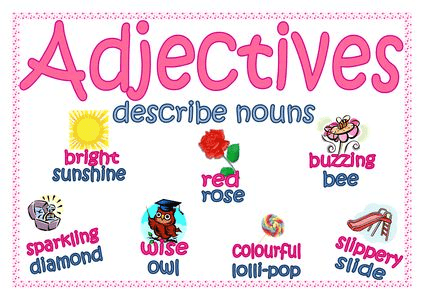
- Adjectives are words that describe nouns (people, places, things, or animals). They tell us more about them.
- Essentially, they are “describing words.”
- Purpose:
- To make sentences more interesting and descriptive.
- To help us paint a clearer picture in our minds.
Common Types of Adjectives for Class 1:
- Colors:
- red, blue, green, yellow, etc.
- Sizes:
- big, small, tall, short, etc.
- Shapes:
- round, square, etc.
- Feelings:
- happy, sad, angry, etc.
- Qualities:
- soft, hard, loud, quiet, etc.
- Numbers:
- one, two, many, few.
How to Teach Adjectives to Class 1:
- Use Visuals:
- Show pictures of objects and ask children to describe them.
- Use colorful flashcards.
- Engage in Activities:
- Play games like “I Spy” using adjectives.
- Have children describe their favorite toys or animals.
- Simple Sentences:
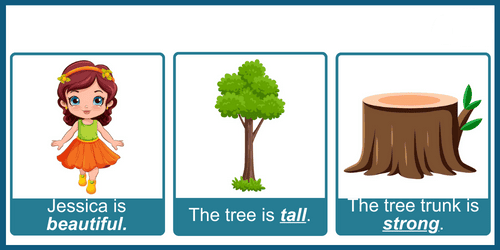
- Use simple sentences with adjectives: “The ball is red.” “The cat is soft.”
- Real-Life Examples:
- Point out adjectives in everyday situations.
Key Points for Class 1:
Use plenty of examples.
Keep it simple and fun.
Focus on common, easy-to-understand adjectives.
What is Required Class 1 Adjectives
Courtesy- EducationalVideos
When considering “required” adjectives for Class 1, it’s less about strict requirements and more about establishing a foundational understanding of descriptive language. The focus is on common, easily grasped concepts that build a base for future learning. Here’s a breakdown of what’s typically emphasized:
Core Concepts:
- Understanding the Function:
- The primary goal is for children to understand that adjectives describe nouns.
- They should recognize that these words add detail and help create mental images.
- Basic Descriptive Categories:
- Colors: Essential for describing objects. (e.g., red, blue, green)
- Sizes: Crucial for understanding relative dimensions. (e.g., big, small, tall)
- Shapes: Introduces basic geometric concepts. (e.g., round, square)
- Qualities: Helps children express sensory experiences. (e.g., soft, hard, hot, cold)
- Feelings: Develops emotional vocabulary. (e.g., happy, sad)
- Numbers (basic): Introduces the concept of quantity. (e.g., one, two, many)
Why These Are Emphasized:
- Everyday Relevance:
- These adjective categories are frequently used in daily conversation, making them immediately applicable.
- Visual and Sensory Connection:
- Colors, sizes, shapes, and qualities are easily visualized and connected to sensory experiences, which is crucial for young learners.
- Foundation for Further Learning:
- These basic concepts provide a solid foundation for understanding more complex adjective types later on.
Teaching Approach:
- The emphasis is on practical application through:
- Visual aids (pictures, flashcards)
- Interactive activities (games, object descriptions)
- Simple sentence construction.
In essence, “required” in this context means “most important and foundational” for building early literacy skills.
Who is Required Class 1 Adjectives
When we talk about “who is required” regarding Class 1 adjectives, we’re not referring to a person, but rather to the understanding that:
- Children in Class 1 are required to begin learning and understanding basic adjectives.
Here’s a breakdown:
- The “requirement” comes from the educational curriculum. In early education, building a strong foundation in language is crucial. This includes understanding parts of speech like adjectives.
- Therefore, it’s a requirement of the curriculum, and thus required of the students, to begin to learn these fundamental concepts.
- The goal is to equip young learners with the ability to:
- Describe their surroundings.
- Express their thoughts and feelings.
- Develop their vocabulary.
- Improve their communication skills.
In essence, the “requirement” is placed on the educational process itself, with the aim of benefiting the children’s language development.
When is Required Class 1 Adjectives
The “when” of required Class 1 adjectives aligns with the early stages of a child’s formal education. Here’s a more detailed look:
- Early Elementary Years:
- Specifically, when children enter Class 1 (typically around 6-7 years old), they begin formal instruction in basic grammar concepts.
- This is when the curriculum introduces them to the idea of describing words and the function of adjectives.
- Foundation for Language Development:
- This early introduction is crucial for building a strong foundation in language skills.
- Learning adjectives helps children:
- Expand their vocabulary.
- Improve their ability to communicate effectively.
- Develop their descriptive abilities.
- Continuous Learning:
- While the initial introduction happens in Class 1, the understanding and use of adjectives continue to develop throughout their education.
- As they progress, they will encounter more complex adjective types and learn to use them in various contexts.
- Throughout Daily life:
- It is also important to note that children are exposed to, and begin to use, adjectives in their daily speech well before they enter formal schooling. So, while formal education begins in class 1, the use of adjectives starts much earlier.
In summary, the “when” is during the early elementary years, particularly in Class 1, as part of the foundational language curriculum, but it is also a skill that is being developed from early childhood.
Where is Required Class 1 Adjectives
When considering “where” Class 1 adjectives are required, it’s important to understand it in a few contexts:
- In the Classroom:
- The primary “where” is within the educational setting, specifically in the Class 1 English curriculum. This means:
- In textbooks and workbooks.
- During lessons and activities.
- In assessments and exercises.
- The primary “where” is within the educational setting, specifically in the Class 1 English curriculum. This means:
- In Language Use:
- Beyond the classroom, adjectives are “required” in everyday language:
- In spoken communication, to describe objects, people, and experiences.
- In written communication, to create vivid and descriptive texts.
- In reading, to understand descriptions in stories and informational texts.
- Beyond the classroom, adjectives are “required” in everyday language:
- In Cognitive Development:
- “Where” also refers to the development of cognitive abilities:
- In the child’s mind, as they learn to categorize and describe the world around them.
- In their ability to express themselves and communicate effectively.
- “Where” also refers to the development of cognitive abilities:
Essentially, Class 1 adjectives are “required” in any situation where language is used to describe and understand the world. This includes:
- Formal education.
- Daily communication.
- The development of language skills.
How is Required Class 1 Adjectives
The “how” of teaching required Class 1 adjectives focuses on methods that are engaging, age-appropriate, and effective for young learners. Here’s a breakdown of common approaches:
1. Visual Learning:
- Flashcards: Using colorful flashcards with pictures of objects and corresponding adjectives (e.g., a red apple, a big elephant).
- Real Objects: Bringing in real objects for children to describe (e.g., a soft teddy bear, a hard block).
- Pictures and Illustrations: Using picture books and illustrations to show examples of adjectives in context.
- Interactive Whiteboards: Utilizing interactive whiteboards for engaging visual activities and games.
2. Active Engagement:
- Games:
- “I Spy”: Playing “I Spy” with adjectives (e.g., “I spy something blue”).
- Adjective Charades: Acting out adjectives for others to guess.
- Matching Games: Matching adjective cards with picture cards.
- Storytelling: Reading stories and asking children to identify the adjectives used to describe characters and objects.
- Descriptive Activities:
- Having children describe their favorite toys, animals, or foods.
- Asking children to describe their feelings using adjectives.
- Sensory Experiences: Engaging multiple senses by having children touch, smell, and see objects, and then describe them.
3. Simple and Repetitive Language:
- Simple Sentences: Using simple sentences with adjectives (e.g., “The cat is black,” “The sun is hot”).
- Repetition: Repeating adjectives in different contexts to reinforce learning.
- Chants and Songs: Using chants and songs to make learning adjectives fun and memorable.
4. Contextual Learning:
- Connecting to Real-Life Experiences: Relating adjectives to children’s everyday experiences.
- Using Examples from the Classroom: Pointing out examples of adjectives in the classroom environment.
5. Positive Reinforcement:
- Encouraging Participation: Creating a supportive and encouraging learning environment.
- Praising Effort: Praising children for their efforts to use adjectives correctly.
Key Principles:
- Keep it fun and interactive.
- Use concrete examples.
- Focus on common, everyday adjectives.
- Provide plenty of opportunities for practice.
- Make sure to include all of the childs senses.
By using these methods, teachers can effectively introduce and reinforce the concept of adjectives in a way that is engaging and meaningful for Class 1 students.
Case Study on Class 1 Adjectives
Courtesy- Tutoring Hour
Creating a case study on Class 1 adjectives involves observing and analyzing how young children learn and apply these descriptive words. Here’s a framework and some key elements to consider:
Case Study Focus:
- Objective:
- To understand how Class 1 students grasp the concept of adjectives.
- To identify effective teaching methods for introducing adjectives.
- To observe the progression of students’ adjective usage.
- Participants:
- A group of Class 1 students.
- Ideally, a diverse group to observe varying learning styles.
- Setting:
- A classroom environment.
- Potentially, observations during playtime or other activities.
Data Collection:
- Observations:
- Record instances of students using adjectives in speech and writing.
- Note the types of adjectives used (colors, sizes, feelings, etc.).
- Observe students’ reactions to different teaching methods.
- Activities:
- Design activities that encourage adjective usage (e.g., describing pictures, objects, or feelings).
- Analyze students’ responses and identify patterns.
- Assessments:
- Use simple quizzes or exercises to assess students’ understanding of adjectives.
- Track students’ progress over time.
- Teacher Interviews:
- Record the methods that the teacher uses.
- Record any observations that the teacher has about the students progress.
Key Areas of Observation:
- Initial Understanding:
- How easily do students grasp the concept of “describing words”?
- What are their initial challenges?
- Vocabulary Development:
- How quickly do students expand their adjective vocabulary?
- Which types of adjectives do they use most frequently?
- Application:
- How effectively do students use adjectives in their own speech and writing?
- Can they apply adjectives in different contexts?
- Engagement:
- Which teaching methods are most engaging and effective?
- How do different activities impact students’ learning?
Example Scenario:
- A teacher introduces adjectives using colorful flashcards and real objects.
- Students participate in an “I Spy” game, describing objects using adjectives.
- The teacher reads a story and asks students to identify the adjectives used to describe characters and settings.
- Observations reveal that students are most engaged during interactive games and activities.
- Assessments show a gradual increase in students’ ability to identify and use adjectives.
Analysis and Conclusion:
- Analyze the collected data to identify patterns and trends.
- Draw conclusions about the effectiveness of different teaching methods.
- Provide recommendations for improving the teaching of adjectives in Class 1.
Important Considerations:
- Age-Appropriateness: Ensure that activities and assessments are appropriate for young learners.
- Individual Differences: Recognize that students learn at different paces.
- Positive Reinforcement: Create a supportive and encouraging learning environment.
By following this framework, you can conduct a valuable case study on Class 1 adjectives and gain insights into how young children develop their language skills.
White paper on Class 1 Adjectives
Foundational Adjective Acquisition in Class 1
Abstract:
This white paper examines the critical role of adjective acquisition in Class 1 students’ early literacy development. It explores the cognitive and linguistic benefits of introducing basic descriptive language, analyzes effective teaching methodologies, and addresses common challenges faced by educators. This paper aims to provide educators and curriculum developers with practical insights and strategies for fostering a strong foundation in adjective usage among young learners.
1. Introduction:
Early childhood education lays the groundwork for future academic success. In Class 1, students begin to develop essential language skills, including vocabulary expansion and sentence construction. Adjectives, as descriptive words, play a crucial role in enriching language and enhancing communication. This paper argues that a focused and engaging approach to adjective instruction is vital for developing children’s expressive abilities and comprehension skills.
2. Cognitive and Linguistic Benefits:
- Vocabulary Expansion: Adjectives introduce children to a wider range of words, enabling them to express themselves more precisely.
- Descriptive Language Development: Learning adjectives allows children to create vivid mental images and communicate their observations effectively.
- Enhanced Comprehension: Understanding adjectives improves children’s ability to interpret and understand written and spoken language.
- Cognitive Categorization: Identifying and using adjectives helps children categorize objects and experiences based on their attributes.
- Improved Sentence Structure: Adjectives add detail and complexity to simple sentences, contributing to more sophisticated language usage.
3. Effective Teaching Methodologies:
- Visual Learning:
- Utilize colorful flashcards, picture books, and real objects to illustrate adjective concepts.
- Employ visual aids to connect abstract concepts to concrete examples.
- Interactive Activities:
- Engage students in games like “I Spy,” adjective charades, and matching activities.
- Incorporate storytelling and role-playing to provide context for adjective usage.
- Sensory Experiences:
- Provide opportunities for students to explore objects through touch, smell, and sight, and then describe their experiences.
- Use sensory activities to reinforce the connection between adjectives and sensory qualities.
- Repetition and Reinforcement:
- Repeat adjectives in different contexts to solidify understanding.
- Use simple sentences and chants to make learning fun and memorable.
- Contextual Learning:
- Connect adjective instruction to real-life experiences and classroom activities.
- Encourage students to use adjectives in their daily conversations.
- Technology Integration:
- Use interactive whiteboards and educational apps to provide engaging and interactive adjective lessons.
4. Common Challenges and Solutions:
- Limited Attention Spans:
- Solution: Break down lessons into short, engaging segments. Use a variety of activities to maintain interest.
- Varied Learning Styles:
- Solution: Employ a diverse range of teaching methods to cater to different learning preferences.
- Abstract Concepts:
- Solution: Use concrete examples and visual aids to make abstract concepts more tangible.
- Vocabulary Disparities:
- Solution: Differentiate instruction to address varying vocabulary levels. Provide extra support for students who require it.
- Assessment Difficulties:
- Solution: Use observational assessments, interactive games, and simple worksheets to evaluate understanding.
5. Curriculum Integration:
- Integrate adjective instruction into existing curriculum areas, such as reading, writing, and science.
- Use picture books and stories to introduce and reinforce adjective concepts.
- Encourage students to use adjectives in their writing and oral presentations.
6. Conclusion:
Effective adjective acquisition in Class 1 is essential for building a strong foundation in language development. By employing engaging teaching methodologies and addressing common challenges, educators can empower young learners to become confident and expressive communicators. This white paper highlights the importance of a focused and comprehensive approach to adjective instruction, emphasizing the cognitive and linguistic benefits that contribute to students’ overall academic success.
7. Recommendations:
- Provide ongoing professional development for teachers on effective adjective instruction.
- Develop and utilize age-appropriate resources and materials.
- Create a supportive and engaging learning environment that encourages exploration and experimentation.
- Implement formative assessments frequently to monitor student progress.
- Encourage parent involvement, by providing at home activities that reinforce the material.
Industrial Application of Class 1 Adjectives
Courtesy- Inspired by Kinder
While “Class 1 adjectives” refers to the basic descriptive words taught to young children, the underlying concept of using adjectives is absolutely vital in industrial applications. Here’s how:
1. Product Description and Marketing:
- Detailed Specifications:
- Industries rely on precise descriptions. Adjectives like “durable,” “high-performance,” “corrosion-resistant,” and “lightweight” are crucial for conveying product qualities.
- For example, in the automotive industry, adjectives describe vehicle features: “fuel-efficient engine,” “spacious interior,” “advanced safety features.”
- Marketing and Branding:
- Adjectives create compelling narratives. “Innovative solutions,” “reliable service,” and “premium quality” are used to attract customers.
- Food industry marketing uses adjectives like “delicious,” “fresh,” and “organic.”
2. Quality Control and Manufacturing:
- Material Properties:
- Industries use adjectives to define material characteristics: “tensile strength,” “thermal conductivity,” “surface smoothness.”
- In construction, adjectives describe materials: “reinforced concrete,” “weatherproof sealant.”
- Process Control:
- Adjectives describe manufacturing processes: “precise machining,” “automated assembly,” “efficient production.”
- Descriptions of product defects utilize adjectives such as “cracked”, “warped”, or “defective”.
3. Technical Documentation and Communication:
- Technical Manuals:
- Adjectives provide clear instructions: “tighten the loose bolt,” “inspect the damaged component.”
- Scientific Reports:
- Researchers use adjectives to describe experimental results: “significant increase,” “negligible variation.”
- Safety Instructions:
- “Hazardous materials”, “flammable liquids”, and “protective equipment” are all examples of how adjectives are used to communicate safety.
4. Design and Engineering:
- Product Design:
- Engineers use adjectives to define design requirements: “ergonomic design,” “aerodynamic shape,” “modular construction.”
- Software Development:
- Programmers use adjectives to describe software features: “user-friendly interface,” “secure data storage,” “scalable architecture.”
In essence:
- Industries depend on clear and precise communication.
- Adjectives are essential for conveying specific qualities, characteristics, and properties.
- From product development to marketing and quality control, adjectives play a vital role in industrial processes.
Therefore, although the begining of learning adjectives starts in early childhood education, the use of those skills are used through all parts of life, and especially in industrial settings.
References
- ^ Aarts, Bas, et al. The Oxford Dictionary of English Grammar. 2nd ed., Oxford University Press, 2014, doi:10.2307/3723099.
- ^ Leech, Geoffrey N. A Glossary of English Grammar. Edinburgh UP, 2006. ISBN 0-7486-2691-3.
- ^ Matthews, P. H. The Concise Oxford Dictionary of Linguistics. 3rd ed., Oxford University Press, 2014, doi:10.1093/acref/9780199675128.001.0001. ISBN 978-0-19-967512-8.
- ^ Jump up to:a b Huddleston, Rodney, Geoffrey K. Pullum, and Brett Reynolds. A Student’s Introduction to English Grammar. 2nd ed., Cambridge University Press, 2022. p.157.
- ^ Huddleston, Rodney, and Geoffrey K. Pullum. The Cambridge Grammar of the English Language. Cambridge University Press, 2002. p. 57.
- ^ Aarts, Bas. Oxford Modern English Grammar. Oxford University Press, 2011. pp. 134–135.
- ^ Lobeck, Anne, and Kristin Denham. Navigating English Grammar. Wiley-Blackwell, 2014. p. 154.
- ^ Jump up to:a b c Aarts, Bas. Oxford Modern English Grammar. Oxford University Press, 2011. pp. 136–138.
- ^ Huddleston, Rodney D., Geoffrey K. Pullum, and Brett Reynolds. A Student’s Introduction to English Grammar. 2nd ed., Cambridge University Press, 2022. pp.165–169.
- ^ Jump up to:a b Aarts, Bas. Oxford Modern English Grammar. Oxford University Press, 2011. pp. 97–100.
- ^ Huddleston, Rodney, and Geoffrey K. Pullum. The Cambridge Grammar of the English Language. Cambridge University Press, 2002. pp. 528–531.
- ^ Jump up to:a b Huddleston, Rodney, and Geoffrey K. Pullum. The Cambridge Grammar of the English Language. Cambridge University Press, 2002. pp. 550–553.
- ^ Aarts, Bas. Oxford Modern English Grammar. Oxford University Press, 2011. p. 153.
- ^ Eckersley, C. E., and J. M Eckersley. A Comprehensive English Grammar for Foreign Students. Longman, 1960. p. 58.
- ^ Zwicky, Arnold M. “Heads.” Journal of Linguistics, vol. 21, no. 1, 1985, pp. 1–29. JSTOR 4175761.
- ^ Jump up to:a b c d Aarts, Bas. Syntactic Gradience: The Nature of Grammatical Indeterminacy. Oxford University Press, 2007. pp. 129–136.
- ^ Huddleston, Rodney, and Geoffrey K. Pullum. The Cambridge Grammar of the English Language. Cambridge University Press, 2002. p. 332.
- ^ Jump up to:a b c d e f g h i j k l Garner, Bryan A. The Chicago Guide to English Grammar, Usage, and Punctuation. University of Chicago Press, 2016. pp. 58–60.
- ^ “The Longman Dictionary of Contemporary English”. Longman Dictionary of Contemporary English Online.
- ^ Matthews, P. H. The Positions of Adjectives in English. Oxford University Press, 2014. p. 136.
- ^ Matthews, P. H. (2014), The Positions of Adjectives in English, Oxford University Press, p. 173, doi:10.1093/acprof:oso/9780199681594.001.0001, ISBN 978-0-19-968159-4
- ^ Huddleston, Rodney, and Geoffrey K. Pullum. The Cambridge Grammar of the English Language. Cambridge University Press, 2002. p. 531–532.
- ^ Huddleston, Rodney, and Geoffrey K. Pullum. The Cambridge Grammar of the English Language. Cambridge University Press, 2002. p. 435.
- ^ Huddleston, Rodney, and Geoffrey K. Pullum. The Cambridge Grammar of the English Language. Cambridge University Press, 2002. p. 907.
- ^ Lobeck, Anne, and Kristin Denham. Navigating English Grammar. Wiley-Blackwell, 2014. pp. 152–154.
- ^ Bauer, Laurie. English Word-Formation. Cambridge University Press, 1983. p. 224.
- ^ Bauer, Laurie. English Word-Formation. Cambridge University Press 1983. p. 222.
- ^ Aarts, Bas. Oxford Modern English Grammar. Oxford University Press, 2011. pp. 42–44, 63–64.
- ^ McCawley, James D. The Syntactic Phenomena of English. Second ed., University of Chicago Press, 1998. pp. 767–769.
- ^ Huddleston, Rodney; Pullum, Geoffrey K.; Reynolds, Brett (2022). A student’s introduction to English grammar (2nd ed.). Cambridge, United Kingdom: Cambridge University Press. pp. 161–163. ISBN 978-1-009-08574-8. OCLC 1255520272.
- ^ Huddleston, Rodney, and Geoffrey K. Pullum. The Cambridge Grammar of the English Language. Cambridge University Press, 2002. p. 353.
- ^ Huddleston, Rodney; Pullum, Geoffrey K. (2002). The Cambridge Grammar of the English Language. Cambridge, UK: Cambridge University Press. p. 355. ISBN 0-521-43146-8. OCLC 46641801.
- ^ Huddleston, Rodney; Pullum, Geoffrey K. (2002). The Cambridge Grammar of the English Language. Cambridge, UK: Cambridge University Press. p. 416. ISBN 0-521-43146-8. OCLC 46641801.
- ^ Von Heusinger, Klaus (2002-08-01). “Specificity and Definiteness in Sentence and Discourse Structure”. Journal of Semantics. 19 (3): 246. doi:10.1093/jos/19.3.245.
- ^ Matthews, P. H. The Positions of Adjectives in English. Oxford University Press, 2014. p. 136.
- ^ Partee, Barbara “Lexical Semantics and Compositionality”. An Invitation to Cognitive Science: Language, edited by Lila Gleitman et al., MIT Press, 1995, doi:10.7551/mitpress/3964.003.0015.
- ^ Bauer, Laurie. “Adjectives, Compounds, and Words.” Nordic Journal of English Studies, vol. 3, no. 1, pp.7–22, doi:10.35360/njes.18.
- Trask, R.L. (2013). A Dictionary of Grammatical Terms in Linguistics. Taylor & Francis. p. 188. ISBN 978-1-134-88420-9.
- ^ adjectivus. Charlton T. Lewis and Charles Short. A Latin Dictionary on Perseus Project.
- ^ ἐπίθετος. Liddell, Henry George; Scott, Robert; A Greek–English Lexicon at the Perseus Project
- ^ Mastronarde, Donald J. Introduction to Attic Greek. University of California Press, 2013. p. 60.
- ^ McMenomy, Bruce A. Syntactical Mechanics: A New Approach to English, Latin, and Greek. University of Oklahoma Press, 2014. p. 8.
- ^ Jump up to:a b See: “Attributive and predicative adjectives” at Lexico, archived 15 May 2020.
- ^ Jump up to:a b Bowern, Claire (2013). A grammar of Bardi. Berlin: De Gruyter Mouton. ISBN 978-3-11-027818-7. OCLC 848086054.
- ^ Simpson, Jane (6 December 2012). Warlpiri Morpho-Syntax : a Lexicalist Approach. Dordrecht: Springer Netherlands. ISBN 978-94-011-3204-6. OCLC 851384391.
- ^ Jump up to:a b c Order of adjectives, British Council.
- ^ R.M.W. Dixon, “Where Have all the Adjectives Gone?” Studies in Language 1, no. 1 (1977): 19–80.
- ^ Dowling, Tim (13 September 2016). “Order force: the old grammar rule we all obey without realising”. The Guardian.
- ^ Adjectives: order (from English Grammar Today), in the Cambridge Advanced Learner’s Dictionary online
- ^ R. Declerck, A Comprehensive Descriptive Grammar of English (1991), p. 350: “When there are several descriptive adjectives, they normally occur in the following order: characteristic – size – shape – age – colour – […]”
- ^ Partee, Barbara (1995). “Lexical semantics and compositionality”. In Gleitman, Lila; Liberman, Mark; Osherson, Daniel N. (eds.). An Invitation to Cognitive Science: Language. The MIT Press. doi:10.7551/mitpress/3964.003.0015. ISBN 978-0-262-15044-6.