Class 1 Subtraction- When teaching Class 1 subtraction, the focus is on building a foundational understanding of the concept. Here’s a breakdown of key aspects:
Core Concepts:
- Understanding “Taking Away”:
- Subtraction is introduced as the action of removing objects from a group.
- Visual aids like pictures, counters, or number lines are essential.
- Single-Digit Subtraction:
- Children learn to subtract numbers within 10.
- Emphasis is placed on mastering basic subtraction facts (e.g., 5 – 2 = 3).
- Number Lines:
- Number lines help visualize subtraction as moving backward.
- Word Problems:
- Simple word problems introduce real-life applications of subtraction.
- Examples: “If you have 5 apples and eat 2, how many are left?”
Key Learning Objectives:
- To understand the meaning of subtraction.
- To subtract single-digit numbers.
- To use number lines to represent subtraction.
- To solve simple subtraction word problems.
Teaching Strategies:
- Hands-on Activities: Using manipulatives like counters or blocks makes learning concrete.
- Visual Aids: Pictures and number lines help children visualize the process.
- Games and Activities: Engaging games make learning fun and reinforce concepts.
- Real-Life Examples: Connecting subtraction to everyday situations helps children understand its relevance.
Where to find resources:
- Educational Websites: Websites like Khan Academy, K5 Learning, and BYJU’S offer worksheets and interactive activities.
- Worksheets: Printable worksheets provide practice opportunities.
In Class 1, the goal is to create a solid foundation for future math learning.
What is Required Class 1 Subtraction
Courtesy- Learning Notebook
In Class 1 subtraction, the focus is on building a fundamental understanding of what “taking away” means. Here’s a breakdown of the key requirements:
Core Skills and Concepts:
- Understanding the Concept of Subtraction:
- This involves grasping that subtraction means “taking away,” “reducing,” or “finding the difference.”
- Using concrete objects (like blocks or counters) and visual aids (like pictures or number lines) is crucial for this understanding.
- Single-Digit Subtraction Within 10:
- Students need to become proficient in subtracting single-digit numbers from numbers within 10.
- This includes memorizing basic subtraction facts (e.g., 5 – 2 = 3, 8 – 3 = 5).
- Using Number Lines:
- Number lines are used to visualize subtraction as moving backward along the line.
- This helps children understand the relationship between numbers and their relative positions.
- Solving Simple Word Problems:
- Students should be able to apply their subtraction skills to solve basic word problems.
- These problems should involve real-life scenarios that make subtraction relevant.
- Understanding Subtraction Symbols:
- Recognizing and understanding the minus (-) and equals (=) symbols.
Key Educational Goals:
- Develop a strong foundation in basic subtraction.
- Build problem-solving skills.
- Foster a positive attitude towards mathematics.
Essentially, Class 1 subtraction is about laying the groundwork for more advanced mathematical concepts.
Who is Required Class 1 Subtraction
When we talk about “who is required Class 1 subtraction,” we’re essentially talking about:
- Class 1 Students:
- The primary group required to learn Class 1 subtraction is, of course, the students themselves. It’s a fundamental part of their early math education.
- The goal is to provide them with the basic tools they need to understand and apply subtraction.
- Educators:
- Teachers are required to teach the concepts of subtraction to Class 1 students. This involves:
- Understanding the curriculum.
- Creating engaging lesson plans.
- Providing appropriate resources and support.
- Assessing the students progress.
- Teachers are required to teach the concepts of subtraction to Class 1 students. This involves:
- Parents/Guardians:
- Parents and guardians play a vital role in reinforcing subtraction concepts at home. This can involve:
- Helping with homework.
- Providing extra practice.
- Making math fun and relevant to everyday life.
- Parents and guardians play a vital role in reinforcing subtraction concepts at home. This can involve:
- The Educational System:
- The overall educational system (schools, curriculum developers, etc.) is responsible for:
- Setting the standards for what students should learn.
- Providing the necessary resources and support.
- The overall educational system (schools, curriculum developers, etc.) is responsible for:
In summary, it’s a collaborative effort involving students, teachers, parents, and the educational system to ensure that Class 1 students grasp the essential concepts of subtraction.
When is Required Class 1 Subtraction

The “when” of required Class 1 subtraction is tied to the developmental stage of children and the structure of early elementary education. Here’s a breakdown:
- Age and Developmental Stage:
- Typically, Class 1 corresponds to children around 5-6 years old. At this age, children are beginning to develop their cognitive abilities to understand abstract concepts like subtraction.
- They are also developing their ability to count and understand number relationships.
- Early Elementary Curriculum:
- In most educational systems, basic arithmetic operations like addition and subtraction are introduced in the early elementary years.
- Class 1 is a crucial time for building this foundational understanding.
- The curriculum is designed to introduce these concepts in a gradual and age-appropriate manner.
- Progression of Mathematical Learning:
- Subtraction is introduced after children have a basic understanding of counting and number recognition.
- It lays the groundwork for more advanced mathematical concepts that will be taught in later grades.
- Therefore, it is required in the time that children are in their first grade of formal education.
- The Importance of Early Introduction:
- Early exposure to subtraction helps children develop problem-solving skills and logical thinking.
- It also helps them to understand the relationship between numbers and quantities.
In essence, Class 1 subtraction is required during the early years of formal education, when children are developmentally ready to grasp these fundamental mathematical concepts.
Where is Required Class 1 Subtraction
Class 1 subtraction is a fundamental skill that’s required in various learning environments, primarily:
- In Schools:
- This is the most obvious place. Class 1 subtraction is a core part of the mathematics curriculum in elementary schools worldwide.
- It’s taught in classrooms, during math lessons, and reinforced through worksheets and activities.
- At Home:
- Parents and guardians play a crucial role in reinforcing subtraction skills at home.
- This can involve helping with homework, practicing with everyday objects, and playing math-related games.
- In Educational Resources:
- Subtraction skills are taught through various educational resources, including:
- Textbooks
- Workbooks
- Online learning platforms
- Educational apps
- Subtraction skills are taught through various educational resources, including:
- In Everyday Life:
- While not a formal “location,” it’s important to recognize that subtraction skills are used in countless everyday situations.
- Children encounter subtraction when:
- Sharing toys
- Counting money
- Solving simple problems
Essentially, Class 1 subtraction is required in any environment where children are learning basic mathematical concepts. This includes formal educational settings and informal, everyday situations.
How is Required Class 1 Subtraction
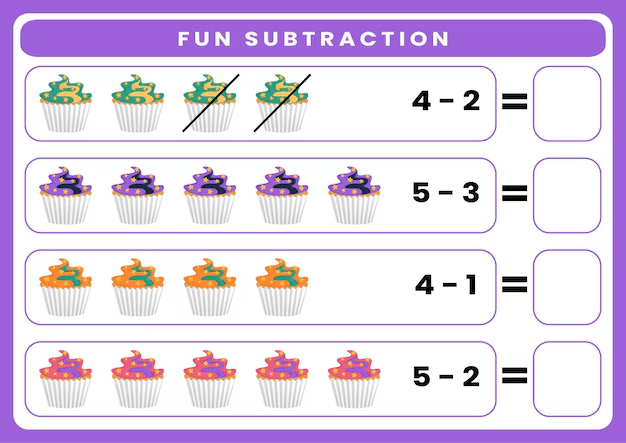
Teaching Class 1 subtraction effectively involves a variety of strategies that cater to young learners’ developmental needs. Here’s a breakdown of how it’s typically approached:
Key Teaching Methods:
- Concrete Manipulatives:
- Using physical objects like counters, blocks, or even fingers allows children to visualize the “taking away” process. This hands-on approach makes the abstract concept of subtraction more tangible.
- Visual Representations:
- Number lines, drawings, and pictures are essential tools.
- Number lines help children see subtraction as movement backward, while drawings allow them to cross out items and visualize the remaining quantity.
- Storytelling and Word Problems:
- Creating simple, relatable stories that involve subtraction helps children understand its practical applications.
- For example, “If you have 5 cookies and eat 2, how many do you have left?”
- Games and Activities:
- Engaging games make learning fun and reinforce subtraction facts.
- These can include card games, board games, or online interactive activities.
- Relating to Real-Life Situations:
- Connecting subtraction to everyday experiences helps children see its relevance.
- Examples: sharing toys, counting snacks, or calculating the remaining time.
- Building on Addition:
- Highlighting the inverse relationship between addition and subtraction can deepen understanding.
- For example, if 2 + 3 = 5, then 5 – 3 = 2.
- Gradual Progression:
- Starting with simple subtraction within small numbers (e.g., within 5) and gradually increasing the difficulty.
- Focusing on mastering basic subtraction facts before moving on to more complex problems.
Important Considerations:
- Patience and Repetition: Young children may need repeated exposure to concepts before they fully grasp them.
- Positive Reinforcement: Encouraging and praising effort is crucial for building confidence.
- Individualized Learning: Recognizing that children learn at different paces and providing appropriate support.
By combining these methods, educators can create a supportive and engaging learning environment that helps Class 1 students develop a solid foundation in subtraction.
Case Study on Class 1 Subtraction
Courtesy- LoveToLearn with Subhashini Balakrishnan
Mastering Subtraction in Class 1 – Sarah’s Journey
Student Profile:
- Name: Sarah
- Age: 6
- Class: 1
- Initial Challenge: Sarah struggled to grasp the concept of subtraction. She relied heavily on counting all objects and found it difficult to visualize “taking away.” She also had difficulty understanding word problems related to subtraction.
Initial Assessment:
- Sarah could count to 10 but struggled with backward counting.
- When presented with a simple subtraction problem like 5 – 2, she would count out 5 objects, then remove 2, and recount the remaining objects. This was time-consuming and prone to errors.
- She showed little understanding of the minus (-) symbol.
- Word problems were particularly challenging, as she couldn’t translate the verbal scenario into a mathematical operation.
Intervention Strategy:
- Concrete Manipulatives:
- The teacher introduced counters, blocks, and number rods.
- Sarah was encouraged to physically remove objects to demonstrate subtraction.
- For example, for 5 – 2, she would place 5 counters, take away 2, and then count the remaining 3.
- Visual Representations:
- Number lines were used to visualize subtraction as moving backward.
- The teacher drew pictures of objects and demonstrated crossing them out to represent “taking away.”
- Sarah was encouraged to draw her own pictures to solve problems.
- Storytelling and Real-Life Scenarios:
- The teacher created simple, engaging stories involving subtraction.
- Examples: “Sarah had 4 apples and gave 1 to her friend. How many apples does Sarah have left?”
- Real-life examples were incorporated, such as sharing snacks or toys.
- Games and Activities:
- “Subtraction Bingo” and “Number Line Hop” were used to make learning fun.
- Card games involving subtraction facts were introduced.
- Gradual Progression:
- The focus was initially on subtraction within 5, then gradually progressed to subtraction within 10.
- Emphasis was placed on mastering basic subtraction facts.
- One on one assistance:
- Sarah was given extra time, and one on one tutoring to reinforce the lessons that were taught in class.
Progress and Outcomes:
- Over several weeks, Sarah showed significant improvement.
- She became more comfortable using manipulatives and visual aids.
- She began to understand the concept of “taking away” and could solve simple subtraction problems more efficiently.
- She showed a better understanding of the minus (-) symbol.
- She was able to solve simple word problems by translating them into mathematical operations.
- Her confidence in math increased dramatically.
Key Learnings:
- Concrete manipulatives and visual aids are essential for teaching subtraction to young learners.
- Storytelling and real-life examples make learning more engaging and relevant.
- Games and activities can reinforce concepts and make learning fun.
- Gradual progression and individualized support are crucial for success.
- Patience and positive reinforcement are vital.
Conclusion:
Sarah’s case demonstrates that with targeted interventions and a focus on concrete learning experiences, Class 1 students can successfully master subtraction. By providing a supportive and engaging learning environment, educators can help children build a strong foundation in mathematics.
White paper on Class 1 Subtraction
Building Foundational Subtraction Skills in Class 1
Abstract:
This white paper explores the critical importance of developing strong subtraction skills in Class 1 students. It examines the cognitive development of young learners, effective teaching methodologies, common challenges, and strategies for fostering a robust understanding of subtraction. By providing a comprehensive overview of best practices, this paper aims to equip educators and parents with the tools necessary to support early mathematical development.
1. Introduction:
Subtraction is a fundamental arithmetic operation that forms the bedrock of mathematical understanding. In Class 1, children are introduced to the concept of “taking away,” laying the groundwork for more advanced mathematical concepts. This paper delves into the pedagogical approaches that facilitate this learning, addressing the unique challenges and opportunities presented at this developmental stage.
2. Cognitive Development and Subtraction:
- Concrete Operational Stage: Class 1 students are typically in the pre-operational to early concrete operational stage of cognitive development. This means they learn best through concrete experiences and visual representations.
- Number Sense: A strong foundation in number sense is crucial. Children need to understand number relationships, counting, and the concept of quantity before they can effectively grasp subtraction.
- Visual-Spatial Reasoning: Visual aids like number lines and manipulatives support visual-spatial reasoning, which is essential for understanding subtraction as a process of reducing quantity.
3. Effective Teaching Methodologies:
- Manipulatives:
- Counters, blocks, and number rods provide concrete representations of numbers, allowing children to physically “take away” quantities.
- This hands-on approach reinforces the abstract concept of subtraction.
- Visual Aids:
- Number lines help visualize subtraction as movement backward.
- Drawings and pictures allow children to cross out items, representing the “taking away” action.
- Storytelling and Word Problems:
- Contextualizing subtraction through stories and real-life scenarios makes it more relatable and meaningful.
- Simple word problems encourage children to translate verbal situations into mathematical operations.
- Games and Activities:
- Engaging games like “Subtraction Bingo” and “Number Line Hop” make learning fun and reinforce subtraction facts.
- Card games and online interactive activities provide varied learning experiences.
- Building on Addition:
- Highlighting the inverse relationship between addition and subtraction deepens understanding.
- For example, demonstrating that if 2 + 3 = 5, then 5 – 3 = 2.
- Gradual Progression:
- Begin with subtraction within small numbers (e.g., within 5) and gradually increase the difficulty to subtraction within 10.
- Mastering basic subtraction facts is essential before moving on to more complex problems.
4. Common Challenges and Solutions:
- Challenge: Difficulty visualizing “taking away.”
- Solution: Emphasize the use of manipulatives and visual aids.
- Challenge: Confusion with the minus (-) symbol.
- Solution: Repeatedly demonstrate the symbol’s meaning through concrete examples.
- Challenge: Difficulty solving word problems.
- Solution: Break down word problems into smaller steps, using visual aids and real-life examples.
- Challenge: Lack of number sense.
- Solution: Reinforce counting and number recognition activities.
- Challenge: Varied learning paces.
- Solution: Provide individualized support and differentiated instruction.
5. Assessment and Evaluation:
- Formative Assessment: Ongoing observation and informal assessments allow teachers to monitor student progress and adjust instruction accordingly.
- Summative Assessment: Worksheets, quizzes, and practical activities can be used to evaluate mastery of subtraction skills.
- Portfolio Assessment: Collecting student work samples over time can demonstrate growth and progress.
6. The Role of Parents and Guardians:
- Reinforcement at Home: Parents can reinforce subtraction skills through everyday activities, such as counting objects, sharing snacks, and playing math games.
- Positive Attitude: Encouraging a positive attitude towards math can boost children’s confidence and motivation.
- Communication with Teachers: Regular communication between parents and teachers ensures a consistent and supportive learning environment.
7. Conclusion:
Developing strong subtraction skills in Class 1 is crucial for building a solid foundation in mathematics. By implementing effective teaching methodologies, addressing common challenges, and fostering a collaborative learning environment, educators and parents can empower young learners to succeed in mathematics.
8. Recommendations:
- Provide ample opportunities for hands-on learning with manipulatives.
- Incorporate visual aids and real-life examples to make subtraction more concrete.
- Use games and activities to make learning fun and engaging.
- Provide individualized support to address diverse learning needs.
- Foster a positive and supportive learning environment.
- Encourage parent involvement.
Industrial Application of Class 1 Subtraction
Courtesy- Manav Sachar
While “Class 1 subtraction” refers to the basic, foundational understanding of subtraction taught to young children, the principles of subtraction are absolutely essential in countless industrial applications. Here’s how those basic concepts scale up:
Core Principles and Industrial Relevance:
- Measurement and Inventory:
- In manufacturing, subtraction is used to calculate differences in measurements, determine remaining stock, and track inventory levels. For example:
- Calculating the difference between a desired product length and the actual product length.
- Subtracting the number of items shipped from the total inventory.
- In manufacturing, subtraction is used to calculate differences in measurements, determine remaining stock, and track inventory levels. For example:
- Quality Control:
- Subtraction is used to determine deviations from specifications. For example:
- Calculating the difference between a product’s measured weight and its target weight.
- Determining the amount of material removed during a machining process.
- Subtraction is used to determine deviations from specifications. For example:
- Financial Transactions:
- Basic subtraction is fundamental to all financial transactions, including:
- Calculating profits and losses.
- Determining the remaining budget after expenses.
- Calculating discounts and deductions.
- Basic subtraction is fundamental to all financial transactions, including:
- Engineering and Design:
- Engineers use subtraction to calculate:
- Stress and strain on materials.
- Differences in pressure and temperature.
- Dimensions and tolerances in design.
- Engineers use subtraction to calculate:
- Computer Programming:
- Subtraction is a fundamental arithmetic operation in computer programming. It’s used in:
- Calculating differences between values.
- Implementing algorithms.
- Controlling processes.
- Subtraction is a fundamental arithmetic operation in computer programming. It’s used in:
- Logistics:
- Subtraction is used in logistics to calculate:
- Remaining delivery amounts.
- Time differences between delivery schedules.
- Weight differences in shipping.
- Subtraction is used in logistics to calculate:
How Basic Skills Translate:
Even though Class 1 subtraction focuses on simple numbers, it establishes the core understanding of:
- Quantity Reduction: This principle applies to everything from reducing raw materials in a production process to reducing errors in a system.
- Difference Calculation: This is essential for measuring variations, deviations, and changes in any industrial setting.
In essence, while the problems become much more complex, the fundamental concept of “taking away” remains a critical part of numerous industrial processes.
References
- ^ “What is to Subtract?”. SplashLearn. 28 April 2022. Retrieved 2022-12-13.
- ^ Jump up to:a b Weisstein, Eric W. “Subtraction”. mathworld.wolfram.com. Retrieved 2020-08-26.
- ^ Cutland, Nigel. Computability: an introduction to recursive function theory.
- ^ Jump up to:a b c Schmid, Hermann (1974). Decimal Computation (1 ed.). Binghamton, NY: John Wiley & Sons. ISBN 978-0-471-76180-8.
- ^ Jump up to:a b c Schmid, Hermann (1983) [1974]. Decimal Computation (1 (reprint) ed.). Malabar, FL: Robert E. Krieger Publishing Company. ISBN 978-0-89874-318-0.
- ^ “Subtraction”. www.mathsisfun.com. Retrieved 2020-08-26.
- ^ “Subtraction”. Oxford English Dictionary (Online ed.). Oxford University Press. (Subscription or participating institution membership required.)
- ^ Paul E. Peterson, Michael Henderson, Martin R. West (2014) Teachers Versus the Public: What Americans Think about Schools and How to Fix Them Brookings Institution Press, p. 163
- ^ Janet Kolodzy (2006) Convergence Journalism: Writing and Reporting across the News Media Rowman & Littlefield Publishers, p. 180
- ^ David Gillborn (2008) Racism and Education: Coincidence Or Conspiracy? Routledge p. 46
- ^ Klapper, Paul (1916). The Teaching of Arithmetic: A Manual for Teachers. pp. 80–. Retrieved 2016-03-11.
- ^ Susan Ross and Mary Pratt-Cotter. 2000. “Subtraction in the United States: An Historical Perspective,” The Mathematics Educator 8(1):4–11. p. 8: “This new version of the decomposition algorithm [i.e., using Brownell’s crutch] has so completely dominated the field that it is rare to see any other algorithm used to teach subtraction today [in America].”
- ^ Ross, Susan C.; Pratt-Cotter, Mary (1999). “Subtraction From a Historical Perspective”. School Science and Mathematics. 99 (7): 389–93. doi:10.1111/j.1949-8594.1999.tb17499.x.
- ^ Klapper 1916, pp. 177–.
- ^ David Eugene Smith (1913). The Teaching of Arithmetic. Ginn. pp. 77–. Retrieved 2016-03-11.
- ^ The Many Ways of Arithmetic in UCSMP Everyday Mathematics Archived 2014-02-25 at the Wayback Machine Subtraction: Trade First
- ^ Partial-Differences Subtraction Archived 2014-06-23 at the Wayback Machine; The Many Ways of Arithmetic in UCSMP Everyday Mathematics Archived 2014-02-25 at the Wayback Machine Subtraction: Partial Differences
- ^ The Many Ways of Arithmetic in UCSMP Everyday Mathematics Archived 2014-02-25 at the Wayback Machine Subtraction: Counting Up
- ^ The Many Ways of Arithmetic in UCSMP Everyday Mathematics Archived 2014-02-25 at the Wayback Machine Subtraction: Left to Right Subtraction
- ^ The Many Ways of Arithmetic in UCSMP Everyday Mathematics Subtraction: Same Change Rule
- “Comprehensive List of Algebra Symbols”. Math Vault. 2020-03-25. Retrieved 2020-08-26.
- ↑ Weisstein, Eric W. “Subtraction”. mathworld.wolfram.com. Retrieved 2020-08-26.
- ↑ “Subtraction”. www.mathsisfun.com. Retrieved 2020-08-26.
- Althöfer, Ingo; Bültermann, Jörg (1995), “Superlinear period lengths in some subtraction games”, Theoretical Computer Science, 148 (1): 111–119, doi:10.1016/0304-3975(95)00019-S, MR 1347670
- Berlekamp, Elwyn R.; Conway, John H.; Guy, Richard K. (2001), Winning Ways for your Mathematical Plays, vol. 1 (2nd ed.), A K Peters
- Bouton, Charles L. (1901–1902), “Nim, a game with a complete mathematical theory”, Annals of Mathematics, Second Series, 3 (1/4): 35–39, doi:10.2307/1967631, JSTOR 1967631
- Coxeter, H. S. M. (1953), “The golden section, phyllotaxis, and Wythoff’s game”, Scripta Mathematica, 19: 135–143, MR 0057548
- Eppstein, David (2018), “Faster evaluation of subtraction games”, in Ito, Hiro; Leonardi, Stefano; Pagli, Linda; Prencipe, Giuseppe (eds.), Proc. 9th International Conference on Fun with Algorithms (FUN 2018), Leibniz International Proceedings in Informatics (LIPIcs), vol. 100, Dagstuhl, Germany: Schloss Dagstuhl – Leibniz-Zentrum für Informatik, pp. 20:1–20:12, doi:10.4230/lipics.fun.2018.20
- Ferguson, T. S. (1974), “On sums of graph games with last player losing”, International Journal of Game Theory, 3 (3): 159–167, doi:10.1007/BF01763255, MR 0384169
- Golomb, Solomon W. (1966), “A mathematical investigation of games of “take-away””, Journal of Combinatorial Theory, 1 (4): 443–458, doi:10.1016/S0021-9800(66)80016-9, MR 0209015
- Larsson, Urban; Fox, Nathan (2015), “An aperiodic subtraction game of nim-dimension two” (PDF), Journal of Integer Sequences, 18 (7), Article 15.7.4, arXiv:1503.05751, MR 3370791
- Larsson, Urban; Rubinstein-Salzedo, Simon (2016), “Grundy values of Fibonacci nim”, International Journal of Game Theory, 45 (3): 617–625, arXiv:1410.0332, doi:10.1007/s00182-015-0473-y, MR 3538534
- Larsson, Urban; Wästlund, Johan (2013), “From heaps of matches to the limits of computability”, Electronic Journal of Combinatorics, 20 (3): P41:1–P41:12, arXiv:1202.0664, doi:10.37236/2244, MR 3118949
- Whinihan, Michael J. (1963), “Fibonacci nim” (PDF), Fibonacci Quarterly, 1 (4): 9–13
- Wythoff, W. A. (1907), “A modification of the game of nim”, Nieuw Archief voor Wiskunde, 7 (2): 199–202


