3D Printing/Additive Manufacturing
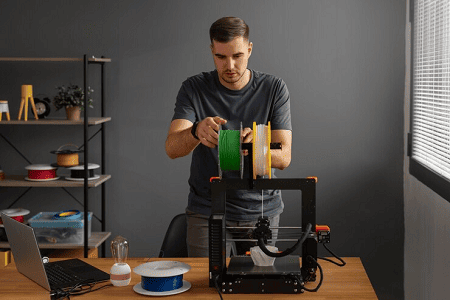
3D Printing, also known as Additive Manufacturing (AM), is a revolutionary technology that creates three-dimensional objects by building them layer by layer from a digital model. It is used across industries such as healthcare, aerospace, automotive, construction, and consumer goods. Below is an overview of key aspects of 3D Printing/Additive Manufacturing:
1. Process Overview:
- Design: A CAD (Computer-Aided Design) model is created or modified.
- Slicing: The CAD model is converted into layers using slicing software.
- Printing: The printer builds the object layer by layer using various materials.
- Post-Processing: Steps such as cleaning, curing, or finishing are applied to the printed object.
2. Key Technologies:
- Fused Deposition Modeling (FDM): Melts thermoplastic filaments to create layers.
- Selective Laser Sintering (SLS): Uses lasers to fuse powdered material.
- Stereolithography (SLA): Utilizes UV light to harden liquid resin.
- Direct Metal Laser Sintering (DMLS): Prints with metal powders for high-strength parts.
- Binder Jetting: Deposits a liquid binding agent onto a powder bed.
3. Materials:
- Plastics: ABS, PLA, Nylon, Polycarbonate.
- Metals: Titanium, Aluminum, Stainless Steel.
- Resins: Standard, Flexible, Durable, Transparent.
- Ceramics: Used in specialized applications.
- Composites: Materials reinforced with fibers or particles.
4. Advantages:
- Customization of designs for specific needs.
- Reduced material waste compared to subtractive manufacturing.
- Short production times and faster prototyping.
- Ability to create complex geometries.
- On-demand production and reduced inventory.
5. Limitations:
- Surface finish and mechanical properties may require post-processing.
- Limitations in material properties and availability.
- High initial cost of industrial-grade 3D printers.
- Longer print times for larger parts.
6. Applications:
- Healthcare: Prosthetics, implants, surgical tools.
- Aerospace & Defense: Lightweight, high-strength components.
- Automotive: Prototyping, end-use parts, tools.
- Consumer Goods: Custom products, jewelry, footwear.
- Construction: 3D-printed homes and structures.
- Education & Research: STEM education, innovation labs.
7. Future Trends:
- Multi-material Printing: Combining different materials in a single build.
- Bio-Printing: Printing human tissues and organs.
- Mass Customization: Large-scale production of personalized products.
- Sustainability: Recycling and use of eco-friendly materials.
- Digital Twins: Integration with Industry 4.0 for real-time manufacturing analytics.
Would you like detailed information on any specific aspect of 3D printing, such as standards (e.g., ISO/ASTM 52900 series), or how it applies to your industry?
What is 3D Printing/Additive Manufacturing ?
3D Printing, also known as Additive Manufacturing (AM), is an advanced manufacturing technique that creates three-dimensional objects by building them layer by layer. Unlike traditional manufacturing methods, which typically remove material (subtractive manufacturing), 3D printing adds material only where needed, based on a digital design.
How 3D Printing Works:
- Digital Design Creation:
- A 3D digital model is designed using CAD (Computer-Aided Design) software or obtained through 3D scanning.
- Slicing the Model:
- The model is converted into thin horizontal layers using slicing software, generating instructions for the printer.
- Printing Process:
- The printer constructs the object by depositing, fusing, or solidifying material layer by layer.
- Post-Processing:
- Printed objects often undergo finishing steps such as cleaning, sanding, painting, or heat treatment to enhance quality.
Key Characteristics of 3D Printing:
- Layered Construction: Objects are built one layer at a time.
- Material Efficiency: Minimal waste compared to subtractive manufacturing.
- Versatility: Capable of using diverse materials such as plastics, metals, ceramics, and bio-materials.
- Design Freedom: Complex geometries, lightweight structures, and intricate designs are achievable.
Technologies in 3D Printing:
- Fused Deposition Modeling (FDM):
Uses thermoplastic filaments to create layers. - Selective Laser Sintering (SLS):
A laser fuses powdered materials to form solid layers. - Stereolithography (SLA):
A UV laser cures liquid resin into solid layers. - Direct Metal Laser Sintering (DMLS):
Builds parts by sintering metal powder with a laser. - Binder Jetting:
A liquid binder is deposited on a powder bed to create objects.
Applications of 3D Printing:
- Healthcare: Customized prosthetics, implants, dental aligners, and surgical tools.
- Aerospace & Defense: Lightweight, high-strength components.
- Automotive: Rapid prototyping, tooling, and end-use parts.
- Consumer Products: Jewelry, footwear, home décor, and electronics.
- Construction: 3D-printed buildings and components.
- Education: Models for learning and research.
Advantages of 3D Printing:
- Customization: Tailored designs for specific needs.
- Reduced Waste: Material is only added where required.
- Rapid Prototyping: Speeds up the design iteration process.
- Complex Designs: Creates intricate structures not possible with traditional methods.
- Cost Efficiency: Low setup cost for small production runs.
Limitations of 3D Printing:
- Material Constraints: Limited selection of materials for some applications.
- Production Speed: Slower for large-scale production compared to conventional methods.
- Post-Processing Needs: Surface finish and mechanical properties may require additional work.
- Size Restrictions: Limited by the printer’s build volume.
Importance of 3D Printing in Modern Manufacturing:
3D printing is transforming industries by enabling innovations in product design, reducing supply chain complexities, and fostering sustainability through efficient material use. It’s a key component of Industry 4.0 and is poised to reshape how products are designed and manufactured in the future.
How is required 3D Printing/Additive Manufacturing ?
3D Printing/Additive Manufacturing is “required” or beneficial in various ways due to its unique capabilities, which allow it to meet specific needs in design, production, and innovation. Here’s how and why 3D printing is necessary in different contexts:
1. Rapid Prototyping and Iteration
- How is it required?
3D printing allows for fast, cost-effective prototyping of designs, enabling designers and engineers to quickly test, evaluate, and modify product concepts without the need for costly molds or tooling. - Why is it needed?
It speeds up the product development cycle, reduces time-to-market, and ensures that designs are optimized before final production. Traditional methods often require weeks or months for prototype production, whereas 3D printing can create a prototype in hours or days.
2. Customization and Personalization
- How is it required?
3D printing allows for the creation of bespoke products that meet individual specifications, from personalized jewelry and footwear to customized medical devices (e.g., prosthetics and dental implants). - Why is it needed?
It enables businesses to offer personalized solutions that traditional manufacturing can’t match due to its reliance on standardized processes and equipment. It also supports healthcare applications, where precise customization is crucial for patient-specific treatments.
3. Complex and Intricate Designs
- How is it required?
3D printing excels at producing complex shapes and geometries that would be impossible or highly expensive to achieve with traditional manufacturing methods (e.g., injection molding or machining). - Why is it needed?
Industries like aerospace, automotive, and healthcare require highly complex parts with intricate internal structures (e.g., lightweight lattice designs, cooling channels in engines, or anatomical models). These parts can be produced with ease using 3D printing.
4. Low-Volume and On-Demand Production
- How is it required?
3D printing can produce small batches or one-off parts efficiently without the setup costs typically associated with traditional manufacturing methods like molding or casting. - Why is it needed?
For industries or situations where high-volume production is unnecessary or impractical, 3D printing is a cost-effective solution. It is also useful for producing spare parts on demand, which reduces the need for maintaining large inventories and allows businesses to react quickly to unforeseen demands.
5. Cost Efficiency for Small-Batch Production
- How is it required?
3D printing is ideal for small-scale production runs where traditional tooling would be too expensive and time-consuming. It can produce multiple versions or variants of parts without extra costs. - Why is it needed?
It provides an economical alternative to traditional manufacturing for industries or products that don’t require mass production but still need precision and quality.
6. Reducing Material Waste
- How is it required?
Traditional manufacturing methods often involve cutting away material from a larger block, which generates a significant amount of waste. In contrast, 3D printing builds objects layer by layer, using only the material needed. - Why is it needed?
This reduces material waste, making 3D printing an environmentally friendlier option. It is particularly beneficial for industries where material costs are high, such as aerospace, automotive, and healthcare.
7. Faster Tooling and Manufacturing Setup
- How is it required?
3D printing can produce tooling, jigs, and fixtures much more quickly than traditional methods. These tools can then be used to manufacture parts or guide the assembly of products. - Why is it needed?
The ability to create tooling quickly and inexpensively streamlines the manufacturing process, helping companies reduce downtime and increase production speed.
8. Distributed Manufacturing and Localized Production
- How is it required?
3D printing can be done in remote locations, local workshops, or on-site, eliminating the need for long shipping routes and centralized factories. - Why is it needed?
This is beneficial in situations where parts or products are needed in remote locations or during disruptions to global supply chains. It enables businesses to produce items on-site or closer to the point of use, improving responsiveness and reducing transportation costs.
9. Low-Cost and Flexible Testing of Materials
- How is it required?
3D printing provides a cost-effective method for experimenting with new materials and testing prototypes made from them. - Why is it needed?
It is important for industries like aerospace, automotive, and healthcare to test new materials for strength, durability, and other properties without committing to costly manufacturing processes. With 3D printing, small batches of new materials can be tested quickly and affordably.
10. Improving Design Collaboration and Innovation
- How is it required?
3D printing can help in creating visual models and physical representations of ideas, which are then used for collaboration among designers, engineers, and clients. - Why is it needed?
Physical models created through 3D printing facilitate better communication and collaboration by allowing stakeholders to review designs, make improvements, and understand the functionality of a product before mass production.
Summary:
3D Printing/Additive Manufacturing is “required” because it enables industries to create complex designs, rapidly prototype, customize products, and produce low-volume runs in a cost-effective and sustainable manner. The technology addresses various needs, including reduced material waste, faster setup times, and the ability to produce highly specific and intricate parts that traditional manufacturing methods cannot easily achieve. As industries continue to embrace digital manufacturing, 3D printing is becoming a vital tool for innovation, customization, and efficiency.
How is required 3D Printing/Additive Manufacturing ?
3D Printing/Additive Manufacturing is required in several ways due to its ability to meet specific needs that traditional manufacturing methods can’t easily fulfill. Here’s how and why it’s necessary in different contexts:
1. Rapid Prototyping and Design Iteration
- How is it required? 3D printing allows companies to create prototypes quickly and cheaply. It reduces the time and cost associated with traditional prototyping methods such as injection molding or CNC machining.
- Why is it needed? For businesses looking to bring products to market faster, 3D printing provides an efficient way to test, modify, and finalize designs without committing to expensive tooling or production setups. This ability to quickly iterate is crucial for industries like automotive, consumer products, and aerospace.
2. Customization and Personalization
- How is it required? 3D printing makes it possible to create highly customized or personalized products at scale. This includes custom prosthetics, bespoke jewelry, or personalized clothing items.
- Why is it needed? Consumers increasingly demand personalized products, and traditional manufacturing processes may be too costly or slow to fulfill these demands. 3D printing allows for low-cost customization, making it ideal for industries such as healthcare (e.g., custom implants), fashion, and consumer electronics.
3. Complex and Intricate Designs
- How is it required? 3D printing can produce complex shapes, geometries, and structures that would be impossible or extremely difficult to manufacture using traditional methods.
- Why is it needed? Industries such as aerospace, automotive, and medical fields require parts with intricate internal features (e.g., lattice structures or complex cooling channels) that are difficult to create with conventional processes. 3D printing allows for greater design freedom and functionality.
4. Small-Scale and On-Demand Production
- How is it required? 3D printing supports on-demand production, allowing companies to produce small quantities of parts as needed rather than investing in large-scale manufacturing.
- Why is it needed? For companies that require limited quantities or need spare parts for machines and equipment, 3D printing offers an efficient solution to avoid the overhead costs of mass production and storage. This is especially useful in industries like aerospace, where parts may be needed for older models or in remote locations.
5. Material Efficiency and Waste Reduction
- How is it required? Unlike traditional subtractive manufacturing, where material is cut away, 3D printing uses only the material necessary to build the object, reducing waste.
- Why is it needed? As sustainability becomes a key concern, reducing material waste is crucial. Industries such as automotive, aerospace, and manufacturing can significantly lower material costs and environmental impact by using 3D printing.
6. Cost-Effective Low-Volume Production
- How is it required? Traditional manufacturing methods require expensive molds, tooling, and large production runs. 3D printing eliminates the need for these upfront costs, making it ideal for low-volume production.
- Why is it needed? Small businesses, startups, or industries requiring low-volume, high-quality parts can save significantly on production costs, enabling them to compete with larger manufacturers. It’s also beneficial for parts that are not produced regularly but are still necessary (e.g., replacement parts in the automotive or aerospace industries).
7. Tooling and Spare Parts
- How is it required? 3D printing can produce specialized tools, jigs, fixtures, and even replacement parts, often at a fraction of the cost and time compared to traditional methods.
- Why is it needed? Manufacturing operations can be interrupted when a part breaks or a tool wears out. 3D printing allows for the rapid production of spare parts on demand, reducing downtime and the need for large inventories.
8. Distributed Manufacturing
- How is it required? 3D printing enables the production of goods at multiple locations (locally or on-site), eliminating the need for long supply chains or shipping costs.
- Why is it needed? In a world where supply chains are increasingly disrupted by global events, having the ability to produce parts locally or even on-site is a significant advantage. This is particularly useful in industries such as construction, healthcare, and aerospace.
9. Medical Applications
- How is it required? 3D printing is revolutionizing the medical field by allowing for the production of customized implants, prosthetics, and anatomical models for surgery preparation.
- Why is it needed? The medical industry requires high precision and customization for implants and prosthetics. 3D printing offers personalized solutions that fit an individual’s body perfectly, improving the success rates of surgeries and treatment outcomes.
10. Innovation and Design Freedom
- How is it required? 3D printing allows engineers and designers to push the boundaries of innovation by testing new materials, structural designs, and more complex geometries that traditional manufacturing can’t replicate.
- Why is it needed? Companies need to remain competitive and innovate continuously. 3D printing allows for experimentation with new ideas, which may not be possible with traditional manufacturing methods.
Summary:
3D Printing/Additive Manufacturing is required because it offers flexibility, speed, and efficiency in production processes. It enables customization, reduces waste, supports complex designs, and allows for rapid prototyping and small-scale manufacturing. As industries demand more efficient, cost-effective, and innovative manufacturing solutions, 3D printing has become an essential technology across various sectors, including healthcare, aerospace, automotive, and more.
When is required 3D Printing/Additive Manufacturing ?
3D Printing/Additive Manufacturing is required in various situations where traditional manufacturing methods may not be as efficient, cost-effective, or capable of achieving the desired results. Here are key scenarios where 3D printing is particularly beneficial:
1. Rapid Prototyping
- When: You need to quickly create and test prototypes for design validation, product iteration, or proof of concept.
- Why: 3D printing allows for fast production of prototypes, reducing time-to-market and facilitating design changes without the cost and time associated with tooling or molds.
2. Customization
- When: You need customized or bespoke parts or products that fit specific user needs, such as customized prosthetics, dental implants, or personalized consumer goods.
- Why: 3D printing enables the creation of unique products tailored to individual specifications without the need for costly retooling.
3. Complex Designs
When: You require parts or structures with complex shapes, intricate details, or internal geometries that cannot be made using traditional manufacturing techniques.
Why: 3D printing excels in producing geometrically complex designs, such as lightweight lattice structures, internal channels, or organic forms, that are difficult or impossible to fabricate with traditional methods.
- 4. Small-Batch or Low-Volume Production
- When: You need to produce a small number of parts or low-volume runs of products.
- Why: Traditional manufacturing methods (e.g., injection molding) often require expensive molds and high setup costs for mass production. 3D printing eliminates these costs and allows for cost-effective small batches.
5. Tooling and Spare Parts
- When: You need to produce specialized tools, jigs, fixtures, or spare parts, especially when they are difficult to source or have long lead times.
- Why: 3D printing can produce functional tools or replacement parts on demand, reducing downtime and supply chain delays.
6. Complex Assemblies and Lightweighting
- When: You need to reduce the number of parts in an assembly or create lightweight structures for aerospace, automotive, or other industries.
- Why: 3D printing allows for the integration of multiple components into a single part or the creation of lightweight structures with optimized material use, reducing both weight and complexity.
7. End-Use Parts
- When: You need functional parts for final products rather than just prototypes.
- Why: 3D printing is increasingly being used for producing functional end-use parts, particularly in industries like aerospace, automotive, and healthcare, where the performance and material properties of the printed parts are suitable for real-world applications.
8. Supply Chain Flexibility and On-Demand Production
- When: You require on-demand production to avoid inventory costs or logistical challenges, especially for spare parts or components in remote locations.
- Why: 3D printing enables localized production, reducing the need for large inventories, minimizing transportation costs, and allowing for on-demand manufacturing.
9. Research and Development (R&D)
- When: Researchers need to experiment with new designs, materials, or technologies for innovation and testing.
- Why: 3D printing is an essential tool for R&D, enabling the rapid creation of experimental parts or prototypes and the exploration of new materials or manufacturing techniques.
10. Education and Training
- When: You need hands-on learning for students or trainees in design, engineering, or manufacturing fields.
- Why: 3D printing provides an interactive and effective way to teach design, material science, and engineering concepts, as well as facilitate real-world applications of theoretical knowledge.
When 3D Printing Is Not Suitable:
While 3D printing offers many advantages, it’s not always the right solution:
- Large-Scale Production: Traditional manufacturing methods like injection molding or casting are more efficient for mass production.
- High-Strength Materials: For some high-strength, high-performance materials, traditional methods may still be preferred.
- Cost-Effectiveness for High Volumes: The cost per part in 3D printing can be higher for large production runs compared to traditional mass manufacturing techniques.
In summary, 3D Printing/Additive Manufacturing is required when you need rapid prototyping, customization, complex design capabilities, low-volume or on-demand production, and flexibility in creating parts that are difficult or expensive to produce with traditional manufacturing methods.
Where is required 3D Printing/Additive Manufacturing ?
3D Printing/Additive Manufacturing is required across a variety of industries and sectors where traditional manufacturing methods may not be efficient, flexible, or capable of producing complex or customized products. Here are some key industries and areas where 3D printing is particularly beneficial:
1. Aerospace
- Where: Aircraft components, engines, and parts for space exploration.
- Why: 3D printing enables the production of lightweight, complex parts that improve fuel efficiency and reduce weight. It also allows for rapid prototyping and production of parts that are difficult to manufacture using traditional methods.
2. Healthcare & Medical
- Where: Prosthetics, dental implants, surgical tools, and anatomical models.
- Why: 3D printing allows for the creation of highly customized medical devices such as prosthetics that are tailored to an individual’s anatomy. It also helps in creating complex anatomical models for pre-surgical planning and training.
3. Automotive
- Where: Spare parts, prototypes, tooling, and end-use parts.
- Why: 3D printing is used for rapid prototyping of automotive parts, helping to test and iterate designs quickly. It also supports the production of lightweight parts for performance optimization and the manufacturing of spare parts on-demand, reducing downtime.
4. Consumer Goods & Fashion
- Where: Jewelry, footwear, eyewear, and customized fashion items.
- Why: 3D printing is used for creating personalized, unique designs in fashion and consumer goods. It allows designers to experiment with innovative forms, materials, and manufacturing processes.
5. Construction & Architecture
- Where: Building components, models, and even entire structures.
- Why: 3D printing is being used to create architectural models for design visualization, as well as building components and structures, offering new possibilities for rapid, cost-effective, and sustainable construction.
6. Education & Research
- Where: Educational institutions, R&D labs, and innovation hubs.
- Why: 3D printing is widely used in educational settings for teaching design, engineering, and manufacturing concepts. It also plays a vital role in research and development for creating prototypes, testing new materials, and exploring new technologies.
7. Electronics & Consumer Devices
- Where: Custom electronic enclosures, circuit boards, and devices.
- Why: 3D printing allows the creation of custom parts for consumer electronics, including casings, mounts, and internal components. It also enables rapid prototyping for electronics development.
8. Defense & Military
- Where: Functional parts for defense equipment, drones, and military vehicles.
- Why: In defense, 3D printing allows for the production of lightweight, durable parts for vehicles, equipment, and drones. It also enables the rapid production of tools and replacement parts in remote or deployed locations.
9. Food Industry
- Where: Customized food shapes and edible designs.
- Why: 3D printing is used in food manufacturing to create intricate, personalized food items, such as chocolates, pastries, and even meat and plant-based proteins, by layer-building edible ingredients.
10. Art & Design
- Where: Sculptures, installations, and customized art objects.
- Why: Artists use 3D printing to push the boundaries of creativity by producing complex, detailed sculptures and designs that would be impossible or difficult to achieve using traditional methods.
11. Energy & Oil & Gas
- Where: Tooling, spare parts, and components for energy infrastructure.
- Why: 3D printing can be used to produce components for oil rigs, power plants, and renewable energy systems, including custom parts for machines, tools, and pumps.
12. Supply Chain & Logistics
- Where: Spare parts and tools on-demand.
- Why: 3D printing supports on-demand production of spare parts, reducing the need for large inventories, lowering transportation costs, and enabling local production to meet specific needs quickly.
13. Industrial Manufacturing
- Where: Manufacturing tools, jigs, fixtures, and low-volume production parts.
- Why: 3D printing is used in industrial settings to produce manufacturing tools and components, offering greater design flexibility, faster production, and reducing waste during production.
Summary:
3D Printing/Additive Manufacturing is required in sectors that demand flexibility, customization, rapid prototyping, and complex design capabilities. It’s particularly useful in aerospace, healthcare, automotive, construction, education, and other industries where traditional manufacturing may be slower, less cost-effective, or unable to produce the desired results. By enabling the creation of unique, high-performance, or highly personalized parts, 3D printing is transforming industries globally.
How is required 3D Printing/Additive Manufacturing ?
3D Printing/Additive Manufacturing is “required” or beneficial in various ways due to its unique capabilities, which allow it to meet specific needs in design, production, and innovation. Here’s how and why 3D printing is necessary in different contexts:
1. Rapid Prototyping and Iteration
- How is it required?
3D printing allows for fast, cost-effective prototyping of designs, enabling designers and engineers to quickly test, evaluate, and modify product concepts without the need for costly molds or tooling. - Why is it needed?
It speeds up the product development cycle, reduces time-to-market, and ensures that designs are optimized before final production. Traditional methods often require weeks or months for prototype production, whereas 3D printing can create a prototype in hours or days.
2. Customization and Personalization
- How is it required?
3D printing allows for the creation of bespoke products that meet individual specifications, from personalized jewelry and footwear to customized medical devices (e.g., prosthetics and dental implants). - Why is it needed?
It enables businesses to offer personalized solutions that traditional manufacturing can’t match due to its reliance on standardized processes and equipment. It also supports healthcare applications, where precise customization is crucial for patient-specific treatments.
3. Complex and Intricate Designs
- How is it required?
3D printing excels at producing complex shapes and geometries that would be impossible or highly expensive to achieve with traditional manufacturing methods (e.g., injection molding or machining). - Why is it needed?
Industries like aerospace, automotive, and healthcare require highly complex parts with intricate internal structures (e.g., lightweight lattice designs, cooling channels in engines, or anatomical models). These parts can be produced with ease using 3D printing.
4. Low-Volume and On-Demand Production
- How is it required?
3D printing can produce small batches or one-off parts efficiently without the setup costs typically associated with traditional manufacturing methods like molding or casting. - Why is it needed?
For industries or situations where high-volume production is unnecessary or impractical, 3D printing is a cost-effective solution. It is also useful for producing spare parts on demand, which reduces the need for maintaining large inventories and allows businesses to react quickly to unforeseen demands.
5. Cost Efficiency for Small-Batch Production
- How is it required?
3D printing is ideal for small-scale production runs where traditional tooling would be too expensive and time-consuming. It can produce multiple versions or variants of parts without extra costs. - Why is it needed?
It provides an economical alternative to traditional manufacturing for industries or products that don’t require mass production but still need precision and quality.
6. Reducing Material Waste
- How is it required?
Traditional manufacturing methods often involve cutting away material from a larger block, which generates a significant amount of waste. In contrast, 3D printing builds objects layer by layer, using only the material needed. - Why is it needed?
This reduces material waste, making 3D printing an environmentally friendlier option. It is particularly beneficial for industries where material costs are high, such as aerospace, automotive, and healthcare.
7. Faster Tooling and Manufacturing Setup
- How is it required?
3D printing can produce tooling, jigs, and fixtures much more quickly than traditional methods. These tools can then be used to manufacture parts or guide the assembly of products. - Why is it needed?
The ability to create tooling quickly and inexpensively streamlines the manufacturing process, helping companies reduce downtime and increase production speed.
8. Distributed Manufacturing and Localized Production
- How is it required?
3D printing can be done in remote locations, local workshops, or on-site, eliminating the need for long shipping routes and centralized factories. - Why is it needed?
This is beneficial in situations where parts or products are needed in remote locations or during disruptions to global supply chains. It enables businesses to produce items on-site or closer to the point of use, improving responsiveness and reducing transportation costs.
9. Low-Cost and Flexible Testing of Materials
- How is it required?
3D printing provides a cost-effective method for experimenting with new materials and testing prototypes made from them. - Why is it needed?
It is important for industries like aerospace, automotive, and healthcare to test new materials for strength, durability, and other properties without committing to costly manufacturing processes. With 3D printing, small batches of new materials can be tested quickly and affordably.
10. Improving Design Collaboration and Innovation
- How is it required?
3D printing can help in creating visual models and physical representations of ideas, which are then used for collaboration among designers, engineers, and clients. - Why is it needed?
Physical models created through 3D printing facilitate better communication and collaboration by allowing stakeholders to review designs, make improvements, and understand the functionality of a product before mass production.
Case study is 3D Printing/Additive Manufacturing ?
Here’s a case study illustrating how 3D Printing/Additive Manufacturing has been successfully implemented to solve real-world challenges:
Case Study: Aerospace Industry – GE Aviation
Background:
GE Aviation, a division of General Electric, is a leading manufacturer of jet engines for commercial and military aircraft. Traditionally, jet engine components are manufactured using complex and expensive casting and machining processes, which have long lead times and produce significant material waste.
Challenge:
- Design Complexity: Jet engines require intricate components that must withstand extreme temperatures and pressures.
- Material Efficiency: Conventional manufacturing wastes costly materials like titanium and nickel alloys.
- Time-to-Market: Developing and testing new engine designs is time-consuming.
Solution:
GE Aviation adopted Additive Manufacturing to produce a fuel nozzle for its LEAP engine.
- Design Innovation:
- The fuel nozzle, previously made of 20 separate parts, was redesigned as a single piece using 3D printing.
- Selective Laser Melting (SLM) technology was used to print the nozzle in a durable cobalt-chromium alloy.
- Production Efficiency:
- 3D printing enabled the creation of intricate internal geometries that improve fuel efficiency and performance.
- The process reduced material waste by up to 75%.
- Cost and Time Savings:
- Production costs decreased as assembly of multiple components was eliminated.
- Manufacturing lead times were reduced by months compared to traditional methods.
Results:
- Performance Gains:
The new fuel nozzle is 25% lighter and five times more durable than its conventionally manufactured counterpart. - Commercial Success:
GE has produced tens of thousands of these 3D-printed nozzles for the LEAP engine, which powers aircraft from Airbus and Boeing. - Industry Leadership:
GE invested heavily in additive manufacturing, acquiring 3D printer manufacturers and scaling up its production capabilities.
Key Takeaways:
- Complexity Simplified:
3D printing consolidated multiple components into a single, more efficient design. - Sustainability:
The process minimized waste of high-value materials. - Innovation:
Additive manufacturing enabled the development of more advanced, high-performance products.
Would you like to explore more case studies, perhaps in healthcare, automotive, or consumer goods?
White paper on is 3D Printing/Additive Manufacturing ?
White Paper: Understanding 3D Printing/Additive Manufacturing
Abstract:
This white paper explores 3D Printing, also known as Additive Manufacturing (AM), as a transformative technology reshaping industries. It provides an overview of the technology, its methodologies, benefits, challenges, and applications across sectors like aerospace, healthcare, and consumer goods. Emerging trends and the potential for scalability in Industry 4.0 are also discussed.
Introduction:
3D Printing is a revolutionary process that builds objects layer by layer from a digital model. Originating in the 1980s, it has transitioned from rapid prototyping to a key player in industrial and consumer manufacturing. By offering customization, efficiency, and sustainability, it stands out as a disruptive technology with significant economic implications.
What is 3D Printing/Additive Manufacturing?
- Definition:
A process of creating a three-dimensional object by layering material, controlled by digital instructions. - Core Technologies:
- Fused Deposition Modeling (FDM): Melts and deposits thermoplastic material.
- Selective Laser Sintering (SLS): Uses lasers to fuse powdered materials.
- Stereolithography (SLA): Cures liquid resin with UV light.
- Metal 3D Printing: Includes techniques like Direct Metal Laser Sintering (DMLS).
Benefits of 3D Printing:
- Complex Geometry:
Enables intricate designs that are impossible with traditional manufacturing. - Material Efficiency:
Reduces waste by using only the required material. - Customization:
Perfect for personalized products, such as medical implants and consumer goods. - On-Demand Production:
Eliminates the need for large inventories. - Sustainability:
Encourages localized manufacturing, reducing transportation emissions.
Challenges:
- High Initial Costs:
Industrial-grade 3D printers and materials can be expensive. - Material Limitations:
Availability and properties of materials are still evolving. - Production Speed:
Slower compared to mass production techniques. - Quality Control:
Consistency in mechanical properties and surface finish can be an issue.
Applications Across Industries:
- Aerospace:
- Example: GE Aviation’s 3D-printed fuel nozzles reduced weight and improved performance.
- Advantage: Lightweight, complex parts.
- Healthcare:
- Example: Patient-specific prosthetics, dental implants, and bio-printing of tissues.
- Advantage: Customization and precision.
- Automotive:
- Example: Prototypes and spare parts for major manufacturers.
- Advantage: Rapid prototyping and part testing.
- Construction:
- Example: 3D-printed buildings in China and the UAE.
- Advantage: Cost and material savings.
- Consumer Goods:
- Example: Custom jewelry, footwear, and electronic casings.
- Advantage: Personalization.
Emerging Trends:
- Hybrid Manufacturing:
Combining traditional and additive methods for scalability. - Sustainability Focus:
Development of biodegradable and recyclable materials. - Large-Scale Printing:
Applications in construction and shipbuilding. - Integration with Industry 4.0:
AI, IoT, and digital twins enabling smart manufacturing.
Future Potential:
- Mass Customization:
Affordable, personalized consumer products. - Distributed Manufacturing:
Production closer to the point of use, reducing supply chain dependencies. - Healthcare Advancements:
3D-printed organs and regenerative medicine.
Conclusion:
3D Printing/Additive Manufacturing has emerged as a pivotal technology for innovation and efficiency. While it faces challenges in scalability and materials, its applications across industries demonstrate its transformative potential. With advancements in technology, materials, and integration into smart manufacturing ecosystems, 3D Printing is poised to redefine production in the coming decades.
Would you like assistance tailoring this white paper to a specific audience, industry, or application?
Industrial Application of research and development is 3D Printing/Additive Manufacturing ?
Industrial Applications of Research and Development in 3D Printing/Additive Manufacturing
Research and development (R&D) in 3D Printing/Additive Manufacturing (AM) has enabled significant advancements across industries. By pushing the boundaries of material science, design capabilities, and process efficiencies, 3D printing is transforming industrial applications into innovative and economically viable solutions.
1. Aerospace and Defense
- Use Cases:
- Lightweight Components: Complex geometries, such as jet engine parts, reduce weight without sacrificing strength.
- Prototyping and Testing: Rapid iteration of components for aircraft and satellites.
- On-Demand Spare Parts: Reduces inventory needs for specialized parts in remote locations.
- R&D Contributions:
- Development of high-performance materials like titanium and nickel alloys.
- Improved design software for creating lattice structures for weight reduction.
- Certification and testing of printed components for safety and reliability.
- Example:
GE Aviation’s fuel nozzles for LEAP engines, which are lighter, stronger, and more efficient, thanks to 3D printing.
2. Healthcare
- Use Cases:
- Patient-Specific Devices: Custom prosthetics, implants, and dental appliances.
- Surgical Tools: Tailored instruments for specific procedures.
- Bioprinting: Research into printing tissues and organs using bio-inks.
- R&D Contributions:
- Development of biocompatible and biodegradable materials.
- Advancements in multi-material 3D printing for complex structures.
- Innovations in bio-printing technology for organ research.
- Example:
Research into 3D-printed kidney scaffolds for regenerative medicine.
3. Automotive Industry
- Use Cases:
- Rapid Prototyping: Speeds up design and testing phases.
- Custom Parts: Low-volume production of performance parts.
- Tooling and Fixtures: Lightweight and durable jigs for manufacturing lines.
- R&D Contributions:
- Exploration of composite materials for strength and durability.
- Development of large-format printers for vehicle body components.
- Implementation of generative design for optimal performance.
- Example:
BMW’s use of 3D-printed tools and fixtures on production lines to enhance efficiency.
4. Energy Sector
- Use Cases:
- Turbine Components: High-performance parts for wind and gas turbines.
- Oil and Gas: Custom parts for pipeline systems and drilling equipment.
- Renewable Energy: Prototyping of solar panels and wind turbine components.
- R&D Contributions:
- Research into heat-resistant and corrosion-resistant materials.
- Additive manufacturing methods for larger-scale components.
- Digital twins to simulate and optimize the lifecycle of printed parts.
- Example:
Siemens’ 3D-printed gas turbine blades withstand extreme heat and stress.
5. Consumer Goods
- Use Cases:
- Customization: Personalized items such as footwear, eyewear, and jewelry.
- Electronics: Casings and components for consumer devices.
- Fashion: Innovative designs for accessories and clothing.
- R&D Contributions:
- Advancements in flexible materials for wearable products.
- Multi-material printing for functional prototypes.
- Integration of electronics into printed designs (e.g., conductive inks).
- Example:
Adidas’ “Futurecraft 4D” shoes, featuring 3D-printed midsoles for improved performance and customization.
6. Construction
- Use Cases:
- 3D-Printed Buildings: Affordable and sustainable housing solutions.
- Infrastructure Components: Bridges, columns, and decorative elements.
- Rapid Construction: Temporary structures for disaster relief.
- R&D Contributions:
- Development of concrete and composite printing materials.
- Large-scale robotic 3D printers for construction projects.
- Research into sustainable materials like recycled plastics.
- Example:
Dubai’s “Office of the Future,” the world’s first 3D-printed commercial building.
7. Electronics
- Use Cases:
- PCB Printing: Prototyping printed circuit boards.
- Microelectronics: Small-scale components for IoT devices.
- Antennas and Sensors: Customizable and lightweight designs.
- R&D Contributions:
- Conductive material development for electronic circuits.
- Hybrid printing processes combining additive and subtractive techniques.
- Integration of active components into printed designs.
- Example:
Research into 3D-printed antennas for 5G technology.
8. Food Industry
- Use Cases:
- Custom Edible Designs: Unique shapes for chocolates, pastries, and candies.
- Nutritional Customization: Personalized meals with precise nutrient content.
- Sustainability: Alternatives using plant-based and lab-grown materials.
- R&D Contributions:
- Development of food-safe printing materials and equipment.
- Exploration of 3D bioprinting for lab-grown meats.
- Scaling production techniques for commercial kitchens.
- Example:
Research into 3D-printed meat substitutes for sustainable food solutions.
9. Education and R&D Institutions
- Use Cases:
- Prototyping tools for research across all industries.
- STEM education, training the next generation of engineers and designers.
- R&D Contributions:
- Collaboration with industries to develop cutting-edge applications.
- Research into advanced materials, processes, and scalability.
- Example:
Universities developing experimental processes like 4D printing, where materials change shape over time.
Key Enablers for Industrial Application:
- Material Innovations: Stronger, lighter, and more versatile materials.
- Process Automation: Integration into smart factories and Industry 4.0.
- Cost Reduction: Improved efficiency and scalability making 3D printing more accessible.
Would you like insights into a specific industry or case studies ?
Courtesy: Fictiv
References
- ^ “3D printing scales up”. The Economist. 5 September 2013. Archived from the original on 15 July 2019. Retrieved 15 July 2019.
- ^ Gao, Wei; Zhang, Yunbo; Ramanujan, Devarajan; Ramani, Karthik; Chen, Yong; Williams, Christopher B.; Wang, Charlie C. L.; Shin, Yung C.; Zhang, Song; Zavattieri, Pablo D. (2015). “The status, challenges, and future of additive manufacturing in engineering”. Computer-Aided Design. 69: 65–89. doi:10.1016/j.cad.2015.04.001. ISSN 0010-4485. S2CID 33086357.
- ^ Ngo, Tuan D.; Kashani, Alireza; Imbalzano, Gabriele; Nguyen, Kate T. Q.; Hui, David (2018). “Additive manufacturing (3D printing): A review of materials, methods, applications and challenges”. Composites Part B: Engineering. 143: 172–196. doi:10.1016/j.compositesb.2018.02.012. S2CID 139464688.
- ^ Excell, Jon (23 May 2010). “The rise of additive manufacturing”. The Engineer. Archived from the original on 19 September 2015. Retrieved 30 October 2013.
- ^ “Learning Course: Additive Manufacturing – Additive Fertigung”. tmg-muenchen.de. Archived from the original on 23 August 2019. Retrieved 23 August 2019.
- ^ Lam, Hugo K.S.; Ding, Li; Cheng, T.C.E.; Zhou, Honggeng (1 January 2019). “The impact of 3D printing implementation on stock returns: A contingent dynamic capabilities perspective”. International Journal of Operations & Production Management. 39 (6/7/8): 935–961. doi:10.1108/IJOPM-01-2019-0075. ISSN 0144-3577. S2CID 211386031.
- ^ “3D Printing: All You Need To Know”. explainedideas.com. Archived from the original on 20 August 2022. Retrieved 11 August 2022.
- ^ Jump up to:a b “Most used 3D printing technologies 2017–2018 | Statistic”. Statista. Archived from the original on 2 March 2019. Retrieved 2 December 2018.
- ^ “Google Ngram Viewer”. books.google.com. Archived from the original on 6 July 2024. Retrieved 23 August 2019.
- ^ “ISO/ASTM 52900:2015 – Additive manufacturing – General principles – Terminology”. iso.org. Archived from the original on 10 July 2017. Retrieved 15 June 2017.
- ^ Jump up to:a b Zelinski, Peter (4 August 2017), “Additive manufacturing and 3D printing are two different things”, Additive Manufacturing, archived from the original on 12 August 2017, retrieved 11 August 2017.
- ^ M. Leinster, Things Pass By, in The Earth In Peril (D. Wollheim ed.). Ace Books 1957, USA, List of Ace SF double titles D-205, p.25, story copyright 1945, by Standard Magazines Inc.
- ^ “US3596285A – Liquid metal recorder”. Google Patents. Archived from the original on 5 March 2024.
- ^ “Ariadne”. New Scientist. 64 (917): 80. 3 October 1974. ISSN 0262-4079. Archived from the original on 6 October 2023.
- ^ Ellam, Richard (26 February 2019). “3D printing: you read it here first”. New Scientist. Archived from the original on 17 August 2019. Retrieved 23 August 2019.
- ^ Jump up to:a b Jane Bird (8 August 2012). “Exploring the 3D printing opportunity”. Financial Times. Archived from the original on 16 January 2016. Retrieved 30 August 2012.
- ^ Hideo Kodama, ” Background of my invention of 3D printer and its spread”, Patent Magazine of Japan Patent Attorneys Association, vo.67, no.13, pp.109-118, November 2014.
- ^ JP-S56-144478, “JP Patent: S56-144478 – 3D figure production device”, issued 10 November 1981
- ^ Hideo Kodama, “A Scheme for Three-Dimensional Display by Automatic Fabrication of Three-Dimensional Model”, IEICE Transactions on Electronics (Japanese Edition), vol. J64-C, No. 4, pp. 237–41, April 1981
- ^ Hideo Kodama, “Automatic method for fabricating a three-dimensional plastic model with photo-hardening polymer”, Review of Scientific Instruments, Vol. 52, No. 11, pp. 1770–73, November 1981
- ^ 4665492, Masters, William E., “United States Patent: 4665492 – Computer automated manufacturing process and system”, issued 12 May 1987 Archived 12 April 2022 at the Wayback Machine
- ^ “3-D Printing Steps into the Spotlight”. Upstate Business Journal. 11 April 2013. Archived from the original on 20 December 2019. Retrieved 20 December 2019.
- ^ Wang, Ben (27 January 1999). Concurrent Design of Products, Manufacturing Processes and Systems. CRC Press. ISBN 978-90-5699-628-4.
- ^ Jean-Claude, Andre. “Disdpositif pour realiser un modele de piece industrielle”. National De La Propriete Industrielle. Archived from the original on 5 February 2016. Retrieved 5 February 2016.
- ^ Mendoza, Hannah Rose (15 May 2015). “Alain Le Méhauté, The Man Who Submitted Patent For SLA 3D Printing Before Chuck Hull”. 3dprint.com. Archived from the original on 3 February 2016. Retrieved 5 February 2016.
- ^ Moussion, Alexandre (2014). “Interview d’Alain Le Méhauté, l’un des pères de l’impression (Interview of Alain Le Mehaute, one of the 3D printinf technologies fathers) 3D”. Primante 3D.
- ^ Jump up to:a b Howard, Robert (2009). Connecting the dots: my life and inventions, from X-rays to death rays. New York, NY: Welcome Rain. pp. 195–197. ISBN 978-1-56649-957-6. OCLC 455879561.
- ^ Jump up to:a b c d Barnatt, Christopher (2013). 3D printing: the next industrial revolution. [Nottingham, England?]: ExplainingTheFuture.com. ISBN 978-1-4841-8176-8. OCLC 854672031.
- ^ “3D Printing: What You Need to Know”. PCMag.com. Archived from the original on 18 October 2013. Retrieved 30 October 2013.
- ^ Apparatus for Production of Three-Dimensional Objects by Stereolithography (8 August 1984)
- ^ Freedman, David H (2012). “Layer By Layer”. Technology Review. 115 (1): 50–53.
- ^ “History of 3D Printing: When Was 3D Printing Invented?”. All3DP. 10 December 2018. Archived from the original on 3 July 2019. Retrieved 22 November 2019.
- ^ “The Evolution of 3D Printing: Past, Present and Future”. 3D Printing Industry. 1 August 2016. Archived from the original on 17 March 2021. Retrieved 24 February 2021.
- ^ Amon, C. H.; Beuth, J. L.; Weiss, L. E.; Merz, R.; Prinz, F. B. (1998). “Shape Deposition Manufacturing With Microcasting: Processing, Thermal and Mechanical Issues”. Journal of Manufacturing Science and Engineering. 120 (3): 656–665. doi:10.1115/1.2830171. Archived from the original (PDF) on 20 December 2014. Retrieved 20 December 2014.
- ^ Beck, J.E.; Fritz, B.; Siewiorek, Daniel; Weiss, Lee (1992). “Manufacturing Mechatronics Using Thermal Spray Shape Deposition” (PDF). Proceedings of the 1992 Solid Freeform Fabrication Symposium. Archived from the original (PDF) on 24 December 2014. Retrieved 20 December 2014.
- ^ Prinz, F. B.; Merz, R.; Weiss, Lee (1997). Ikawa, N. (ed.). Building Parts You Could Not Build Before. Proceedings of the 8th International Conference on Production Engineering. London, UK: Chapman & Hall. pp. 40–44.
- ^ Wu, Peng; Wang, Jun; Wang, Xiangyu (1 August 2016). “A critical review of the use of 3-D printing in the construction industry”. Automation in Construction. 68: 21–31. doi:10.1016/j.autcon.2016.04.005. hdl:20.500.11937/7988. ISSN 0926-5805. S2CID 54037889.
- ^ “About – RepRap”. reprap.org. Archived from the original on 27 December 2023. Retrieved 27 November 2023.
- ^ Malone, Evan; Lipson, Hod (1 January 2007). “Fab@Home: the personal desktop fabricator kit”. Rapid Prototyping Journal. 13 (4): 245–255. doi:10.1108/13552540710776197. ISSN 1355-2546.
- ^ Matias, Elizabeth; Rao, Bharat (2015). “3D printing: On its historical evolution and the implications for business”. 2015 Portland International Conference on Management of Engineering and Technology (PICMET). pp. 551–558. doi:10.1109/PICMET.2015.7273052. ISBN 978-1-8908-4331-1. S2CID 10569154. Archived from the original on 25 January 2024. Retrieved 29 November 2023.
- ^ GE jet engine bracket challenge, archived from the original on 7 November 2020, retrieved 7 June 2014
- ^ Zelinski, Peter (2 June 2014), “How do you make a howitzer less heavy?”, Modern Machine Shop, archived from the original on 15 November 2020, retrieved 7 June 2014
- ^ “As Billions More Fly, Here’s How Aviation Could Evolve”. National Geographic. 22 June 2017. Archived from the original on 27 February 2021. Retrieved 20 November 2020.
- ^ “Aviation and Aerospace Industry”. GE Additive. Archived from the original on 17 January 2021. Retrieved 20 November 2020.
- ^ “Pratt & Whitney to Deliver First Entry Into Service Engine Parts Using Additive Manufacturing”. Additive Manufacturing. 6 April 2015. Archived from the original on 19 October 2020. Retrieved 20 December 2020.
- ^ Han, Pinlina (2017). “Additive Design and Manufacturing of Jet Engine Parts”. Engineering. 3 (5): 648–652. Bibcode:2017Engin…3..648H. doi:10.1016/j.eng.2017.05.017.
- ^ b. Mtaho, Adam; r.Ishengoma, Fredrick (2014). “3D Printing: Developing Countries Perspectives”. International Journal of Computer Applications. 104 (11): 30. arXiv:1410.5349. Bibcode:2014IJCA..104k..30R. doi:10.5120/18249-9329. S2CID 5381455.
- ^ “Filabot: Plastic Filament Maker”. Kickstarter. 24 May 2012. Retrieved 1 December 2018.
- ^ Cook, Benjamin Stassen (26 March 2014). “VIPRE 3D Printed Electronics”. Archived from the original on 2 April 2019. Retrieved 2 April 2019.
- ^ “3D Printer Price: How Much Does a 3D Printer Cost?”. 3D Insider. 22 June 2017. Archived from the original on 27 January 2021. Retrieved 24 February 2021.
- ^ “How Much Does a 3D Printer Cost? Calculate the ROI Now”. Formlabs. Archived from the original on 16 January 2021. Retrieved 24 February 2021.
- ^ “Patient receives the world’s first fully 3D-printed prosthetic eye”. Engadget. 30 November 2021. Archived from the original on 4 December 2021. Retrieved 4 December 2021.
- ^ “Vsak dan prvi – 24ur.com”. www.24ur.com. Retrieved 4 December 2021.
- ^ “World’s biggest 3D printer whirs into action”. www.bbc.com. Archived from the original on 26 April 2024. Retrieved 26 April 2024.
- ^ University of Illinois at Urbana-Champaign (25 May 2024). “Synthetic Bones Designed by AI Set to Transform Orthopedic Surgery”. SciTechDaily. Archived from the original on 26 May 2024. Retrieved 26 May 2024.
- ^ Salas, Joe (23 May 2024). “Autonomous robot invents the world’s best shock absorber”. New Atlas. Archived from the original on 26 May 2024. Retrieved 26 May 2024.
- ^ Jump up to:a b Fazal, Faraz; Melchels, Ferry P.W.; McCormack, Andrew; Silva, Andreia F.; Handley, Ella-Louise; Mazlan, Nurul Ain; Callanan, Anthony; Koutsos, Vasileios; Radacsi, Norbert (25 July 2024). “Fabrication of a Compliant Vascular Graft Using Extrusion Printing and Electrospinning Technique”. Advanced Materials Technologies. doi:10.1002/admt.202400224. ISSN 2365-709X.
- ^ Weller, Christian; Kleer, Robin; Piller, Frank T. (1 June 2015). “Economic implications of 3D printing: Market structure models in light of additive manufacturing revisited”. International Journal of Production Economics. 164: 43–56. doi:10.1016/j.ijpe.2015.02.020. ISSN 0925-5273. Archived from the original on 9 July 2019. Retrieved 27 March 2024.
- ^ Ben-Ner, Avner; Siemsen, Enno (February 2017). “Decentralization and Localization of Production: The Organizational and Economic Consequences of Additive Manufacturing (3D Printing)”. California Management Review. 59 (2): 5–23. doi:10.1177/0008125617695284. ISSN 0008-1256. Archived from the original on 27 March 2024. Retrieved 27 March 2024.
- ^ Li, Zhaolong; Wang, Qinghai; Liu, Guangdong (April 2022). “A Review of 3D Printed Bone Implants”. Micromachines. 13 (4): 528. doi:10.3390/mi13040528. ISSN 2072-666X. PMC 9025296. PMID 35457833.
- ^ P. Sivasankaran and B. Radjaram, “3D Printing and Its Importance in Engineering – A Review”, 2020 International Conference on System, Computation, Automation and Networking (ICSCAN), Pondicherry, India, 2020, pp. 1-3, doi:10.1109/ICSCAN49426.2020.9262378.
- ^ Zhang, Zhi; Zhang, Lei; Song, Bo; Yao, Yonggang; Shi, Yusheng (1 March 2022). “Bamboo-inspired, simulation-guided design and 3D printing of light-weight and high-strength mechanical metamaterials”. Applied Materials Today. 26: 101268. doi:10.1016/j.apmt.2021.101268. ISSN 2352-9407.
- ^ Westerweel, Bram; Basten, Rob; denBoer, Jelmar; vanHoutum, Geert-Jan (June 2021). “Printing Spare Parts at Remote Locations: Fulfilling the Promise of Additive Manufacturing”. Production and Operations Management. 30 (6): 1615–1632. doi:10.1111/poms.13298. ISSN 1059-1478. Archived from the original on 27 March 2024. Retrieved 27 March 2024.
- ^ Manero, Albert; Smith, Peter; Sparkman, John; Dombrowski, Matt; Courbin, Dominique; Kester, Anna; Womack, Isaac; Chi, Albert (January 2019). “Implementation of 3D Printing Technology in the Field of Prosthetics: Past, Present, and Future”. International Journal of Environmental Research and Public Health. 16 (9): 1641. doi:10.3390/ijerph16091641. ISSN 1660-4601. PMC 6540178. PMID 31083479.
- ^ Caprioli, Matteo; Roppolo, Ignazio; Chiappone, Annalisa; Larush, Liraz; Pirri, Candido Fabrizio; Magdassi, Shlomo (28 April 2021). “3D-printed self-healing hydrogels via Digital Light Processing”. Nature Communications. 12 (1): 2462. Bibcode:2021NatCo..12.2462C. doi:10.1038/s41467-021-22802-z. ISSN 2041-1723. PMC 8080574. PMID 33911075.
- ^ Nachal, N.; Moses, J. A.; Karthik, P.; Anandharamakrishnan, C. (1 September 2019). “Applications of 3D Printing in Food Processing”. Food Engineering Reviews. 11 (3): 123–141. doi:10.1007/s12393-019-09199-8. ISSN 1866-7929.
- ^ Zastrow, Mark (5 February 2020). “3D printing gets bigger, faster and stronger”. Nature. 578 (7793): 20–23. Bibcode:2020Natur.578…20Z. doi:10.1038/d41586-020-00271-6. ISSN 0028-0836. PMID 32025009.
- ^ Schubert, Carl; Langeveld, Mark C. van; Donoso, Larry A. (1 February 2014). “Innovations in 3D printing: a 3D overview from optics to organs”. British Journal of Ophthalmology. 98 (2): 159–161. doi:10.1136/bjophthalmol-2013-304446. ISSN 0007-1161. PMID 24288392. Archived from the original on 27 March 2024. Retrieved 27 March 2024.
- ^ K. J. A. Al Ahbabi, M. M. S. Alrashdi and W. K. Ahmed, “The Capabilities of 3D Printing Technology in the Production of Battery Energy Storage System”, 2021 6th International Conference on Renewable Energy: Generation and Applications (ICREGA), Al Ain, United Arab Emirates, 2021, pp. 211-216, doi:10.1109/ICREGA50506.2021.9388302.
- ^ F. Auricchio, “The magic world of 3D printing”, 2017 IEEE MTT-S International Microwave Workshop Series on Advanced Materials and Processes for RF and THz Applications (IMWS-AMP), Pavia, Italy, 2017, pp. 1-1, doi:10.1109/IMWS-AMP.2017.8247328.
- ^ Attaran, Mohsen (2017). “The rise of 3-D printing: The advantages of additive manufacturing over traditional manufacturing”. Business Horizons. 60 (5): 677–688. doi:10.1016/j.bushor.2017.05.011.
- ^ Javaid, Mohd; Haleem, Abid (2021). “Role of additive manufacturing applications towards environmental sustainability”. Advanced Industrial and Engineering Polymer Research. 4 (4): 312–322. doi:10.1016/j.aiepr.2021.07.005.
- ^ Trento, Chin (27 December 2023). “Additive Manufacturing vs Traditional Manufacturing”. Stanford Advanced Materials. Retrieved 31 July 2024.
- ^ Elbadawi, Moe; Basit, A.W. (2023). “Energy consumption and carbon footprint of 3D printing in pharmaceutical manufacture”. International Journal of Pharmaceutics. 639. doi:10.1016/j.ijpharm.2023.122926. PMID 37030639.
- ^ Hegab, Hussain; Khanna, Navneet (2023). “Design for sustainable additive manufacturing: A review”. Sustainable Materials and Technologies. 35: e00576. Bibcode:2023SusMT..3500576H. doi:10.1016/j.susmat.2023.e00576.
- ^ Jacobs, Paul Francis (1 January 1992). Rapid Prototyping & Manufacturing: Fundamentals of Stereolithography. Society of Manufacturing Engineers. ISBN 978-0-87263-425-1.
- ^ Azman, Abdul Hadi; Vignat, Frédéric; Villeneuve, François (29 April 2018). “Cad Tools and File Format Performance Evaluation in Designing Lattice Structures for Additive Manufacturing”. Jurnal Teknologi. 80 (4). doi:10.11113/jt.v80.12058. ISSN 2180-3722.
- ^ “3D solid repair software – Fix STL polygon mesh files – LimitState:FIX”. Print.limitstate.com. Archived from the original on 4 March 2016. Retrieved 4 January 2016.
- ^ “3D Printing Pens”. yellowgurl.com. Archived from the original on 16 September 2016. Retrieved 9 August 2016.
- ^ “Model Repair Service”. Modelrepair.azurewebsites.net. Archived from the original on 4 March 2016. Retrieved 4 January 2016.
- ^ “3D Printing Overhang: How to 3D Print Overhangs”. All3DP. 16 June 2021. Archived from the original on 9 October 2021. Retrieved 11 October 2021.
- ^ “Magics, the Most Powerful 3D Printing Software | Software for additive manufacturing”. Software.materialise.com. Archived from the original on 4 January 2016. Retrieved 4 January 2016.
- ^ “netfabb Cloud Services”. Netfabb.com. 15 May 2009. Archived from the original on 30 December 2015. Retrieved 4 January 2016.
- ^ “How to repair a 3D scan for printing”. Anamarva.com. Archived from the original on 24 January 2016. Retrieved 4 January 2016.
- ^ Fausto Bernardini, Holly E. Rushmeier (2002). “The 3D Model Acquisition Pipeline GAS” (PDF). Computer Graphics Forum. 21 (2): 149–72. doi:10.1111/1467-8659.00574. S2CID 15779281. Archived (PDF) from the original on 3 March 2016. Retrieved 4 January 2016.
- ^ Satyanarayana, B.; Prakash, Kode Jaya (2015). “Component Replication Using 3D Printing Technology”. Procedia Materials Science. 10. Elsevier BV: 263–269. doi:10.1016/j.mspro.2015.06.049. ISSN 2211-8128.
- ^ “Objet Connex 3D Printers”. Objet Printer Solutions. Archived from the original on 7 November 2011. Retrieved 31 January 2012.
- ^ Lee, Handol; Kwak, Dong-Bin; Choi, Chi Young; Ahn, Kang-Ho (2023). “Accurate measurements of particle emissions from a three-dimensional printer using a chamber test with a mixer-installed sampling system”. Scientific Reports. 13 (1): 6495. Bibcode:2023NatSR..13.6495L. doi:10.1038/s41598-023-33538-9. PMC 10119104. PMID 37081153. 6495.
- ^ “Design Guide: Preparing a File for 3D Printing” (PDF). Xometry. Archived (PDF) from the original on 20 January 2018. Retrieved 19 January 2018.
- ^ “How to Smooth 3D-Printed Parts”. Machine Design. 29 April 2014. Archived from the original on 29 November 2020. Retrieved 23 August 2019.
- ^ Kraft, Caleb. “Smoothing Out Your 3D Prints With Acetone Vapor”. Make. Archived from the original on 24 March 2016. Retrieved 5 January 2016.
- ^ Hart, Kevin R.; Dunn, Ryan M.; Sietins, Jennifer M.; Hofmeister Mock, Clara M.; Mackay, Michael E.; Wetzel, Eric D. (2018). “Increased fracture toughness of additively manufactured amorphous thermoplastics via thermal annealing”. Polymer. 144: 192–204. doi:10.1016/j.polymer.2018.04.024. ISSN 0032-3861.
- ^ Valvez, S.; Silva, A.P.; Reis, P.N.B.; Berto, F. (2022). “Annealing effect on mechanical properties of 3D printed composites”. Procedia Structural Integrity. 37: 738–745. doi:10.1016/j.prostr.2022.02.004. ISSN 2452-3216.
- ^ Jump up to:a b Benwood, C.; Anstey, A.; Andrzejewski, J.; Misra, M.; Mohanty, A. K. (2018). “Improving the Impact Strength and Heat Resistance of 3D Printed Models: Structure, Property, and Processing Correlationships during Fused Deposition Modeling (FDM) of Poly(Lactic Acid)”. ACS Omega. 3 (4): 4400–4411. doi:10.1021/acsomega.8b00129. PMC 6641607. PMID 31458666.
- ^ Wijnbergen, D.C.; van der Stelt, M.; Verhamme, L.M. (2021). “The effect of annealing on deformation and mechanical strength of tough PLA and its application in 3D printed prosthetic sockets”. Rapid Prototyping Journal. 27 (11): 81–89. doi:10.1108/RPJ-04-2021-0090. S2CID 244259184.
- ^ Wei Du; Qian Bai; Bi Zhang (2016). “A Novel Method for Additive/Subtractive Hybrid Manufacturing of Metallic Parts”. Procedia Manufacturing. 5: 1018–1030. doi:10.1016/j.promfg.2016.08.067. ISSN 2351-9789.
- ^ Li F, Chen S, Shi J, Tian H (2018). “Investigation on Surface Quality in a Hybrid Manufacturing System Combining Wire and Arc Additive Manufacturing and Machining”. In Chen S, Zhang Y, Feng Z (eds.). Transactions on Intelligent Welding Manufacturing. Springer. pp. 127–137. doi:10.1007/978-981-10-7043-3_9. ISBN 978-981-10-7042-6.
- ^ Delfs, P.; T̈ows, M.; Schmid, H.-J. (October 2016). “Optimized build orientation of additive manufactured parts for improved surface quality and build time”. Additive Manufacturing. 12: 314–320. doi:10.1016/j.addma.2016.06.003. ISSN 2214-8604.
- ^ O’Connell, Jackson (29 April 2022). “Cura Adaptive Layers – Simply Explained”. All3DP. Archived from the original on 29 March 2023. Retrieved 29 March 2023.
- ^ Boissonneault, Tess (15 August 2022). “Your Guide to Painting PLA 3D Prints”. Wevolver. Archived from the original on 29 March 2023. Retrieved 29 March 2023.
- ^ Haselhuhn, Amberlee S.; Gooding, Eli J.; Glover, Alexandra G.; Anzalone, Gerald C.; Wijnen, Bas; Sanders, Paul G.; Pearce, Joshua M. (2014). “Substrate Release Mechanisms for Gas Metal Arc Weld 3D Aluminum Metal Printing”. 3D Printing and Additive Manufacturing. 1 (4): 204. doi:10.1089/3dp.2014.0015. S2CID 135499443.
- ^ Haselhuhn, Amberlee S.; Wijnen, Bas; Anzalone, Gerald C.; Sanders, Paul G.; Pearce, Joshua M. (2015). “In situ formation of substrate release mechanisms for gas metal arc weld metal 3-D printing”. Journal of Materials Processing Technology. 226: 50. doi:10.1016/j.jmatprotec.2015.06.038. Archived from the original on 28 April 2019. Retrieved 19 July 2019.
- ^ Jump up to:a b Huet, Natalie (16 July 2021). “Amsterdam unveils the world’s first 3D-printed steel bridge”. euronews.
- ^ Wang, Xin; Jiang, Man; Zhou, Zuowan; Gou, Jihua; Hui, David (2017). “3D printing of polymer matrix composites: A review and prospective”. Composites Part B: Engineering. 110: 442–458. doi:10.1016/j.compositesb.2016.11.034.
- ^ Rose, L. (2011). On the degradation of porous stainless steel (Thesis). University of British Columbia. pp. 104–143. doi:10.14288/1.0071732.
- ^ Zadi-Maad, Ahmad; Rohbib, Rohbib; Irawan, A (2018). “Additive manufacturing for steels: a review”. IOP Conference Series: Materials Science and Engineering. 285 (1): 012028. Bibcode:2018MS&E..285a2028Z. doi:10.1088/1757-899X/285/1/012028.
- ^ Galante, Raquel; G. Figueiredo-Pina, Celio; Serro, Ana Paula (2019). “Additive manufacturing of ceramics for dental applications”. Dental Materials. 35 (6): 825–846. doi:10.1016/j.dental.2019.02.026. PMID 30948230. S2CID 96434269.
- ^ Cooper, Kenneth G. (2001). Rapid prototyping technology: selection and application. New York: Marcel Dekker. pp. 39–41. ISBN 0-8247-0261-1. OCLC 45873626.
- ^ Jump up to:a b Burns, Marshall (1993). Automated fabrication: improving productivity in manufacturing. Englewood Cliffs, N.J.: PTR Prentice Hall. pp. 8, 15, 49, 95, 97. ISBN 0-13-119462-3. OCLC 27810960.
- ^ Mici, Joni; Ko, Jang Won; West, Jared; Jaquith, Jeffrey; Lipson, Hod (2019). “Parallel electrostatic grippers for layered assembly”. Additive Manufacturing. 27: 451–460. doi:10.1016/j.addma.2019.03.032. S2CID 141154762.
- ^ Spec2Fab: A reducer-tuner model for translating specifications to 3D prints. Spec2Fab. CiteSeerX 10.1.1.396.2985.
- ^ Researchers Turn to Multi-Material 3D Printing to Develop Responsive, Versatile Smart Composites. Researchers Turn to Multi-Material 3D Printing to Develop Responsive, Versatile Smart Composites. Archived from the original on 20 February 2019. Retrieved 19 February 2019.
- ^ CIMP-3D. CIMP-3d (in Chinese). Archived from the original on 20 February 2019. Retrieved 19 February 2019.
- ^ CIMP-3D. CIMP-3d. Archived from the original on 19 February 2019. Retrieved 18 February 2019.
- ^ Momeni, Farhang, Xun Liu, and Jun Ni. “A review of 4D printing”. Materials & design 122 (2017): 42-79.
- ^ Joshi, Siddharth, et al. “4D printing of materials for the future: Opportunities and challenges.” Applied Materials Today 18 (2020): 100490.
- ^ “Additive manufacturing – General Principles – Overview of process categories and feedstock”. ISO/ASTM International Standard (17296–2:2015(E)). 2015.
- ^ “Standard Terminology for Additive Manufacturing – General Principles – Terminology”. ASTM International – Standards Worldwide. 1 December 2015. Archived from the original on 9 February 2019. Retrieved 23 August 2019.
- ^ Sherman, Lilli Manolis (15 November 2007). “A whole new dimension – Rich homes can afford 3D printers”. The Economist. Archived from the original on 27 March 2008. Retrieved 24 January 2008.
- ^ Wohlers, Terry. “Factors to Consider When Choosing a 3D Printer (WohlersAssociates.com, Nov/Dec 2005)”. Archived from the original on 4 November 2020. Retrieved 6 January 2007.
- ^ “Casting aluminium parts directly from 3D printed PLA parts”. 3ders.org. 25 September 2012. Retrieved 30 October 2013.[permanent dead link]
- ^ “How Selective Heat Sintering Works”. THRE3D.com. Archived from the original on 3 February 2014. Retrieved 3 February 2014.
- ^ Woern, Aubrey; Byard, Dennis; Oakley, Robert; Fiedler, Matthew; Snabes, Samantha (12 August 2018). “Fused Particle Fabrication 3-D Printing: Recycled Materials’ Optimization and Mechanical Properties”. Materials. 11 (8): 1413. Bibcode:2018Mate…11.1413W. doi:10.3390/ma11081413. PMC 6120030. PMID 30103532.
- ^ “Powder bed fusion – DMLS, SLS, SLM, MJF, EBM”. make.3dexperience.3ds.com. Archived from the original on 10 April 2019. Retrieved 10 April 2019.
- ^ “Aluminium-powder DMLS-printed part finishes race first”. Machine Design. 3 March 2014. Archived from the original on 9 July 2023. Retrieved 13 April 2023.
- ^ Hiemenz, Joe. “Rapid prototypes move to metal components (EE Times, 3/9/2007)”. Archived from the original on 2 November 2012. Retrieved 31 January 2012.
- ^ “Rapid Manufacturing by Electron Beam Melting”. SMU.edu. Archived from the original on 20 July 2018. Retrieved 18 July 2017.
- ^ “Material extrusion – FDM”. make.3dexperience.3ds.com. Archived from the original on 9 February 2019. Retrieved 13 March 2019.
- ^ “3DEXPERIENCE Platform”. make.3dexperience.3ds.com. Archived from the original on 3 April 2023. Retrieved 3 April 2023.
- ^ Doyle, Michael; Agarwal, Kuldeep; Sealy, Winston; Schull, Kevin (2015). “Effect of Layer Thickness and Orientation on Mechanical Behavior of Binder Jet Stainless Steel 420 + Bronze Parts”. Elsevier Procedia Manufacturing. 1: 251–262. doi:10.1016/j.promfg.2015.09.016. ISSN 2351-9789. S2CID 138624845.
- ^ Cameron Coward (7 April 2015). 3D Printing. DK Publishing. p. 74. ISBN 978-1-61564-745-3.
- ^ Johnson, R. Colin. “Cheaper avenue to 65 nm? (EE Times, 3/30/2007)”.
- ^ “The World’s Smallest 3D Printer”. TU Wien. 12 September 2011. Archived from the original on 20 September 2011. Retrieved 15 September 2011.
- ^ “3D-printing multi-material objects in minutes instead of hours”. Kurzweil Accelerating Intelligence. 22 November 2013. Archived from the original on 25 January 2021. Retrieved 26 November 2013.
- ^ St. Fleur, Nicholas (17 March 2015). “3-D Printing Just Got 100 Times Faster”. The Atlantic. Archived from the original on 19 March 2015. Retrieved 19 March 2015.
- ^ Beese, Allison M.; Carroll, Beth E. (2015). “Review of Mechanical Properties of Ti-6Al-4V Made by Laser-Based Additive Manufacturing Using Powder Feedstock”. JOM. 68 (3): 724. Bibcode:2016JOM….68c.724B. doi:10.1007/s11837-015-1759-z. S2CID 138250882.
- ^ Gibson, Ian; Rosen, David; Stucker, Brent (2015). Additive Manufacturing Technologies (PDF). doi:10.1007/978-1-4939-2113-3. ISBN 978-1-4939-2112-6.
- ^ Jump up to:a b Kelly, Brett E.; Bhattacharya, Indrasen; Heidari, Hossein; Shusteff, Maxim; Spadaccini, Christopher M.; Taylor, Hayden K. (31 January 2019). “Volumetric additive manufacturing via tomographic reconstruction”. Science. 363 (6431): 1075–1079. Bibcode:2019Sci…363.1075K. doi:10.1126/science.aau7114. ISSN 0036-8075. PMID 30705152. S2CID 72336143.
- ^ Jump up to:a b “Star Trek–like replicator creates entire objects in minutes”. Science. 31 January 2019. Archived from the original on 19 May 2022. Retrieved 31 January 2019.
- ^ Jump up to:a b Kelly, Brett; Bhattacharya, Indrasen; Shusteff, Maxim; Panas, Robert M.; Taylor, Hayden K.; Spadaccini, Christopher M. (16 May 2017). “Computed Axial Lithography (CAL): Toward Single Step 3D Printing of Arbitrary Geometries”. arXiv:1705.05893 [cs.GR].
- ^ Jump up to:a b “German RepRap introduces L280, first Liquid Additive Manufacturing (LAM) production-ready 3D printer”. 3ders.org. Archived from the original on 13 April 2019. Retrieved 13 April 2019.
- ^ Davies, Sam (2 November 2018). “German RepRap to present series-ready Liquid Additive Manufacturing system at Formnext”. TCT Magazine. Retrieved 13 April 2019.
- ^ “German RepRap presenting Liquid Additive Manufacturing technology at RAPID+TCT”. TCT Magazine. 10 May 2017. Retrieved 13 April 2019.
- ^ Scott, Clare (2 November 2018). “German RepRap to Present Liquid Additive Manufacturing and L280 3D Printer at Formnext”. 3DPrint.com | The Voice of 3D Printing / Additive Manufacturing. Archived from the original on 13 April 2019. Retrieved 13 April 2019.
- ^ “German RepRap develops new polyurethane material for Liquid Additive Manufacturing”. TCT Magazine. 2 August 2017. Retrieved 13 April 2019.
- ^ “Essentium to acquire collider to advance DLP 3D printing technology”. Make Parts Fast. 20 July 2021. Archived from the original on 3 April 2023. Retrieved 3 April 2023.
- ^ “3D Printer Uses Standard Paper”. www.rapidtoday.com. Archived from the original on 9 November 2020. Retrieved 19 March 2013.
- ^ Yang, Y.; Gong, Y.; Qu, S. (2019). “Additive/subtractive hybrid manufacturing of 316L stainless steel powder: Densification, microhardness and residual stress”. J Mech Sci Technol. 33 (12): 5797–5807. doi:10.1007/s12206-019-1126-z. S2CID 214298577.
- ^ Boisselier, D.; Sankaré, S.; Engel, T. (2014). “Improvement of the Laser Direct Metal Deposition Process in 5-axis Configuration”. Physics Procedia. 56 (8th International Conference on Laser Assisted Net Shape Engineering LANE 2014): 239–249. Bibcode:2014PhPro..56..239B. doi:10.1016/j.phpro.2014.08.168. S2CID 109491084.
- ^ Li, L.; Haghighi, A.; Yang, Y. (2018). “A novel 6-axis hybrid additive-subtractive manufacturing process: Design and case studies”. Journal of Manufacturing Processes. 33: 150–160. doi:10.1016/j.jmapro.2018.05.008. S2CID 139579311.
- ^ “Saving with Feature Additions”. BeAM Machines. 17 July 2020. Archived from the original on 4 July 2022. Retrieved 29 April 2022.
- ^ Beese, Allison M.; Carroll, Beth E. (21 December 2015). “Review of Mechanical Properties of Ti-6Al-4V Made by Laser-Based Additive Manufacturing Using Powder Feedstock”. JOM. 68 (3): 724–734. Bibcode:2016JOM….68c.724B. doi:10.1007/s11837-015-1759-z. ISSN 1047-4838. S2CID 138250882.
- ^ Gibson, Ian; Rosen, David; Stucker, Brent (2015). “Chapter 10”. Additive Manufacturing Technologies – Springer (PDF). doi:10.1007/978-1-4939-2113-3. ISBN 978-1-4939-2112-6. S2CID 114833020. Archived (PDF) from the original on 29 August 2023. Retrieved 14 August 2023.
- ^ Surovi, Nowrin Akter; Hussain, Shaista; Soh, Gim Song (2022). A Study of Machine Learning Framework for Enabling Early Defect Detection in Wire Arc Additive Manufacturing Processes. International Design Engineering Technical Conferences and Computers and Information in Engineering Conference. Vol. 86229. pp. V03AT03A002.
- ^ Nilsiam, Yuenyong; Haselhuhn, Amberlee; Wijnen, Bas; Sanders, Paul; Pearce, Joshua M. (2015). “Integrated Voltage – Current Monitoring and Control of Gas Metal Arc Weld Magnetic Ball-Jointed Open Source 3-D Printer”. Machines. 3 (4): 339–51. doi:10.3390/machines3040339.
- ^ Pinar, A.; Wijnen, B.; Anzalone, G. C.; Havens, T. C.; Sanders, P. G.; Pearce, J. M. (2015). “Low-cost Open-Source Voltage and Current Monitor for Gas Metal Arc Weld 3-D Printing”. Journal of Sensors. 2015: 1–8. doi:10.1155/2015/876714.
- ^ Magalhães, Samuel; Sardinha, Manuel; Vicente, Carlos; Leite, Marco; Ribeiro, Relógio; Vaz, Maria; Reis, Luís (23 August 2021). “Validation of a low-cost selective powder deposition process through the characterization of tin bronze specimens”. The Journal of Materials: Design and Applications. 235 (12): 2681–2691. doi:10.1177/14644207211031941. S2CID 238738655.
- ^ Li, Zongan; Xu, Mengjia; Wang, Jiahang; Zhang, Feng (October 2022). “Recent Advances in Cryogenic 3D Printing Technologies”. Advanced Engineering Materials. 24 (10): 2200245. doi:10.1002/adem.202200245. ISSN 1438-1656. S2CID 248488161.
- ^ Jump up to:a b Zhang, Wei; Leu, Ming C; Ji, Zhiming; Yan, Yongnian (1 June 1999). “Rapid freezing prototyping with water”. Materials & Design. 20 (2): 139–145. doi:10.1016/S0261-3069(99)00020-5. ISSN 0261-3069.
- ^ Tan, Zhengchu; Parisi, Cristian; Di Silvio, Lucy; Dini, Daniele; Forte, Antonio Elia (24 November 2017). “Cryogenic 3D Printing of Super Soft Hydrogels”. Scientific Reports. 7 (1): 16293. Bibcode:2017NatSR…716293T. doi:10.1038/s41598-017-16668-9. ISSN 2045-2322. PMC 5701203. PMID 29176756.
- ^ Xiong, Zhuo; Yan, Yongnian; Wang, Shenguo; Zhang, Renji; Zhang, Chao (7 June 2002). “Fabrication of porous scaffolds for bone tissue engineering via low-temperature deposition”. Scripta Materialia. 46 (11): 771–776. doi:10.1016/S1359-6462(02)00071-4. ISSN 1359-6462.
- ^ Huang, Tieshu; Mason, Michael S.; Hilmas, Gregory E.; Leu, Ming C. (1 June 2006). “Freeze-form extrusion fabrication of ceramic parts”. Virtual and Physical Prototyping. 1 (2): 93–100. doi:10.1080/17452750600649609. ISSN 1745-2759. S2CID 135763440.
- ^ Taufik, Mohammad; Jain, Prashant K. (10 December 2016). “Additive Manufacturing: Current Scenario”. Proceedings of International Conference on: Advanced Production and Industrial Engineering -ICAPIE 2016: 380–386. Archived from the original on 1 October 2020. Retrieved 31 May 2017.
- ^ Jump up to:a b Corsini, Lucia; Aranda-Jan, Clara B.; Moultrie, James (2019). “Using digital fabrication tools to provide humanitarian and development aid in low-resource settings”. Technology in Society. 58: 101117. doi:10.1016/j.techsoc.2019.02.003. ISSN 0160-791X. Archived from the original on 29 April 2023. Retrieved 23 August 2019.
- ^ Vincent (January–February 2011). “Origins: A 3D Vision Spawns Stratasys, Inc”. Today’s Machining World. Vol. 7, no. 1. pp. 24–25. Archived from the original on 6 October 2023. Retrieved 27 March 2023.
- ^ Wong, Venessa (28 January 2014). “A Guide to All the Food That’s Fit to 3D Print (So Far)”. Bloomberg.com. Archived from the original on 18 July 2019. Retrieved 4 March 2017.
- ^ “Did BeeHex Just Hit “Print” to Make Pizza at Home?”. 27 May 2016. Archived from the original on 21 February 2023. Retrieved 28 May 2016.
- ^ “Foodini 3D Printer Cooks Up Meals Like the Star Trek Food Replicator”. Archived from the original on 2 May 2020. Retrieved 27 January 2015.
- ^ “3D Printed Food System for Long Duration Space Missions”. sbir.gsfc.nasa.gov. Archived from the original on 24 July 2020. Retrieved 24 April 2019.
- ^ Bejerano, Pablo G. (28 September 2018). “Barcelona researcher develops 3D printer that makes ‘steaks'”. El País. ISSN 1134-6582. Archived from the original on 25 December 2019. Retrieved 21 June 2019.
- ^ Lidia Montes; Ruqayyah Moynihan. “A researcher has developed a plant-based meat substitute that’s made with a 3D printer”. Business Insider. Archived from the original on 15 November 2023. Retrieved 21 June 2019.
- ^ Jump up to:a b “3D Printed Clothing Becoming a Reality”. Resins Online. 17 June 2013. Archived from the original on 1 November 2013. Retrieved 30 October 2013.
- ^ Michael Fitzgerald (28 May 2013). “With 3-D Printing, the Shoe Really Fits”. MIT Sloan Management Review. Archived from the original on 8 November 2020. Retrieved 30 October 2013.
- ^ Sharma, Rakesh (10 September 2013). “3D Custom Eyewear The Next Focal Point For 3D Printing”. Forbes.com. Archived from the original on 13 September 2013. Retrieved 10 September 2013.
- ^ “3D Printing: Challenges and Opportunities for International Relations”. Council on Foreign Relations. 23 October 2013. Archived from the original on 28 October 2013. Retrieved 30 October 2013.
- ^ “Koenigsegg One:1 Comes With 3D Printed Parts”. Business Insider. Archived from the original on 9 December 2020. Retrieved 14 May 2014.
- ^ “Conheça o Urbee, primeiro carro a ser fabricado com uma impressora 3D”. tecmundo.com.br. 3 November 2010.
- ^ Eternity, Max (23 November 2014). “The Urbee 3D-Printed Car: Coast to Coast on 10 Gallons?”.
- ^ 3D Printed Car Creator Discusses Future of the Urbee on YouTube
- ^ “Local Motors shows Strati, the world’s first 3D-printed car”. 13 January 2015. Archived from the original on 29 June 2016. Retrieved 21 July 2016.
- ^ Simmons, Dan (6 May 2015). “Airbus had 1,000 parts 3D printed to meet deadline”. BBC. Archived from the original on 4 November 2020. Retrieved 27 November 2015.
- ^ Zitun, Yoav (27 July 2015). “The 3D printer revolution comes to the IAF”. Ynetnews. Ynet News. Archived from the original on 29 September 2015. Retrieved 29 September 2015.
- ^ Zelinski, Peter (31 March 2017), “GE team secretly printed a helicopter engine, replacing 900 parts with 16”, Modern Machine Shop, retrieved 9 April 2017.
- ^ Greenberg, Andy (23 August 2012). “‘Wiki Weapon Project’ Aims To Create A Gun Anyone Can 3D-Print at Home”. Forbes. Archived from the original on 25 August 2012. Retrieved 27 August 2012.
- ^ Poeter, Damon (24 August 2012). “Could a “Printable Gun” Change the World?”. PC Magazine. Archived from the original on 27 August 2012. Retrieved 27 August 2012.
- ^ Samsel, Aaron (23 May 2013). “3D Printers, Meet Othermill: A CNC machine for your home office (VIDEO)”. Guns.com. Archived from the original on 4 October 2018. Retrieved 30 October 2013.
- ^ “The Third Wave, CNC, Stereolithography, and the end of gun control”. Popehat. 6 October 2011. Archived from the original on 12 December 2020. Retrieved 30 October 2013.
- ^ Rosenwald, Michael S. (25 February 2013). “Weapons made with 3-D printers could test gun-control efforts”. Washington Post. Archived from the original on 20 October 2019. Retrieved 23 August 2017.
- ^ “Making guns at home: Ready, print, fire”. The Economist. 16 February 2013. Archived from the original on 2 November 2013. Retrieved 30 October 2013.
- ^ Rayner, Alex (6 May 2013). “3D-printable guns are just the start, says Cody Wilson”. The Guardian. London. Archived from the original on 31 July 2013. Retrieved 10 December 2016.
- ^ Manjoo, Farhad (8 May 2013). “3-D-printed gun: Yes, it will be possible to make weapons with 3-D printers. No, that doesn’t make gun control futile”. Slate.com. Archived from the original on 5 December 2018. Retrieved 30 October 2013.
- ^ Islam, Muhammed Kamrul; Hazell, Paul J.; Escobedo, Juan P.; Wang, Hongxu (July 2021). “Biomimetic armour design strategies for additive manufacturing: A review”. Materials & Design. 205: 109730. doi:10.1016/j.matdes.2021.109730.
- ^ Eppley, B. L.; Sadove, A. M. (1 November 1998). “Computer-generated patient models for reconstruction of cranial and facial deformities”. J Craniofac Surg. 9 (6): 548–556. doi:10.1097/00001665-199811000-00011. PMID 10029769.
- ^ Poukens, Jules (1 February 2008). “A classification of cranial implants based on the degree of difficulty in computer design and manufacture”. The International Journal of Medical Robotics and Computer Assisted Surgery. 4 (1): 46–50. doi:10.1002/rcs.171. PMID 18240335. S2CID 26121479.
- ^ Perry, Keith (12 March 2014). “Man makes surgical history after having his shattered face rebuilt using 3D printed parts”. The Daily Telegraph. London. Archived from the original on 11 January 2022. Retrieved 12 March 2014.
- ^ Zopf, David A.; Hollister, Scott J.; Nelson, Marc E.; Ohye, Richard G.; Green, Glenn E. (2013). “Bioresorbable Airway Splint Created with a Three-Dimensional Printer”. New England Journal of Medicine. 368 (21): 2043–5. doi:10.1056/NEJMc1206319. PMID 23697530.
- ^ Moore, Calen (11 February 2014). “Surgeons have implanted a 3-D-printed pelvis into a U.K. cancer patient”. fiercemedicaldevices.com. Archived from the original on 14 June 2016. Retrieved 4 March 2014.
- ^ “3D-printed sugar network to help grow artificial liver”. BBC News. 2 July 2012. Archived from the original on 13 September 2020. Retrieved 21 July 2018.
- ^ “RFA-HD-15-023: Use of 3-D Printers for the Production of Medical Devices (R43/R44)”. NIH grants. Archived from the original on 31 March 2023. Retrieved 30 September 2015.
- ^ Belgrano, Fabricio dos Santos; Diegel, Olaf; Pereira, Nei; Hatti-Kaul, Rajni (2018). “Cell immobilization on 3D-printed matrices: A model study on propionic acid fermentation”. Bioresource Technology. 249: 777–782. Bibcode:2018BiTec.249..777B. doi:10.1016/j.biortech.2017.10.087. PMID 29136932.
- ^ Melocchi, Alice; Uboldi, Marco; Cerea, Matteo; Foppoli, Anastasia; Maroni, Alessandra; Moutaharrik, Saliha; Palugan, Luca; Zema, Lucia; Gazzaniga, Andrea (1 October 2020). “A Graphical Review on the Escalation of Fused Deposition Modeling (FDM) 3D Printing in the Pharmaceutical Field”. Journal of Pharmaceutical Sciences. 109 (10): 2943–2957. doi:10.1016/j.xphs.2020.07.011. hdl:2434/828138. ISSN 0022-3549. PMID 32679215. S2CID 220630295.
- ^ Afsana; Jain, Vineet; Haider, Nafis; Jain, Keerti (20 March 2019). “3D Printing in Personalized Drug Delivery”. Current Pharmaceutical Design. 24 (42): 5062–5071. doi:10.2174/1381612825666190215122208. PMID 30767736. S2CID 73421860.
- ^ Trenfield, Sarah J; Awad, Atheer; Madla, Christine M; Hatton, Grace B; Firth, Jack; Goyanes, Alvaro; Gaisford, Simon; Basit, Abdul W (3 October 2019). “Shaping the future: recent advances of 3D printing in drug delivery and healthcare” (PDF). Expert Opinion on Drug Delivery. 16 (10): 1081–1094. doi:10.1080/17425247.2019.1660318. ISSN 1742-5247. PMID 31478752. S2CID 201805196. Archived (PDF) from the original on 7 November 2020. Retrieved 5 October 2020.
- ^ Schelly, C., Anzalone, G., Wijnen, B., & Pearce, J. M. (2015). “Open-source 3-D printing Technologies for education: Bringing Additive Manufacturing to the Classroom”. Journal of Visual Languages & Computing.
- ^ Grujović, N., Radović, M., Kanjevac, V., Borota, J., Grujović, G., & Divac, D. (September 2011). “3D printing technology in education environment.” In 34th International Conference on Production Engineering (pp. 29–30).
- ^ Mercuri, Rebecca; Meredith, Kevin (2014). “An educational venture into 3D Printing”. 2014 IEEE Integrated STEM Education Conference. pp. 1–6. doi:10.1109/ISECon.2014.6891037. ISBN 978-1-4799-3229-0. S2CID 16555348.
- ^ “Despite Market Woes, 3D Printing Has a Future Thanks to Higher Education – Bold”. 2 December 2015. Archived from the original on 30 March 2016. Retrieved 1 April 2016.
- ^ Oppliger, Douglas E.; Anzalone, Gerald; Pearce, Joshua M.; Irwin, John L. (15 June 2014). “The RepRap 3-D Printer Revolution in STEM Education”. 2014 ASEE Annual Conference & Exposition: 24.1242.1–24.1242.13. ISSN 2153-5868. Archived from the original on 7 July 2023. Retrieved 23 August 2019.
- ^ Gillen, Andrew (2016). “Teacher’s Toolkit: The New Standard in Technology Education: 3-D Design Class”. Science Scope. 039 (9). doi:10.2505/4/ss16_039_09_8. ISSN 0887-2376.
- ^ Jump up to:a b Zhang, Chenlong; Anzalone, Nicholas C.; Faria, Rodrigo P.; Pearce, Joshua M. (2013). “Open-Source 3D-Printable Optics Equipment”. PLOS ONE. 8 (3): e59840. Bibcode:2013PLoSO…859840Z. doi:10.1371/journal.pone.0059840. PMC 3609802. PMID 23544104.
- ^ “UMass Amherst Library Opens 3-D Printing Innovation Center”. Library Journal. 2 April 2015. Archived from the original on 2 April 2015. Retrieved 23 August 2019.
- ^ Pearce, Joshua M. (14 September 2012). “Building Research Equipment with Free, Open-Source Hardware”. Science. 337 (6100): 1303–1304. Bibcode:2012Sci…337.1303P. doi:10.1126/science.1228183. ISSN 0036-8075. PMID 22984059. S2CID 44722829.
- ^ Scopigno, R.; Cignoni, P.; Pietroni, N.; Callieri, M.; Dellepiane, M. (2017). “Digital Fabrication Techniques for Cultural Heritage: A Survey]” (PDF). Computer Graphics Forum. 36 (1): 6–21. doi:10.1111/cgf.12781. S2CID 26690232. Archived (PDF) from the original on 12 April 2017. Retrieved 12 April 2017.
- ^ “Museum uses 3D printing to take fragile maquette by Thomas Hart Benton on tour through the States”. Archived from the original on 17 November 2015.
- ^ Vranich, Alexei (December 2018). “Reconstructing ancient architecture at Tiwanaku, Bolivia: the potential and promise of 3D printing”. Heritage Science. 6 (1): 65. doi:10.1186/s40494-018-0231-0. S2CID 139309556.
- ^ “British Museum releases 3D printer scans of artefacts”. Independent.co.uk. 4 November 2014. Archived from the original on 7 November 2014.
- ^ “Threeding Uses Artec 3D Scanning Technology to Catalog 3D Models for Bulgaria’s National Museum of Military History”. 3dprint.com. 20 February 2015. Archived from the original on 17 November 2015. Retrieved 13 November 2015.
- ^ Soulellis, P. (2017). Material Speculation: ISIS. In M. Allahyari & D. Rourke (Eds.), The 3D Additivist Cookbook (pp. 129–131). Institute of Network Cultures.
- ^ Jump up to:a b Parsinejad, H.; Choi, I.; Yari, M. (2021). “Production of Iranian Architectural Assets for Representation in Museums: Theme of Museum-Based Digital Twin”. Body, Space and Technology. 20 (1): 61–74. doi:10.16995/bst.364.
- ^ “First 3D Printed Footbridge In Amsterdam Revealed To The Public – NPR”. npr.org. Retrieved 9 September 2024.
- ^ “3D Printed Circuit Boards are the Next Big Thing in Additive Manufacturing”. 20 June 2018. Archived from the original on 24 April 2019. Retrieved 24 April 2019.
- ^ “Additive Manufacturing Inks & Materials for Custom 3D Printing Solutions”. nano-di.com.
- ^ Séquin, Carlo H. (2005). “Rapid prototyping”. Communications of the ACM. 48 (6): 66–73. doi:10.1145/1064830.1064860. S2CID 2216664. INIST 16817711.
- ^ “3D printed clock and gears”. Instructables.com. Archived from the original on 26 July 2020. Retrieved 30 October 2013.
- ^ “Successful Sumpod 3D printing of a herringbone gear”. 3d-printer-kit.com. 23 January 2012. Archived from the original on 2 November 2013. Retrieved 30 October 2013.
- ^ “”backscratcher” 3D Models to Print – yeggi”. yeggi.com. Archived from the original on 28 November 2020. Retrieved 23 August 2019.
- ^ Congressional Research Service. “3D Printing: Overview, Impacts, and the Federal Role” (August 2, 2019) Fas.org
- ^ “3D Printing Technology Insight Report, 2014, patent activity involving 3D-Printing from 1990–2013” (PDF). Archived (PDF) from the original on 11 November 2020. Retrieved 10 June 2014.
- ^ Thompson, Clive (30 May 2012). “3-D Printing’s Legal Morass”. Wired. Archived from the original on 21 December 2020. Retrieved 4 March 2017.
- ^ Jump up to:a b Weinberg, Michael (January 2013). “What’s the Deal with copyright and 3D printing?” (PDF). Institute for Emerging Innovation. Archived from the original (PDF) on 24 November 2020. Retrieved 30 October 2013.
- ^ “Homeland Security bulletin warns 3D-printed guns may be “impossible” to stop”. Fox News. 23 May 2013. Archived from the original on 24 September 2015. Retrieved 30 October 2013.
- ^ “Controlled by Guns”. Quiet Babylon. 7 May 2013. Archived from the original on 4 November 2020. Retrieved 30 October 2013.
- ^ “3dprinting”. Joncamfield.com. Archived from the original on 28 November 2020. Retrieved 30 October 2013.
- ^ “State Dept Censors 3D Gun Plans, Citing “National Security””. News.antiwar.com. 10 May 2013. Archived from the original on 7 November 2020. Retrieved 30 October 2013.
- ^ “Wishful Thinking Is Control Freaks’ Last Defense Against 3D-Printed Guns”. Reason.com. 8 May 2013. Archived from the original on 17 January 2019. Retrieved 30 October 2013.
- ^ Lennard, Natasha (10 May 2013). “The Pirate Bay steps in to distribute 3-D gun designs”. Salon.com. Archived from the original on 11 May 2013. Retrieved 30 October 2013.
- ^ “US demands removal of 3D printed gun blueprints”. neurope.eu. Archived from the original on 30 October 2013. Retrieved 30 October 2013.
- ^ Economía, E. F. E. (9 May 2013). “España y EE.UU. lideran las descargas de los planos de la pistola de impresión casera”. El País. ElPais.com. Archived from the original on 27 June 2017. Retrieved 30 October 2013.
- ^ “Sen. Leland Yee Proposes Regulating Guns From 3-D Printers”. CBS Sacramento. 8 May 2013. Archived from the original on 31 December 2020. Retrieved 30 October 2013.
- ^ “Schumer Announces Support For Measure To Make 3D Printed Guns Illegal”. 5 May 2013. Archived from the original on 10 December 2020. Retrieved 23 August 2019.
- ^ “Four Horsemen of the 3D Printing Apocalypse”. Makezine.com. 30 June 2011. Archived from the original on 30 March 2013. Retrieved 30 October 2013.
- ^ Ball, James (10 May 2013). “US government attempts to stifle 3D-printer gun designs will ultimately fail”. The Guardian. London. Archived from the original on 21 March 2022. Retrieved 10 December 2016.
- ^ “Like It Or Not, 3D Printing Will Probably Be Legislated”. TechCrunch. 18 January 2013. Archived from the original on 17 November 2013. Retrieved 30 October 2013.
- ^ Beckhusen, Robert (15 February 2013). “3-D Printing Pioneer Wants Government to Restrict Gunpowder, Not Printable Guns”. Wired. Archived from the original on 11 November 2013. Retrieved 30 October 2013.
- ^ Bump, Philip (10 May 2013). “How Defense Distributed Already Upended the World”. The Atlantic Wire. Archived from the original on 7 June 2013. Retrieved 30 October 2013.
- ^ “News”. European Plastics News. Archived from the original on 29 October 2013. Retrieved 30 October 2013.
- ^ Cochrane, Peter (21 May 2013). “Peter Cochrane’s Blog: Beyond 3D Printed Guns”. TechRepublic. Archived from the original on 6 July 2024. Retrieved 30 October 2013.
- ^ Gilani, Nadia (6 May 2013). “Gun factory fears as 3D blueprints put online by Defense Distributed”. Metro.co.uk. Archived from the original on 8 November 2020. Retrieved 30 October 2013.
- ^ “Liberator: First 3D-printed gun sparks gun control controversy”. Digitaljournal.com. 6 May 2013. Archived from the original on 4 November 2020. Retrieved 30 October 2013.
- ^ “First 3D Printed Gun “The Liberator” Successfully Fired”. International Business Times UK. 7 May 2013. Archived from the original on 29 October 2013. Retrieved 30 October 2013.
- ^ “FAA prepares guidance for wave of 3D-printed aerospace parts”. SpaceNews.com. 20 October 2017. Archived from the original on 6 July 2024. Retrieved 23 August 2019.
- ^ “eCFR – Code of Federal Regulations”. ecfr.gov. Archived from the original on 4 August 2018. Retrieved 4 August 2018.
- ^ “FAA to launch eight-year additive manufacturing road map”. 3D Printing Industry. 21 October 2017. Archived from the original on 19 January 2018. Retrieved 18 January 2018.
- ^ Jump up to:a b “2017 – Edition 4 – May 5, 2017 – ARSA”. arsa.org. Archived from the original on 19 January 2018. Retrieved 18 January 2018.
- ^ “Embracing Drones and 3D Printing in the Regulatory Framework”. MRO Network. 10 January 2018. Archived from the original on 23 August 2019. Retrieved 23 August 2019.
- ^ Jump up to:a b Approaches to safe 3D printing: a guide for makerspace users, schools, libraries, and small businesses (Report). U.S. National Institute for Occupational Safety and Health. 1 November 2023. doi:10.26616/nioshpub2024103.
 This article incorporates text from this source, which is in the public domain.
 - ^ “3D Printing and monitoring of workers: a new industrial revolution?”. osha.europa.eu. 7 June 2017. Archived from the original on 24 September 2017. Retrieved 31 October 2017.
- ^ Jump up to:a b c “How Loud Are 3D Printers and Making Them Quiet”. 21 July 2020. Archived from the original on 12 November 2022. Retrieved 12 November 2022.
- ^ Albert, Mark (17 January 2011). “Subtractive plus additive equals more than (– + + = >)”. Modern Machine Shop. Vol. 83, no. 9. p. 14. Archived from the original on 9 December 2020. Retrieved 26 March 2012.
- ^ “Jeremy Rifkin and The Third Industrial Revolution Home Page”. The third industrial revolution.com. Archived from the original on 25 February 2017. Retrieved 4 January 2016.
- ^ “A third industrial revolution”. The Economist. 21 April 2012. Archived from the original on 16 June 2018. Retrieved 4 January 2016.
- ^ Hollow, Matthew. Confronting a New ‘Era of Duplication’? 3D Printing, Replicating Technology and the Search for Authenticity in George O. Smith’s Venus Equilateral Series (Thesis). Durham University. Archived from the original on 27 June 2021. Retrieved 21 July 2013.
- ^ Ratto, Matt; Ree, Robert (2012). “Materializing information: 3D printing and social change”. First Monday. 17 (7). doi:10.5210/fm.v17i7.3968.
- ^ “Additive Manufacturing: A supply chain wide response to economic uncertainty and environmental sustainability” (PDF). Archived from the original (PDF) on 15 January 2014. Retrieved 11 January 2014.
- ^ Jump up to:a b c d Kostakis, Vasilis (12 January 2013). “At the Turning Point of the Current Techno-Economic Paradigm: Commons-Based Peer Production, Desktop Manufacturing and the Role of Civil Society in the Perezian Framework”. TripleC: Communication, Capitalism & Critique. 11 (1): 173–190. doi:10.31269/triplec.v11i1.463. ISSN 1726-670X. Archived from the original on 23 August 2019. Retrieved 23 August 2019.
- ^ Kostakis, Vasilis; Papachristou, Marios (2014). “Commons-based peer production and digital fabrication: The case of a Rep Rap-based, Lego-built 3D printing-milling machine”. Telematics and Informatics. 31 (3): 434–43. doi:10.1016/j.tele.2013.09.006. S2CID 2297267.
- ^ Kostakis, Vasilis; Fountouklis, Michail; Drechsler, Wolfgang (2013). “Peer Production and Desktop Manufacturing”. Science, Technology, & Human Values. 38 (6): 773–800. doi:10.1177/0162243913493676. JSTOR 43671156. S2CID 43962759.
- ^ Thomas Campbell; Christopher Williams; Olga Ivanova; Banning Garrett (17 October 2011). “Could 3D Printing Change the World?”. Atlantic Council. Archived from the original on 23 August 2019. Retrieved 23 August 2019.
- ^ Haufe, Patrick; Bowyer, Adrian; Bradshaw, Simon (2010). “The intellectual property implications of low-cost 3D printing”. SCRIPTed. 7 (1): 5–31. ISSN 1744-2567.
- ^ Gershenfeld, Neil (2008). Fab: The Coming Revolution on Your Desktop—from Personal Computers to Personal Fabrication. Basic Books. pp. 13–14. ISBN 978-0-7867-2204-4. Archived from the original on 6 July 2024. Retrieved 23 August 2019.
- ^ “The Inequality Puzzle”. Democracy Journal. 14 May 2014. Archived from the original on 23 August 2019. Retrieved 23 August 2019.
- ^ Jump up to:a b Spence, Michael (22 May 2014). “Labor’s Digital Displacement | by Michael Spence”. Project Syndicate. Archived from the original on 8 March 2022. Retrieved 23 August 2019.
- ^ Andre, Helene (29 November 2017). “Naomi Wu – “My visibility allows me to direct more attention to important issues and other deserving women””. Women in 3D Printing. Archived from the original on 4 December 2017. Retrieved 3 December 2017.
- ^ OnAllBands (15 March 2024). “DX Engineering-Sponsored CB0ZA Juan Fernandez Islands DXpedition a Big Success”. OnAllBands. Retrieved 7 October 2024.
- ^ Jump up to:a b c Mohd Yusuf, Shahir; Cutler, Samuel; Gao, Nong (29 November 2019). “Review: The Impact of Metal Additive Manufacturing on the Aerospace Industry”. Metals. 9 (12): 1286. doi:10.3390/met9121286. ISSN 2075-4701.
- ^ Ma, Junfeng; Harstvedt, James D.; Dunaway, Daniel; Bian, Linkan; Jaradat, Raed (10 August 2018). “An exploratory investigation of Additively Manufactured Product life cycle sustainability assessment”. Journal of Cleaner Production. 192: 55–70. Bibcode:2018JCPro.192…55M. doi:10.1016/j.jclepro.2018.04.249. ISSN 0959-6526.
- ^ Lyons Hardcastle, Jessica (24 November 2015). “Is 3D Printing the Future of Sustainable Manufacturing?”. Environmental Leader. Archived from the original on 22 January 2019. Retrieved 21 January 2019.
- ^ Gelber, Malte; Uiterkamp, Anton J.M. Schoot; Visser, Cindy (October 2015). “A Global Sustainability Perspective of 3D Printing Technologies”. Energy Policy. 74 (1): 158–167. doi:10.1016/j.enpol.2014.08.033.
- ^ Attaran, Mohsen (1 September 2017). “The rise of 3-D printing: The advantages of additive manufacturing over traditional manufacturing”. Business Horizons. 60 (5): 677–688. doi:10.1016/j.bushor.2017.05.011. ISSN 0007-6813.
- ^ Simpson, Timothy W. (31 January 2018). “Lightweighting with Lattices”. Additive Manufacturing. Archived from the original on 22 January 2019. Retrieved 21 January 2019.
- ^ Reeves, P. (2012). “Example of Econolyst Research-Understanding the Benefits of AM on CO2” (PDF). The Econolyst. Archived (PDF) from the original on 19 August 2019. Retrieved 21 January 2019.
- ^ Liu, Zhichao; Jiang, Qiuhong; Ning, Fuda; Kim, Hoyeol; Cong, Weilong; Xu, Changxue; Zhang, Hong-chao (10 October 2018). “Investigation of Energy Requirements and Environmental Performance for Additive Manufacturing Processes”. Sustainability. 10 (10): 3606. doi:10.3390/su10103606. hdl:2346/92286. ISSN 2071-1050.
- ^ “A third industrial revolution”. The Economist. 21 April 2012. ISSN 0013-0613. Retrieved 23 October 2024.
- ^ Peng, Tao; Kellens, Karel; Tang, Renzhong; Chen, Chao; Chen, Gang (May 2018). “Sustainability of additive manufacturing: An overview on its energy demand and environmental impact”. Additive Manufacturing. 21 (1): 694–704. doi:10.1016/j.addma.2018.04.022.
- ^ Daniele, Rigotti; Armoni, Davide; Dul, Sithiprumnea; Alessandro, Pegoretti (4 August 2023). “From Nautical Waste to Additive Manufacturing: Sustainable Recycling of High-Density Polyethylene for 3D Printing Applications”. Journal of Composites Science. 7 (8): 320. doi:10.3390/jcs7080320. hdl:11572/399272. ISSN 2504-477X.
- ^ McMahon, Martin (2023). “Metal powders in Additive Manufacturing: An exploration of sustainable production, usage and recycling”. Metal AM.